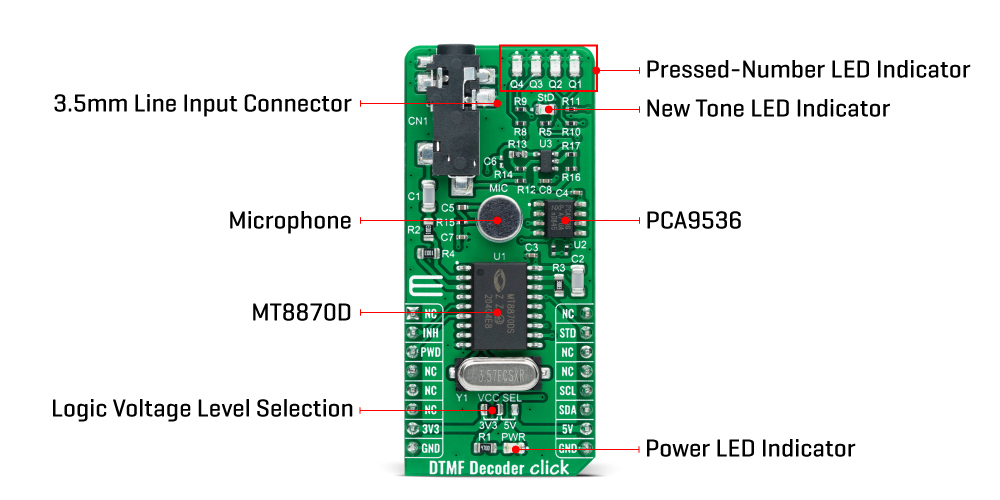
The DTMF Decoder Click Board™ is based on the MT8870D, an integrated DTMF receiver with enhanced sensitivity from Microchip Technology. It offers low power consumption and high performance and consists of a band split filter section, which separates the high and low group tones, followed by a digital counting section that verifies the received tones' frequency and duration before passing the corresponding code to the output bus.
The DTMF Decoder Click Board™ has two ways to detect tones: with a mobile phone with a 3.5mm jack which provides the DTMF signals to MT8870D decoder, or using an onboard microphone used to listen the DTMF tones generated by the cell phone. The MT8870D uses digital counting techniques to detect and decode all 16 DTMF tone-pairs into a 4-bit code.
The DTMF Decoder Click Board™ communicates with MCU using standard I2C 2-Wire interface, with a clock frequency up to 100kHz in the Standard and 400kHz in the Fast Mode. Using the PCA9536 port expander that communicates with the MCU via I2C communication, it is possible to visually display, in binary form, the digit of the pressed number. The digit in binary form is then visually displayed using four red LEDs, labelled from Q1 to Q4, located in the board's upper right corner.
The DTMF Decoder Click Board™ also has a power-down feature routed on the CS pin of the mikroBUS™ socket labelled as PWD. A logic high applied to pin PWD will power down the device to minimize the power consumption in a Standby mode, which stops the oscillator and the filters' functions. Also, it uses the interrupt pin of the mikroBUS™ labelled as STD with an additional LED indicator signaling that a received tone pair has been registered, and INH pin, which inhibits the detection of tones representing characters A, B, C, and D. The output code will remain the same as the previously detected code.
The DTMF Decoder Click Board™can operate with both 3.3V and 5V logic voltage levels selected via the VCC SEL jumper. This way, it is allowed for both 3.3V and 5V capable MCUs to properly use the I2C communication lines. However, the Click board™ comes equipped with a library containing easy-to-use functions and an example code that can be used, as a reference, for further development.
| Type | Signal Processing |
| Applications | Can be used for paging systems, remote control, electronic communications circuits, and various other applications. |
| On-board modules | MT8870D - an integrated DTMF receiver with enhanced sensitivity from Microchip Technology |
| Key Features | Low power consumption, complete DTMF receiver, high performance, internal gain setting amplifier, power-down mode, inhibit mode, and more. |
| Interface | I2C |
| Compatibility | mikroBUS |
| Click board size | L (57.15 x 25.4 mm) |
| Input Voltage | 3.3V or 5V |
This table shows how the pinout of the DTMF Decoder Click Board™ corresponds to the pinout on the mikroBUS™ socket (the latter shown in the two middle columns).
| Notes | Pin |  |
Pin | Notes | |||
|---|---|---|---|---|---|---|---|
| NC | 1 | AN | PWM | 16 | NC | ||
| Inhibit Mode | INH | 2 | RST | INT | 15 | STD | New Tone Indicator |
| Power Down Mode | PWD | 3 | CS | RX | 14 | NC | |
| NC | 4 | SCK | TX | 13 | NC | ||
| NC | 5 | MISO | SCL | 12 | SCL | I2C Clock | |
| NC | 6 | MOSI | SDA | 11 | SDA | I2C Data | |
| Power Supply | 3.3V | 7 | 3.3V | 5V | 10 | 5V | Power Supply |
| Ground | GND | 8 | GND | GND | 9 | GND | Ground |
| Label | Name | Default | Description |
|---|---|---|---|
| LD1 | PWR | - | Power LED Indicator |
| LD2 | StD | - | New Tone LED Indicator |
| LD3-LD6 | Q1 - Q4 | - | Pressed-Number LED Indicator |
| JP1 | VCC SEL | Left | Logic Level Voltage Selection 3V3/5V: Left position 3V3, Right position 5V |
| Description | Min | Typ | Max | Unit |
|---|---|---|---|---|
| Supply Voltage | 3.3 | - | 5 | V |
| Frequency | - | 3.579545 | - | MHz |
| Power Consumption | - | 15 | - | mW |
| Operating Temperature Range | -40 | +25 | +85 | °C |
We provide a library for the DTMF Decoder Click Board™ as well as a demo application (example), developed using MikroElektronika compilers. The demo can run on all the main MikroElektronika development boards.
The package can be downloaded/installed directly from NECTO Studio The package Manager (recommended), downloaded from our LibStock™ or found on mikroE Github account.
This library contains API for the DTMF Decoder Click Board™ driver.
dtmfdecoder_cfg_setup - Config Object Initialization function.dtmfdecoder_init - Initialization function.dtmfdecoder_default_cfg - Click Default Configuration function.This example shows the basic tone capture of DTMF frequencies, decoding and representing them on the UART LOG.
void application_task ( void ) {
    uint8_t result;

    if ( dtmfdecoder_delayed_steering_check( &dtmfdecoder ) ) {
        result = dtmfdecoder_tone_read( &dtmfdecoder );
        log_printf( &logger, " Detected key tone:t%crn", result );
        Delay_ms( tone_register_delay );
    }
}
The full application code, and ready-to-use projects can be installed directly from NECTO Studio The package Manager (recommended), downloaded from our LibStock™ or found on the mikroE Github account.
Other mikroE Libraries used in the example:
Depending on the development board you are using, you may need USB UART Click Board™, USB UART 2 Click Board™ or RS232 Click Board™ to connect to your PC, for development systems with no UART to USB interface available on the board. The terminal available in all MikroElektronika compilers, or any other terminal application of your choice, can be used to read the message.
The DTMF Decoder Click Board™ is supported with mikroSDK - MikroElektronika Software Development Kit. To ensure proper operation of mikroSDK compliant Click board™ demo applications, mikroSDK should be downloaded from the LibStock and installed for the compiler you are using.
- attachments: [{"download_file":[{"download_file":"DTMF Decoder Click Board™ Schematic"}],"download_filetype":[{"download_filetype":"pdf"}]},{"download_file":[{"download_file":"Microchip Technology MT8870D DTMF Receiver and Decoder Datasheet"}],"download_filetype":[{"download_filetype":"pdf"}]},{"download_file":[{"download_file":"NXP PCA9536 I2C and SMBus 4-Bit I/O Port"}],"download_filetype":[{"download_filetype":"pdf"}]}] - device_vendor: Microchip Technology, NXP USA Inc. - device_type: MCP6001T-I/OT, MT8870DSR1, PCA9536D,118 - warranty: 12 months - brand: MikroE - manufacturer: Mikroelektronika d.o.o. - target_keyword: DTMF Decoder Click Board - brands: gid://shopify/Metaobject/56256004319 - breadcrumbs: ["gid://shopify/Collection/447955239135","gid://shopify/Collection/241680580797","gid://shopify/Collection/241544298685"] - customhs_code: 847330 - detailed_description: {"type":"root","children":[{"type":"heading","level":3,"children":[{"type":"text","value":"How Does The DTMF Decoder Click Board™ Work?"}]},{"type":"paragraph","children":[{"type":"text","value":"The "},{"type":"text","value":"DTMF Decoder Click Board™","bold":true,"italic":true},{"type":"text","value":" is based on the MT8870D, an integrated DTMF receiver with enhanced sensitivity from Microchip Technology. It offers low power consumption and high performance and consists of a band split filter section, which separates the high and low group tones, followed by a digital counting section that verifies the received tones' frequency and duration before passing the corresponding code to the output bus."}]},{"type":"paragraph","children":[{"type":"text","value":""}]},{"type":"paragraph","children":[{"type":"text","value":"The "},{"type":"text","value":"DTMF Decoder Click Board™","bold":true},{"type":"text","value":" has two ways to detect tones: with a mobile phone with a 3.5mm jack which provides the DTMF signals to MT8870D decoder, or using an onboard microphone used to listen the DTMF tones generated by the cell phone. The MT8870D uses digital counting techniques to detect and decode all 16 DTMF tone-pairs into a 4-bit code."}]},{"type":"paragraph","children":[{"type":"text","value":"The "},{"type":"text","value":"DTMF Decoder Click Board™","bold":true},{"type":"text","value":" communicates with MCU using standard I2C 2-Wire interface, with a clock frequency up to 100kHz in the Standard and 400kHz in the Fast Mode. Using the PCA9536 port expander that communicates with the MCU via I2C communication, it is possible to visually display, in binary form, the digit of the pressed number. The digit in binary form is then visually displayed using four red LEDs, labelled from Q1 to Q4, located in the board's upper right corner."}]},{"type":"paragraph","children":[{"type":"text","value":"The "},{"type":"text","value":"DTMF Decoder Click Board™","bold":true},{"type":"text","value":" also has a power-down feature routed on the CS pin of the mikroBUS™ socket labelled as PWD. A logic high applied to pin PWD will power down the device to minimize the power consumption in a Standby mode, which stops the oscillator and the filters' functions. Also, it uses the interrupt pin of the mikroBUS™ labelled as STD with an additional LED indicator signaling that a received tone pair has been registered, and INH pin, which inhibits the detection of tones representing characters A, B, C, and D. The output code will remain the same as the previously detected code."}]},{"type":"paragraph","children":[{"type":"text","value":"The "},{"type":"text","value":"DTMF Decoder Click Board™","bold":true},{"type":"text","value":"can operate with both 3.3V and 5V logic voltage levels selected via the VCC SEL jumper. This way, it is allowed for both 3.3V and 5V capable MCUs to properly use the I2C communication lines. However, the Click board™ comes equipped with a library containing easy-to-use functions and an example code that can be used, as a reference, for further development."}]},{"type":"heading","level":3,"children":[{"type":"text","value":"SPECIFICATIONS"}]},{"type":"paragraph","children":[{"type":"text","value":"Type\nSignal Processing\nApplications\nCan be used for paging systems, remote control, electronic communications circuits, and various other applications.\nOn-board modules\nMT8870D - an integrated DTMF receiver with enhanced sensitivity from Microchip Technology\nKey Features\nLow power consumption, complete DTMF receiver, high performance, internal gain setting amplifier, power-down mode, inhibit mode, and more.\nInterface\nI2C\nCompatibility\nmikroBUS\nClick board size\nL (57.15 x 25.4 mm)\nInput Voltage\n3.3V or 5V"}]},{"type":"heading","level":3,"children":[{"type":"text","value":"PINOUT DIAGRAM"}]},{"type":"paragraph","children":[{"type":"text","value":"This table shows how the pinout of the "},{"type":"text","value":"DTMF Decoder Click Board™","bold":true},{"type":"text","value":" corresponds to the pinout on the mikroBUS™ socket (the latter shown in the two middle columns)."}]},{"type":"paragraph","children":[{"type":"text","value":"Notes\nPin\nPin\nNotes\nNC\n1\nAN\nPWM\n16\nNC\nInhibit Mode\nINH\n2\nRST\nINT\n15\nSTD\nNew Tone Indicator\nPower Down Mode\nPWD\n3\nCS\nRX\n14\nNC\nNC\n4\nSCK\nTX\n13\nNC\nNC\n5\nMISO\nSCL\n12\nSCL\nI2C Clock\nNC\n6\nMOSI\nSDA\n11\nSDA\nI2C Data\nPower Supply\n3.3V\n7\n3.3V\n5V\n10\n5V\nPower Supply\nGround\nGND\n8\nGND\nGND\n9\nGND\nGround"}]},{"type":"heading","level":3,"children":[{"type":"text","value":"ONBOARD SETTINGS AND INDICATORS"}]},{"type":"paragraph","children":[{"type":"text","value":"Label\nName\nDefault\nDescription\nLD1\nPWR\n-\nPower LED Indicator\nLD2\nStD\n-\nNew Tone LED Indicator\nLD3-LD6\nQ1 - Q4\n-\nPressed-Number LED Indicator\nJP1\nVCC SEL\nLeft\nLogic Level Voltage Selection 3V3/5V: Left position 3V3, Right position 5V"}]},{"type":"heading","level":3,"children":[{"type":"text","value":"DTMF DECODER CLICK ELECTRICAL SPECIFICATIONS"}]},{"type":"paragraph","children":[{"type":"text","value":"Description\nMin\nTyp\nMax\nUnit\nSupply Voltage\n3.3\n-\n5\nV\nFrequency\n-\n3.579545\n-\nMHz\nPower Consumption\n-\n15\n-\nmW\nOperating Temperature Range\n-40\n+25\n+85\n°C"}]},{"type":"heading","level":3,"children":[{"type":"text","value":" "}]}]} - summary:The DTMF Decoder Click Board™ is a compact add-on board that contains an integrated DTMF receiver with enhanced sensitivity. This board features the MT8870D, a complete DTMF receiver integrating the band-split filter and digital decoder functions from Microchip Technology. It offers low power consumption and high performance and uses digital counting techniques to detect and decode all 16 DTMF tone-pairs into a 4-bit code. Whenever a valid tone is detected, it outputs the associated value in binary on four LEDs, with an additional indicator that strobes after each new tone. This Click Board™ is suitable for paging systems, remote control, electronic communications circuits, and various other applications.
The DTMF Decoder Click Board™ is supported by a mikroSDK compliant library, which includes functions that simplify software development. This Click Board™ comes as a fully tested product, ready to be used on a system equipped with the mikroBUS™ socket.