# Title: ADC 12 Click Board™
## Description: How Does The ADC 12 Click Board™ Work? The ADC 12 Click Board™ is based on the ADS7828, a low-power 12-bit data acquisition device that features a serial I2C interface and an 8-channel multiplexer from Texas Instruments. The architecture of the ADS7828, which is a classic Successive Approximation Register (SAR) A/D converter, is based on capacitive redistribution that inherently includes a sample-and-hold function. It has an integrated I2C input and output port as well as screw terminal connectors for each analogue input channel. It is controlled by an internally generated free-running clock. When the ADS7828 is not performing conversions or being addressed, it keeps the A/D converter core powered off, and the internal clock does not operate. When the A/D converter enters the Hold mode, the voltage on the selected channel pin of the input terminal is captured on the internal capacitor array. The input current on the analogue inputs depends on the conversion rate of the device. During the sample period, the source must charge the internal sampling capacitor. After the capacitor has been fully charged, there is no further input current. The amount of charge transfer from the analogue source to the converter is a function of the conversion rate. The ADC 12 Click Board™ communicates with MCU using the standard I2C 2-Wire interface with a frequency up to 100kHz in the Standard, up to 400kHz in the Fast, and up to 3.4MHz in the High-Speed mode. It also allows the choice of the last two least significant bits (LSB) A0 and A1 by positioning SMD jumpers labelled as ADDR SEL to an appropriate position marked as 0 and 1. This Click board™ also posses a jumper for selecting the reference voltage labelled as VREF SEL. The ADS7828 can operate with an internal 2.5V reference or an external reference (in this case logic voltage level VCC), which can be selected by positioning SMD jumpers to an appropriate position marked as INT and EXT. The ADC 12 Click Board™ is designed to be operated with both 3.3V and 5V logic voltage levels that can be selected via VCC SEL jumper. This allows for both 3.3V and 5V capable MCUs to use the I2C communication lines properly. However, the Click board™ comes equipped with a library that contains easy to use functions and an example code that can be used as a reference for further development. Specifications Type ADC Applications Can be used for applications requiring the A/D converter to be close to the input source in remote locations and for applications requiring isolation. On-board modules ADC 12 Click is based on the ADS7828, a low-power 12-bit data acquisition device that features a serial I2C interface and an 8-channel multiplexer from Texas Instruments. Key Features Low power consumption, 12-bit data acquisition device, 8-channel multiplexer, internal voltage reference, and more. Interface I2C Compatibility mikroBUS Click board size M (42.9 x 25.4 mm) Input Voltage 3.3V or 5V Pinout diagram This table shows how the pinout on the ADC 12 Click Board™ corresponds to the pinout on the mikroBUS™ socket (the latter shown in the two middle columns). Notes Pin Pin Notes NC 1 AN PWM 16 NC NC 2 RST INT 15 NC NC 3 CS RX 14 NC NC 4 SCK TX 13 NC NC 5 MISO SCL 12 SCL I2C Clock NC 6 MOSI SDA 11 SDA I2C Data Power Supply 3.3V 7 3.3V 5V 10 5V Power Supply Ground GND 8 GND GND 9 GND Ground Onboard settings and indicators Label Name Default Description LD1 PWR - Power LED Indicator JP1 VCC SEL Left Power Supply Voltage Selection 3V3/5V: Left position 3V3, Right position 5V JP2 VREF SEL Left Reference Voltage Selection INT/EXT: Left position INT, Right position EXT JP3-JP4 ADDR SEL Left I2C Address Selection: Left position 0, Right position 1 ADC 12 Click electrical specifications Description Min Typ Max Unit VCC Supply Voltage -0.3 - 6 V ADC Supply Voltage 0 - 5.25 A Power Consumption - - 0.68 mW Operating Temperature Range -40 - +85 °C
## Product type: Click Board
## Vendor: Mikroelektronika d.o.o.
## Tags: ADC, ADC Click, Click Board, MikroE, Mixed Signal
## Price range: 20.3 - 20.3 GBP
## Link: https://thedebugstore.com/products/mikroe-4376-adc-12-click-board-uk
## Compare-at price range: 29.0 - 29.0 GBP
## Options
- Title: Default Title
## Collections
- [New Products](https://thedebugstore.com/a/llms/collections/new-products-debug-store)
- [Mikroelektronika d.o.o. (MikroE)](https://thedebugstore.com/a/llms/collections/mikroelektronika-catalogue-uk)
- [Mixed Signal Click Boards™](https://thedebugstore.com/a/llms/collections/mixed-signal-click-boards-catalogue-uk)
- [MikroE Click Boards™](https://thedebugstore.com/a/llms/collections/mikroe-click-boards-catalogue-uk)
- [ADC Click Boards™](https://thedebugstore.com/a/llms/collections/adc-click-boards-catalogue-uk)
- [Click Boards™ Summer Sale](https://thedebugstore.com/a/llms/collections/inventory-sale)
- [MikroE Sale](https://thedebugstore.com/a/llms/collections/mikroe-sale)
- [MIKROE Stock](https://thedebugstore.com/a/llms/collections/mikroe-products-in-stock-sale)
## Variants
- Default Title, SKU: MIKROE-4376, Available: yes, Inventory: 1
## Metafields
- full_description: How Does The ADC 12 Click Board™ Work?
The ADC 12 Click Board™ is based on the ADS7828, a low-power 12-bit data acquisition device that features a serial I2C interface and an 8-channel multiplexer from Texas Instruments. The architecture of the ADS7828, which is a classic Successive Approximation Register (SAR) A/D converter, is based on capacitive redistribution that inherently includes a sample-and-hold function. It has an integrated I2C input and output port as well as screw terminal connectors for each analogue input channel. It is controlled by an internally generated free-running clock. When the ADS7828 is not performing conversions or being addressed, it keeps the A/D converter core powered off, and the internal clock does not operate.
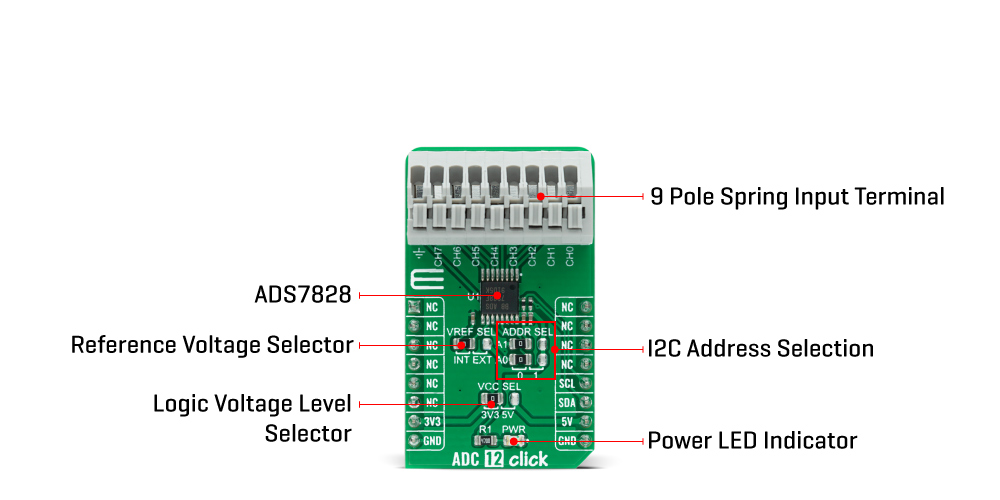
When the A/D converter enters the Hold mode, the voltage on the selected channel pin of the input terminal is captured on the internal capacitor array. The input current on the analogue inputs depends on the conversion rate of the device. During the sample period, the source must charge the internal sampling capacitor. After the capacitor has been fully charged, there is no further input current. The amount of charge transfer from the analogue source to the converter is a function of the conversion rate.
The ADC 12 Click Board™ communicates with MCU using the standard I2C 2-Wire interface with a frequency up to 100kHz in the Standard, up to 400kHz in the Fast, and up to 3.4MHz in the High-Speed mode. It also allows the choice of the last two least significant bits (LSB) A0 and A1 by positioning SMD jumpers labelled as ADDR SEL to an appropriate position marked as 0 and 1. This Click board™ also posses a jumper for selecting the reference voltage labelled as VREF SEL. The ADS7828 can operate with an internal 2.5V reference or an external reference (in this case logic voltage level VCC), which can be selected by positioning SMD jumpers to an appropriate position marked as INT and EXT.
The ADC 12 Click Board™ is designed to be operated with both 3.3V and 5V logic voltage levels that can be selected via VCC SEL jumper. This allows for both 3.3V and 5V capable MCUs to use the I2C communication lines properly. However, the Click board™ comes equipped with a library that contains easy to use functions and an example code that can be used as a reference for further development.
Specifications
| Type |
ADC |
| Applications |
Can be used for applications requiring the A/D converter to be close to the input source in remote locations and for applications requiring isolation. |
| On-board modules |
ADC 12 Click is based on the ADS7828, a low-power 12-bit data acquisition device that features a serial I2C interface and an 8-channel multiplexer from Texas Instruments. |
| Key Features |
Low power consumption, 12-bit data acquisition device, 8-channel multiplexer, internal voltage reference, and more. |
| Interface |
I2C |
| Compatibility |
mikroBUS |
| Click board size |
M (42.9 x 25.4 mm) |
| Input Voltage |
3.3V or 5V |
Pinout diagram
This table shows how the pinout on the ADC 12 Click Board™ corresponds to the pinout on the mikroBUS™ socket (the latter shown in the two middle columns).
| Notes |
Pin |
 |
Pin |
Notes |
| |
NC |
1 |
AN |
PWM |
16 |
NC |
|
| |
NC |
2 |
RST |
INT |
15 |
NC |
|
| |
NC |
3 |
CS |
RX |
14 |
NC |
|
| |
NC |
4 |
SCK |
TX |
13 |
NC |
|
| |
NC |
5 |
MISO |
SCL |
12 |
SCL |
I2C Clock |
| |
NC |
6 |
MOSI |
SDA |
11 |
SDA |
I2C Data |
| Power Supply |
3.3V |
7 |
3.3V |
5V |
10 |
5V |
Power Supply |
| Ground |
GND |
8 |
GND |
GND |
9 |
GND |
Ground |
Onboard settings and indicators
| Label |
Name |
Default |
Description |
| LD1 |
PWR |
- |
Power LED Indicator |
| JP1 |
VCC SEL |
Left |
Power Supply Voltage Selection 3V3/5V: Left position 3V3, Right position 5V |
| JP2 |
VREF SEL |
Left |
Reference Voltage Selection INT/EXT: Left position INT, Right position EXT |
| JP3-JP4 |
ADDR SEL |
Left |
I2C Address Selection: Left position 0, Right position 1 |
ADC 12 Click electrical specifications
| Description |
Min |
Typ |
Max |
Unit |
| VCC Supply Voltage |
-0.3 |
- |
6 |
V |
| ADC Supply Voltage |
0 |
- |
5.25 |
A |
| Power Consumption |
- |
- |
0.68 |
mW |
| Operating Temperature Range |
-40 |
- |
+85 |
°C |
- description_tag: The ADC 12 Click Board™ is a compact add-on board that contains a fully-featured, general-purpose analogue-to-digital converter. This board features the ADS7828, a low-power 12-bit data acquisition device that features an 8-channel multiplexer from Texas Instruments. Available from Debug Store UK.
- title_tag: MikroE ADC 12 Click Board™ (MIKROE-4376)
- manufacturer: Mikroelektronika d.o.o.
- warranty: 12 months
- amazon_enable: TRUE
- amazon_title: ADC 12 Click Board
- amazon_product_type: computercomponent
- amazon_block: FALSE
- amazon_prime_enable: FALSE
- amazon_search: MikroElektronika Microelectronica MIKROE-1100
- amazon_uk_price: 21.12
- amazon_uk_currency: GBP
- amazon_de_currency: EUR
- amazon_de_price: 23.8656
- amazon_fr_currency: EUR
- amazon_fr_price: 23.8656
- amazon_es_currency: EUR
- amazon_es_price: 23.8656
- amazon_nl_currency: EUR
- amazon_nl_price: 23.8656
- amazon_it_currency: EUR
- amazon_it_price: 23.8656
- amazon_se_curency: SEK
- amazon_se_price: 240.768
- amazon_product_id: 8606015073231
- amazon_product_id_type: EAN
- amazon_update: Update
- amazon_short_description: The ADC 12 Click Board™ is a compact add-on board that contains a fully-featured, general-purpose analog-to-digital converter. This board features the ADS7828, a low-power 12-bit data acquisition device that features a serial I2C interface and an 8-channel multiplexer from Texas Instruments. The A/D converter features a sample-and-hold amplifier and an internal, asynchronous clock. The combination of an I2C serial interface, up to eight differential analog inputs, built-in reference with buffered output, and micro-power consumption makes this Click board™ ideal for applications requiring the A/D converter to be close to the input source in remote locations and for applications requiring isolation.ADC 12 Click is supported by a mikroSDK compliant library, which includes functions that simplify software development. This Click board™ comes as a fully tested product, ready to be used on a system equipped with the mikroBUS™ socket.
- amazon_long_description: IC/module: MCP3204 Analog-to-Digital Converter
ADC Click is designed using MCP3204, a 12-bit Analog-to-Digital Converter. The MCP3204 is programmable to provide two pseudo-differential input pairs or four single-ended inputs. It establishes communication with the devices using a simple serial interface compatible with the SPI protocol. It is capable of conversion rates of up to 100 ksps.
Why ADC Click is needed'
The ADC Click is needed to provide a link between the analog world of transducers and the digital world of signal processing and data handling. This accessory board allows for multiple connections with the help of its 12-bit ADC that engages itself in quantization of the input and converts the voltage periodically that is sampling the input, thereby facilitating the process of data integration.
SMD Jumpers
The ADC Click Board™ comprises of two zero-ohm SMD jumpers: PWR SEL and REFERENCE. PWR SEL allow the user to select a 5V or 3.3V power supply. The REFERENCE enable user selection of either VCC or 4.096V as the voltage reference.
- amazon_main_image: https://www.thedebugstore.com/images/product/lg-mikroe-click-adc-front.jpg
- amazon_other_image_1: https://www.thedebugstore.com/images/product/lg-mikroe-click-adc-back.jpg
- amazon_other_image_2: https://www.thedebugstore.com/images/product/lg-mikroe-click-adc-connected.jpg
- amazon_other_image_3: https://www.thedebugstore.com/images/product/lg-mikroe-click-adc-back.jpg
- amazon_other_image_4: https://www.thedebugstore.com/images/product/lg-mikroe-click-adc-connected.jpg
- amazon_browse_node: 428655031
- related_products: MIKROE-4105,MIKROE-3394,MIKROE-3115,MIKROE-2932,MIKROE-2846,MIKROE-2879,MIKROE-1894,MIKROE-1893
- mpn: MIKROE-4376
- backorder_label: If no stock shown above, check availability
- examples:
We provide a library for the ADC 12 Click Board™ on our LibStock page, as well as a demo application (example), developed using MikroElektronika compilers. The demo can run on all the main MikroElektronika development boards.
Library Description
The library covers all the necessary functions to control the ADC 12 Click Board™. Users can set or read input mode or power-down mode, read raw ADC or voltage and send commands to input register or read the output.
Key Functions
void adc12_send_cmd ( uint8_t cmd_byte ); - Function is used to configure the device.uint16_t adc12_single_ended ( uint8_t chan, uint16_t v_ref ); - Function is used to get raw ADC value.uint16_t adc12_differential ( uint8_t chan, uint16_t v_ref ); - Function is used to get raw ADC value.
Example Description
The application is composed of three sections :
- System Initialization - Initializes I2C and LOG structures, and start to write log.
- Application Initialization - Initializes I2C driver and configures ADC 12 Click Board™, enables single-ended inputs, and turns on Internal Reference and ADC.
- Application Task - This is an example that shows the capabilities of the ADC 12 Click Board™ by reading raw value and voltage input on channel 0 and displaying data every second.
void application_task ( )
{
    mikrobus_logWrite( "Read Channel 0 raw", _LOG_LINE );
    adc_r = adc12_single_ended ( ADC12_SNGL_END_CH0, ADC12_INT_V_REF_VAL );
    WordToStr( adc_r, log_txt );
    Ltrim( log_txt );
    mikrobus_logWrite( "ADC raw: ", _LOG_TEXT );
    mikrobus_logWrite( log_txt, _LOG_LINE );
    mikrobus_logWrite( "", _LOG_LINE );
    mikrobus_logWrite( "Read Channel 0 voltage", _LOG_LINE );
    adc_v = adc12_single_ended_volt ( ADC12_SNGL_END_CH0, ADC12_INT_V_REF_VAL );
    FloatToStr( adc_v, log_txt );
    Ltrim( log_txt );
    mikrobus_logWrite( "ADC raw: ", _LOG_TEXT );
    mikrobus_logWrite( log_txt, _LOG_TEXT );
    mikrobus_logWrite( "mV", _LOG_LINE );
    mikrobus_logWrite( "------------------------", _LOG_LINE );
    Delay_ms( 1000 );
}
The full application code, and ready to use projects can be found on our LibStock page.
Other mikroE Libraries used in the example:
Additional Notes and Information
Depending on the development board you are using, you may need a USB UART click, USB UART 2 click or RS232 click to connect to your PC, for development systems with no UART to USB interface available on the board. The terminal available in all MikroElektronika compilers, or any other terminal application of your choice, can be used to read the message.
mikroSDK
The ADC 12 Click Board™ is supported with mikroSDK - MikroElektronika Software Development Kit. To ensure proper operation of mikroSDK compliant Click board™ demo applications, mikroSDK should be downloaded from the LibStock and installed for the compiler you are using.
- google_product_category: 2165
- attachments: [{"download_file":[{"download_file":"ADC 12 Click Board™ Schematic"}],"download_filetype":[{"download_filetype":"pdf"}]},{"download_file":[{"download_file":"Texas Instruments ADS7828 12-bit ADC Datasheet"}],"download_filetype":[{"download_filetype":"pdf"}]}]
- condition: new
- custom_product: false
- mpn: MIKROE-4376
- google_product_category: Electronics
- custom_label_0: Click Board
- key_feature_2: Low power consumption, 12-bit data acquisition device, 8-channel multiplexer, internal voltage reference, and more.
- key_feature_3: The ADC 12 Click is based on the ADS7828, a low-power 12-bit data acquisition device that features a serial I2C interface and an 8-channel multiplexer from Texas Instruments
- key_feature_4: Can be used for applications requiring the A/D converter to be close to the input source in remote locations and for applications requiring isolation.
- key_feature_5: MikroBUS: I2C Interface
- device_vendor: Texas Instruments
- device_type: ADS7828E/2K5
- warranty: 12 months
- brand: MikroE
- manufacturer: Mikroelektronika d.o.o.
- badge: No reviews
- widget:
- target_keyword: ADC 12 Click Board
- brands: gid://shopify/Metaobject/56256004319
- breadcrumbs: ["gid://shopify/Collection/447955239135","gid://shopify/Collection/241680580797","gid://shopify/Collection/241545314493"]
- customhs_code: 847330
- detailed_description: {"type":"root","children":[{"type":"heading","level":3,"children":[{"type":"text","value":"How Does The ADC 12 Click Board™ Work?"}]},{"type":"paragraph","children":[{"type":"text","value":"The "},{"type":"text","value":"ADC 12 Click Board™","bold":true,"italic":true},{"type":"text","value":" is based on the ADS7828, a low-power 12-bit data acquisition device that features a serial I2C interface and an 8-channel multiplexer from Texas Instruments. The architecture of the ADS7828, which is a classic Successive Approximation Register (SAR) A/D converter, is based on capacitive redistribution that inherently includes a sample-and-hold function. It has an integrated I2C input and output port as well as screw terminal connectors for each analogue input channel. It is controlled by an internally generated free-running clock. When the ADS7828 is not performing conversions or being addressed, it keeps the A/D converter core powered off, and the internal clock does not operate."}]},{"type":"paragraph","children":[{"type":"text","value":""}]},{"type":"paragraph","children":[{"type":"text","value":"When the A/D converter enters the Hold mode, the voltage on the selected channel pin of the input terminal is captured on the internal capacitor array. The input current on the analogue inputs depends on the conversion rate of the device. During the sample period, the source must charge the internal sampling capacitor. After the capacitor has been fully charged, there is no further input current. The amount of charge transfer from the analogue source to the converter is a function of the conversion rate."}]},{"type":"paragraph","children":[{"type":"text","value":"The "},{"type":"text","value":"ADC 12 Click Board™","bold":true},{"type":"text","value":" communicates with MCU using the standard I2C 2-Wire interface with a frequency up to 100kHz in the Standard, up to 400kHz in the Fast, and up to 3.4MHz in the High-Speed mode. It also allows the choice of the last two least significant bits (LSB) A0 and A1 by positioning SMD jumpers labelled as ADDR SEL to an appropriate position marked as 0 and 1. This Click board™ also posses a jumper for selecting the reference voltage labelled as VREF SEL. The ADS7828 can operate with an internal 2.5V reference or an external reference (in this case logic voltage level VCC), which can be selected by positioning SMD jumpers to an appropriate position marked as INT and EXT."}]},{"type":"paragraph","children":[{"type":"text","value":"The "},{"type":"text","value":"ADC 12 Click Board™","bold":true},{"type":"text","value":" is designed to be operated with both 3.3V and 5V logic voltage levels that can be selected via VCC SEL jumper. This allows for both 3.3V and 5V capable MCUs to use the I2C communication lines properly. However, the Click board™ comes equipped with a library that contains easy to use functions and an example code that can be used as a reference for further development."}]},{"type":"heading","level":3,"children":[{"type":"text","value":"Specifications"}]},{"type":"paragraph","children":[{"type":"text","value":" "}]},{"type":"paragraph","children":[{"type":"text","value":"Type\nADC\nApplications\nCan be used for applications requiring the A/D converter to be close to the input source in remote locations and for applications requiring isolation.\nOn-board modules\nADC 12 Click is based on the ADS7828, a low-power 12-bit data acquisition device that features a serial I2C interface and an 8-channel multiplexer from Texas Instruments.\nKey Features\nLow power consumption, 12-bit data acquisition device, 8-channel multiplexer, internal voltage reference, and more.\nInterface\nI2C\nCompatibility\nmikroBUS\nClick board size\nM (42.9 x 25.4 mm)\nInput Voltage\n3.3V or 5V"}]},{"type":"paragraph","children":[{"type":"text","value":" "}]},{"type":"heading","level":3,"children":[{"type":"text","value":"Pinout diagram"}]},{"type":"paragraph","children":[{"type":"text","value":"This table shows how the pinout on the "},{"type":"text","value":"ADC 12 Click Board™","bold":true},{"type":"text","value":" corresponds to the pinout on the mikroBUS™ socket (the latter shown in the two middle columns)."}]},{"type":"paragraph","children":[{"type":"text","value":"Notes\nPin\nPin\nNotes\nNC\n1\nAN\nPWM\n16\nNC\nNC\n2\nRST\nINT\n15\nNC\nNC\n3\nCS\nRX\n14\nNC\nNC\n4\nSCK\nTX\n13\nNC\nNC\n5\nMISO\nSCL\n12\nSCL\nI2C Clock\nNC\n6\nMOSI\nSDA\n11\nSDA\nI2C Data\nPower Supply\n3.3V\n7\n3.3V\n5V\n10\n5V\nPower Supply\nGround\nGND\n8\nGND\nGND\n9\nGND\nGround"}]},{"type":"heading","level":3,"children":[{"type":"text","value":"Onboard settings and indicators"}]},{"type":"paragraph","children":[{"type":"text","value":"Label\nName\nDefault\n Description\nLD1\nPWR\n-\nPower LED Indicator\nJP1\nVCC SEL\nLeft\nPower Supply Voltage Selection 3V3/5V: Left position 3V3, Right position 5V\nJP2\nVREF SEL\nLeft\nReference Voltage Selection INT/EXT: Left position INT, Right position EXT\nJP3-JP4\nADDR SEL\nLeft\nI2C Address Selection: Left position 0, Right position 1"}]},{"type":"heading","level":3,"children":[{"type":"text","value":"ADC 12 Click electrical specifications"}]},{"type":"paragraph","children":[{"type":"text","value":"Description\nMin\nTyp\nMax\nUnit\nVCC Supply Voltage\n-0.3\n-\n6\nV\nADC Supply Voltage\n0\n-\n5.25\nA\nPower Consumption\n-\n-\n0.68\nmW\nOperating Temperature Range\n-40\n-\n+85\n°C"}]}]}
- summary: The ADC 12 Click Board™ is a compact add-on board that contains a fully-featured, general-purpose analogue-to-digital converter. This board features the ADS7828, a low-power 12-bit data acquisition device that features a serial I2C interface and an 8-channel multiplexer from Texas Instruments. The A/D converter features a sample-and-hold amplifier and an internal, asynchronous clock. The combination of an I2C serial interface, up to eight differential analogue inputs, built-in reference with buffered output, and micro-power consumption makes this Click Board™ ideal for applications requiring the A/D converter to be close to the input source in remote locations and for applications requiring isolation.
The ADC 12 Click Board™ is supported by a mikroSDK compliant library, which includes functions that simplify software development. This Click Board™ comes as a fully tested product, ready to be used on a system equipped with the mikroBUS™ socket.