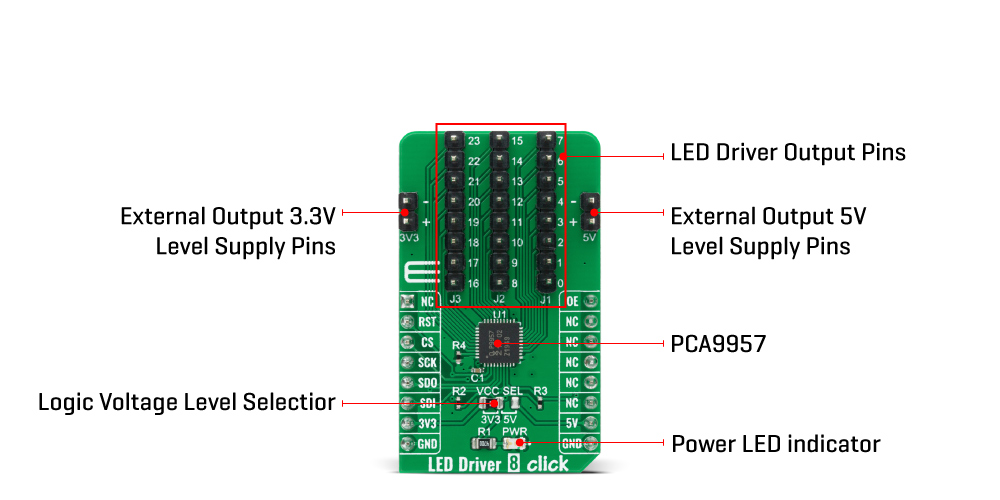
The LED Driver 8 Click Board™ is based on the PCA9957, a daisy-chain SPI compatible 4-wire serial bus controlled 24-channel constant current LED driver optimized for dimming and blinking 32 mA RGBA LEDs from NXP Semiconductors. The PCA9957 has 24 internal 8-bit DACs with an operating frequency of 31.25 kHz and a duty cycle from 0% to 100% used to adjust brightness levels for each LED current source. Each LED output is programmable and can be turned off, on (with no PWM control), set at its individual PWM controller value, or both individual and group PWM controller values. Its output peak current is adjustable with an 8-bit linear DAC from 125 μA to 31.875 mA because of the R4 resistor of 2kΩ connected to the REXT pin.
Gradation control for all current sources is achieved through serial interface and allows the user to ramp current automatically without any help from the MCU. It has two operation modes for each group: Single-Shot Mode (output pattern once) and Continuous Mode (output pattern repeat). Each channel can be set to either Gradation Mode or Normal Mode and assigned to any one of six gradation control groups. These groups have four independent registers to control ramp-up and ramp-down rate, step time, hold ON/OFF time, and final hold ON output current.
The LED Driver 8 Click Board™ communicates with MCU through a daisy-chain SPI compatible 4-wire serial interface with a clock frequency up to 10 MHz. The input labeled as OE routed to the PWM pin on the mikroBUS™ blinks all the LED outputs and can be used to externally PWM the outputs, which is useful when multiple devices need to be dimmed or blinked together without using software control. The PCA9957 also has a short load and overtemperature detection circuitry, thermal shutdown feature which protects the device when the internal junction temperature exceeds the factory-defined limit, and a Reset function routed to the RST pin on the mikroBUS™ which is activated by sending an active low input on this pin with a minimum pulse width of 2.5μs.
The LED Driver 8 Click Board™ is designed to be operated with both 3.3V and 5V logic voltage levels that can be selected via VCC SEL jumper. This allows for both 3.3V and 5V capable MCUs to use the SPI communication lines properly.
| Type | LED Drivers |
| Applications | Can be used in the purpose of LED Status signalization, in LED displays, LED backlight, keypad backlights for cellular phones, or handheld devices, and many more. |
| On-board modules | The LED Driver 8 Click Board™ is based on the PCA9957, a daisy-chain SPI compatible 4-wire serial bus controlled 24-channel constant current LED driver optimized for dimming and blinking 32 mA RGBA LEDs from NXP Semiconductors. |
| Key Features | Low power consumption, programmable LED drivers channels, gradation control for all channels, low standby current, no glitch on LED outputs on Power-Up, and more. |
| Interface | SPI |
| Compatibility | mikroBUS |
| Click board size | M (42.9 x 25.4 mm) |
| Input Voltage | 3.3V or 5V |
This table shows how the pinout on the LED Driver 8 Click Board™ corresponds to the pinout on the mikroBUS™ socket (the latter shown in the two middle columns).
| Notes | Pin |  |
Pin | Notes | |||
|---|---|---|---|---|---|---|---|
| NC | 1 | AN | PWM | 16 | OE | Enable Input | |
| Reset Input | RST | 2 | RST | INT | 15 | NC | |
| SPI Chip Select | CS | 3 | CS | RX | 14 | NC | |
| SPI Clock | SCK | 4 | SCK | TX | 13 | NC | |
| SPI Data OUT | SDO | 5 | MISO | SCL | 12 | NC | |
| SPI Data IN | SDI | 6 | MOSI | SDA | 11 | NC | |
| Power Supply | 3.3V | 7 | 3.3V | 5V | 10 | 5V | Power Supply |
| Ground | GND | 8 | GND | GND | 9 | GND | Ground |
| Label | Name | Default | Description |
|---|---|---|---|
| LD1 | PWR | - | Power LED Indicator |
| JP1 | VCC SEL | left | Power Supply Voltage Selection 3V3/5V: Left position 3V3, Right position 5V |
| J1-J3 | - | - | LED Driver Output Header |
| J4 | - | - | External Output 3.3V Level Supply Header |
| J5 | - | - | External Output 5V Level Supply Header |
| Description | Min | Typ | Max | Unit |
|---|---|---|---|---|
| Supply Voltage | -0.5 | - | 6 | V |
| Maximum Output Current on LED pins | - | - | 40 | mA |
| SPI Clock Frequency | - | - | 10 | MHz |
| Operating Temperature Range | -40 | - | +85 | °C |
The Brushless 7 Click is the motor control expansion board based on TC78B009FTG IC which is a three phase PWM chopper driver for sensorless brushless motors and its capable for driving Delta or Wye configured motors. For controlling the motor speed, you can select between couple of interfaces such as PWM duty cycle, I2C or analogue voltage.

One of the biggest advantages of this board is capability to independently monitor and control the motor without an external microcontroller. For doing that the TC78B009FTG features implemented Non-volatile memory (NVM) which serves for storing parameters/modes which will be accessed by the driver and used for control. Operating modes:
Brushless 7 Click also features two SSM6K513NU N-Chanel FETs from Toshiba for each of three phases. Using this FET capable of handling 15A allows low power dissipation when driving 5A BLDC before hitting output current limit threshold. Output current limit function is used to restrain the current flowing to the motor. Motor current is detected by external shunt resistor and the detected voltage is inputted to RSA pin. Minimum and maximum input voltage range must be in range of 11V up to 27V and maximum motor current should not exceed 5A.
For interfacing Brushless 7 Click board you can use I2C interface for various settings over which you can use for setting NVM memory and control the driver, or SPD input pin for controlling the motor speed based on PWM duty cycle or analogue output from the MCU (for this MCU need DAC on the SPD pin of the mikroBUS). The motor’s output current can be monitored on the analog output (CMO pin) on mikroBUS™, by amplifying the RSB pin voltage detected by the external shunt resistor and converting it to a DC level with peak hold circuit.
In order to provide additional settings beside interface control for this board, we have used four switches for mode, control and I2C address selection (BRAKE, SEL, ID1 and ID2). This board also has visual indicators for rotation speed (FG LED) and abnormality (ALERT LED) detection monitoring. These indicator statuses can be also visible on INT pin by moving INT SEL jumper to preferred output selection.
- amazon_main_image: https://www.thedebugstore.com/images/product/lg-led-driver-8-click-front.jpg - amazon_other_image_1: https://www.thedebugstore.com/images/product/lg-led-driver-8-click-angle.jpg - amazon_other_image_2: https://www.thedebugstore.com/images/product/lg-led-driver-8-click-fusion.jpg - amazon_other_image_3: https://www.thedebugstore.com/images/product/lg-led-driver-8-click-shuttle.jpg - amazon_other_image_4: https://www.thedebugstore.com/images/product/lg-led-driver-8-click-breadboard.jpg - amazon_other_image_5: https://www.thedebugstore.com/images/product/lg-led-driver-8-click-clicker.jpg - amazon_other_image_6: https://www.thedebugstore.com/images/product/lg-led-driver-8-click-clicker.jpg - amazon_browse_node: 428655031 - related_products: MIKROE-3649 - mpn: MIKROE-4268 - backorder_label: If no stock shown above, check availability - badge: - widget:We provide a library for the LED Driver 8 Click Board™ on our LibStock page, as well as a demo application (example), developed using MikroElektronika compilers. The demo can run on all the main MikroElektronika development boards.
The library contains a basic functions for using the LED Driver 8 Click Board™.
void leddriver8_set_mode_register( uint8_t mode_1, uint8_t mode_2 ) - Function for set mode registersvoid leddriver8_set_output_gain ( uint8_t num_led, uint8_t value ) - Functions for set output gainvoid leddriver8_set_brightness ( uint8_t num_led, uint8_t value ) - Functions for set BrightnessThe application is composed of three sections :
void application_task ( )
{
 uint8_t cnt;
 for( cnt = 0; cnt < 0xFF; cnt++ )
 {
 leddriver8_set_brightness( LEDDRIVER8_BRIGHTNESS_ALL_LED, cnt );
 Delay_ms( 15 );
 }
 for( cnt = 0; cnt < 5; cnt++ )
 {
 leddriver8_set_brightness( LEDDRIVER8_LED_0, 200 );
 Delay_ms( 1000 );
 leddriver8_set_brightness( LEDDRIVER8_LED_0, 0 );
 Delay_ms( 1000 );
 }
}
The full application code, and ready to use projects can be found on our LibStock page.
Other mikroE Libraries used in the example:
Depending on the development board you are using, you may need a USB UART click, USB UART 2 click or RS232 click to connect to your PC, for development systems with no UART to USB interface available on the board. The terminal available in all MikroElektronika compilers, or any other terminal application of your choice, can be used to read the message.
The LED Driver 8 Click Board™ is supported with mikroSDK - MikroElektronika Software Development Kit. To ensure proper operation of mikroSDK compliant Click board™ demo applications, mikroSDK should be downloaded from the LibStock and installed for the compiler you are using.
on our LibStock page, as well as a demo application (example), developed using MikroElektronika compilers. The demo can run on all the main MikroElektronika development boards.
- attachments: [{"download_file":[{"download_file":"LED Driver 8 Click Board™ Schematic"}],"download_filetype":[{"download_filetype":"pdf"}]},{"download_file":[{"download_file":"NXP PCA9957 24-Chgannel LED Driver Datasheet"}],"download_filetype":[{"download_filetype":"pdf"}]}] - condition: new - custom_product: false - mpn: MIKROE-4268 - google_product_category: Electronics - custom_label_0: Click Board - device_vendor: NXP USA Inc. - device_type: PCA9957HNMP - warranty: 12 months - brand: MikroE - key_feature_1: 24-LED Driver with Programmable Brightness and Blinking - manufacturer: Mikroelektronika d.o.o. - target_keyword: LED Driver 8 Click Board - brands: gid://shopify/Metaobject/56256004319 - breadcrumbs: ["gid://shopify/Collection/447955239135","gid://shopify/Collection/241680580797","gid://shopify/Collection/241544822973"] - customhs_code: 847330 - detailed_description: {"type":"root","children":[{"type":"heading","level":3,"children":[{"type":"text","value":"How Does The LED Driver 8 Click Board™ Work?"}]},{"type":"paragraph","children":[{"type":"text","value":"The "},{"type":"text","value":"LED Driver 8 Click Board™","bold":true,"italic":true},{"type":"text","value":" is based on the PCA9957, a daisy-chain SPI compatible 4-wire serial bus controlled 24-channel constant current LED driver optimized for dimming and blinking 32 mA RGBA LEDs from NXP Semiconductors. The PCA9957 has 24 internal 8-bit DACs with an operating frequency of 31.25 kHz and a duty cycle from 0% to 100% used to adjust brightness levels for each LED current source. Each LED output is programmable and can be turned off, on (with no PWM control), set at its individual PWM controller value, or both individual and group PWM controller values. Its output peak current is adjustable with an 8-bit linear DAC from 125 μA to 31.875 mA because of the R4 resistor of 2kΩ connected to the REXT pin."}]},{"type":"paragraph","children":[{"type":"text","value":""}]},{"type":"paragraph","children":[{"type":"text","value":"Gradation control for all current sources is achieved through serial interface and allows the user to ramp current automatically without any help from the MCU. It has two operation modes for each group: Single-Shot Mode (output pattern once) and Continuous Mode (output pattern repeat). Each channel can be set to either Gradation Mode or Normal Mode and assigned to any one of six gradation control groups. These groups have four independent registers to control ramp-up and ramp-down rate, step time, hold ON/OFF time, and final hold ON output current."}]},{"type":"paragraph","children":[{"type":"text","value":"The "},{"type":"text","value":"LED Driver 8 Click Board™","bold":true},{"type":"text","value":" communicates with MCU through a daisy-chain SPI compatible 4-wire serial interface with a clock frequency up to 10 MHz. The input labeled as OE routed to the PWM pin on the mikroBUS™ blinks all the LED outputs and can be used to externally PWM the outputs, which is useful when multiple devices need to be dimmed or blinked together without using software control. The PCA9957 also has a short load and overtemperature detection circuitry, thermal shutdown feature which protects the device when the internal junction temperature exceeds the factory-defined limit, and a Reset function routed to the RST pin on the mikroBUS™ which is activated by sending an active low input on this pin with a minimum pulse width of 2.5μs."}]},{"type":"paragraph","children":[{"type":"text","value":"The "},{"type":"text","value":"LED Driver 8 Click Board™","bold":true},{"type":"text","value":" is designed to be operated with both 3.3V and 5V logic voltage levels that can be selected via VCC SEL jumper. This allows for both 3.3V and 5V capable MCUs to use the SPI communication lines properly."}]},{"type":"heading","level":3,"children":[{"type":"text","value":"SPECIFICATIONS"}]},{"type":"paragraph","children":[{"type":"text","value":"Type\nLED Drivers\nApplications\nCan be used in the purpose of LED Status signalization, in LED displays, LED backlight, keypad backlights for cellular phones, or handheld devices, and many more.\nOn-board modules\nThe LED Driver 8 Click Board™ is based on the PCA9957, a daisy-chain SPI compatible 4-wire serial bus controlled 24-channel constant current LED driver optimized for dimming and blinking 32 mA RGBA LEDs from NXP Semiconductors.\nKey Features\nLow power consumption, programmable LED drivers channels, gradation control for all channels, low standby current, no glitch on LED outputs on Power-Up, and more.\nInterface\nSPI\nCompatibility\nmikroBUS\nClick board size\nM (42.9 x 25.4 mm)\nInput Voltage\n3.3V or 5V"}]},{"type":"paragraph","children":[{"type":"text","value":" "}]},{"type":"heading","level":3,"children":[{"type":"text","value":"PINOUT DIAGRAM"}]},{"type":"paragraph","children":[{"type":"text","value":"This table shows how the pinout on the "},{"type":"text","value":"LED Driver 8 Click Board™","bold":true},{"type":"text","value":" corresponds to the pinout on the mikroBUS™ socket (the latter shown in the two middle columns)."}]},{"type":"paragraph","children":[{"type":"text","value":"Notes\nPin\nPin\nNotes\nNC\n1\nAN\nPWM\n16\nOE\nEnable Input\nReset Input\nRST\n2\nRST\nINT\n15\nNC\nSPI Chip Select\nCS\n3\nCS\nRX\n14\nNC\nSPI Clock\nSCK\n4\nSCK\nTX\n13\nNC\nSPI Data OUT\nSDO\n5\nMISO\nSCL\n12\nNC\nSPI Data IN\nSDI\n6\nMOSI\nSDA\n11\nNC\nPower Supply\n3.3V\n7\n3.3V\n5V\n10\n5V\nPower Supply\nGround\nGND\n8\nGND\nGND\n9\nGND\nGround"}]},{"type":"heading","level":3,"children":[{"type":"text","value":"ONBOARD SETTINGS AND INDICATORS"}]},{"type":"paragraph","children":[{"type":"text","value":"Label\nName\nDefault\n Description\nLD1\nPWR\n-\nPower LED Indicator\nJP1\nVCC SEL\nleft\nPower Supply Voltage Selection 3V3/5V: Left position 3V3, Right position 5V\nJ1-J3\n-\n-\nLED Driver Output Header\nJ4\n-\n-\nExternal Output 3.3V Level Supply Header\nJ5\n-\n-\nExternal Output 5V Level Supply Header"}]},{"type":"heading","level":3,"children":[{"type":"text","value":"LED DRIVER 8 CLICK ELECTRICAL SPECIFICATIONS"}]},{"type":"paragraph","children":[{"type":"text","value":"Description\nMin\nTyp\nMax\nUnit\nSupply Voltage\n-0.5\n-\n6\nV\nMaximum Output Current on LED pins\n-\n-\n40\nmA\nSPI Clock Frequency\n-\n-\n10\nMHz\nOperating Temperature Range\n-40\n-\n+85\n°C"}]},{"type":"heading","level":3,"children":[{"type":"text","value":" "}]}]} - summary:The LED Driver 8 Click Board™ is a compact add-on board optimized for dimming and blinking 32 mA RGBA LEDs. This board features the 24-channel SPI-compatible constant current LED driver from NXP Semiconductors. It has 24 LED output channels, a programmable group dimming/blinking mixed with individual LED brightness, and programmable LED output delay to reduce EMI and surge currents. It also possesses gradation control for all channels where all 24 constant current output channels can sink up to 32 mA, and tolerate up to 5.5 V in its OFF state. As the name itself says, this Click Board™, next to driving RGBA LEDs can be used for the purpose of LED Status signalization in LED displays, LED backlight, keypad backlights for cellular phones or handheld devices, and many more.
The LED Driver 8 Click Board™ is supported by a mikroSDK compliant library, which includes functions that simplify software development. This Click Board™ comes as a fully tested product, ready to be used on a system equipped with the mikroBUS™ socket.