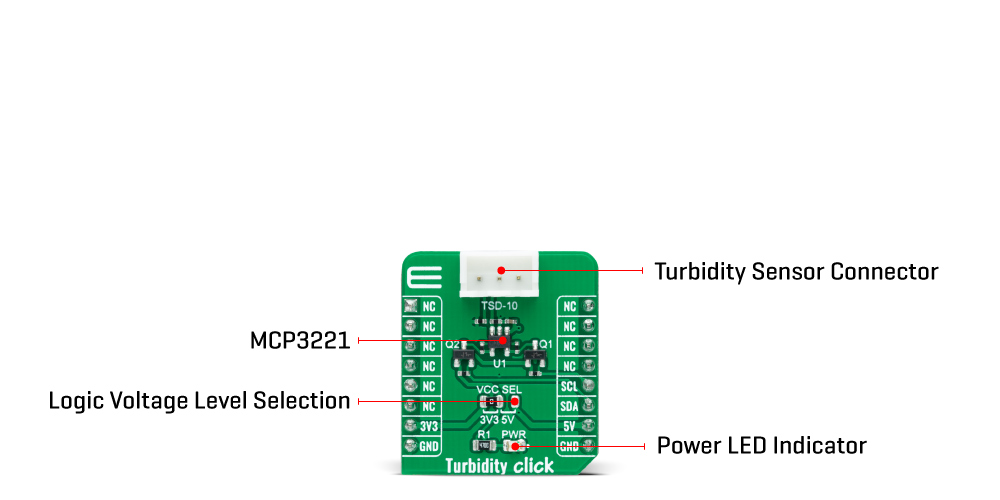
The Turbidity Click Board™ is an adapter that simplifies the interface of a Turbidity Sensor with a host MCU. This Click board™ represents a small-size PCB that can be connected to the mikroBUS™ socket like any other Turbidity Click Board™, with a 1x3 2.5mm pitch vertical type board connector placed on itself used for the turbidity sensor connection. Each of the connector pins corresponds to a pin of the turbidity sensor. Each of the connector pins corresponds to the turbidity sensor pins connected to this same connector via an additional 3-wire cable for the Turbidity Click Board™, specially made for this purpose. This way allows easy pin access and manipulation while retaining a perfect connection quality at all times.
The Turbidity Click Board™ allows users to upgrade their projects with a sensor that senses the cloudiness or haziness of a liquid caused by large numbers of individual particles invisible to the naked eye. The turbidity level is determined based on a comparison between clean water measurements and later based on the used water at the end of usage; more precisely, the turbidity sensor measures the amount of transmitted light to determine the turbidity of the liquid. As well as turbidity, this sensor also measures liquid temperature.
The analog output voltage of the Turbidity Sensor can be converted to a digital value using MCP3221, a successive approximation A/D converter with a 12-bit resolution from Microchip, using a 2-wire I2C compatible interface. Using MCP3221 and I2C interface, data transfers at rates of up to 100kbit/s in the Standard and 400kbit/s in the Fast Mode.
The Turbidity Click Board™ can operate with both 3.3V and 5V logic voltage levels selected via the VCC SEL jumper. This way, it is allowed for both 3.3V and 5V capable MCUs to use the I2C communication lines properly. However, the Click board™ comes equipped with a library containing easy-to-use functions and an example code that can be used, as a reference, for further development.
| Type | Adapter, Environmental |
| Applications | The Turbidity Click Board™ can be used to senses the cloudiness or haziness of a fluid caused by large numbers of individual particles invisible to the naked eye |
| On-board modules | The Turbidity Click Board™ is adapter with socket for the TSD-10 Turbidity Sensor |
| Key Features | Low power consumption, high performance, allowing sensing of the cloudiness or haziness of a fluid, I2C configurable analog-to-digital converter, suitable for both mikroBUS™ power rails, and more |
| Interface | I2C |
| Compatibility | mikroBUS |
| Click board size | S (28.6 x 25.4 mm) |
| Input Voltage | 3.3V or 5V |
This table shows how the pinout of the Turbidity Click Board™ corresponds to the pinout on the mikroBUS™ socket (the latter shown in the two middle columns).
| Notes | Pin |  |
Pin | Notes | |||
|---|---|---|---|---|---|---|---|
| NC | 1 | AN | PWM | 16 | NC | ||
| NC | 2 | RST | INT | 15 | NC | ||
| NC | 3 | CS | RX | 14 | NC | ||
| NC | 4 | SCK | TX | 13 | NC | ||
| NC | 5 | MISO | SCL | 12 | SCL | I2C Clock | |
| NC | 6 | MOSI | SDA | 11 | SDA | I2C Data | |
| Power Supply | 3.3V | 7 | 3.3V | 5V | 10 | 5V | Power Supply |
| Ground | GND | 8 | GND | GND | 9 | GND | Ground |
| Label | Name | Default | Description |
|---|---|---|---|
| LD1 | PWR | - | Power LED Indicator |
| JP1 | VCC SEL | Left | Logic Level Voltage Selection 3V3/5V: Left position 3V3, Right position 5V |
| Description | Min | Typ | Max | Unit |
|---|---|---|---|---|
| Supply Voltage | 3.3 | - | 5 | V |
| Nephelometric Turbidity Unit | 0 | - | 4500 | NTU |
| Operating Temperature Range | -10 | +25 | +90 | °C |
We provide a library for the Turbidity Click Board™ as well as a demo application (example), developed using MikroElektronika compilers. The demo can run on all the main MikroElektronika development boards.
Package can be downloaded/installed directly from NECTO Studio Package Manager (recommended), downloaded from our LibStock™ or found on Mikroe Github account.
This library contains API for the Turbidity Click Board™ driver.
Key functions
turbidity_get_ntu Turbidity get NTU function.
turbidity_read_adc Turbidity read ADC function.
turbidity_get_adc_voltage Turbidity get voltage function.
This library contains API for the Turbidity Click Board™ driver. The demo application reads ADC value, ADC voltage and Nephelometric Turbidity Units ( NTU ).
 void application_task ( void )
 {
     static float ntu;

     turbidity_get_ntu( &turbidity, &ntu );
     log_printf( &logger, "tNTU : %.2frn", ntu );
     log_printf( &logger, "----------------------------rn" );
     Delay_ms( 1000 );
 }
The full application code, and ready to use projects can be installed directly from NECTO Studio Package Manager(recommended way), downloaded from our LibStock™ or found on Mikroe Github account.
Other MikroE Libraries used in the example:
Depending on the development board you are using, you may need a USB UART click, USB UART 2 Click or RS232 Click to connect to your PC, for development systems with no UART to USB interface available on the board. UART terminal is available in all MikroElektronika compilers.
The Turbidity Click Board™ is supported with mikroSDK - MikroElektronika Software Development Kit. To ensure proper operation of mikroSDK compliant Click board™ demo applications, mikroSDK should be downloaded from the LibStock and installed for the compiler you are using.
- attachments: [{"download_file":[{"download_file":"Turbidity Click Board™ Schematic"}],"download_filetype":[{"download_filetype":"pdf"}]},{"download_file":[{"download_file":"Microchip 12-Bit ADC Datasheet"}],"download_filetype":[{"download_filetype":"pdf"}]}] - manufacturer: Mikroelektronika d.o.o. - warranty: 12 months - backorder_label: If no stock shown above, check availability - condition: new - custom_product: false - mpn: MIKROE-4276 - google_product_category: Electronics - custom_label_0: Click Board - mpn: MIKROE-4276 - device_vendor: Microchip Technology - device_type: MCP3221A5T-E/OT - warranty: 12 months - brand: MikroE - manufacturer: Mikroelektronika d.o.o. - target_keyword: Turbidity Click Board - brands: gid://shopify/Metaobject/56256004319 - breadcrumbs: ["gid://shopify/Collection/447955239135","gid://shopify/Collection/241680580797"] - customhs_code: 847330 - detailed_description: {"type":"root","children":[{"type":"heading","level":3,"children":[{"type":"text","value":"How Does The Turbidity Click Board™ Work?"}]},{"type":"paragraph","children":[{"type":"text","value":"The "},{"type":"text","value":"Turbidity Click Board™","bold":true,"italic":true},{"type":"text","value":" is an adapter that simplifies the interface of a Turbidity Sensor with a host MCU. This Click board™ represents a small-size PCB that can be connected to the mikroBUS™ socket like any other "},{"type":"text","value":"Turbidity Click Board™","bold":true},{"type":"text","value":", with a 1x3 2.5mm pitch vertical type board connector placed on itself used for the turbidity sensor connection. Each of the connector pins corresponds to a pin of the turbidity sensor. Each of the connector pins corresponds to the turbidity sensor pins connected to this same connector via an additional 3-wire cable for the "},{"type":"text","value":"Turbidity Click Board™","bold":true},{"type":"text","value":", specially made for this purpose. This way allows easy pin access and manipulation while retaining a perfect connection quality at all times."}]},{"type":"paragraph","children":[{"type":"text","value":""}]},{"type":"paragraph","children":[{"type":"text","value":"The "},{"type":"text","value":"Turbidity Click Board™","bold":true},{"type":"text","value":" allows users to upgrade their projects with a sensor that senses the cloudiness or haziness of a liquid caused by large numbers of individual particles invisible to the naked eye. The turbidity level is determined based on a comparison between clean water measurements and later based on the used water at the end of usage; more precisely, the turbidity sensor measures the amount of transmitted light to determine the turbidity of the liquid. As well as turbidity, this sensor also measures liquid temperature."}]},{"type":"paragraph","children":[{"type":"text","value":"The analog output voltage of the Turbidity Sensor can be converted to a digital value using MCP3221, a successive approximation A/D converter with a 12-bit resolution from Microchip, using a 2-wire I2C compatible interface. Using MCP3221 and I2C interface, data transfers at rates of up to 100kbit/s in the Standard and 400kbit/s in the Fast Mode."}]},{"type":"paragraph","children":[{"type":"text","value":"The "},{"type":"text","value":"Turbidity Click Board™","bold":true},{"type":"text","value":" can operate with both 3.3V and 5V logic voltage levels selected via the VCC SEL jumper. This way, it is allowed for both 3.3V and 5V capable MCUs to use the I2C communication lines properly. However, the Click board™ comes equipped with a library containing easy-to-use functions and an example code that can be used, as a reference, for further development."}]},{"type":"heading","level":3,"children":[{"type":"text","value":"SPECIFICATIONS"}]},{"type":"paragraph","children":[{"type":"text","value":"Type\nAdapter, Environmental\nApplications\nThe Turbidity Click Board™ can be used to senses the cloudiness or haziness of a fluid caused by large numbers of individual particles invisible to the naked eye\nOn-board modules\nThe Turbidity Click Board™ is adapter with socket for the TSD-10 Turbidity Sensor\nKey Features\nLow power consumption, high performance, allowing sensing of the cloudiness or haziness of a fluid, I2C configurable analog-to-digital converter, suitable for both mikroBUS™ power rails, and more\nInterface\nI2C\nCompatibility\nmikroBUS\nClick board size\nS (28.6 x 25.4 mm)\nInput Voltage\n3.3V or 5V"}]},{"type":"heading","level":3,"children":[{"type":"text","value":"PINOUT DIAGRAM"}]},{"type":"paragraph","children":[{"type":"text","value":"This table shows how the pinout of the "},{"type":"text","value":"Turbidity Click Board™","bold":true},{"type":"text","value":" corresponds to the pinout on the mikroBUS™ socket (the latter shown in the two middle columns)."}]},{"type":"paragraph","children":[{"type":"text","value":"Notes\nPin\nPin\nNotes\nNC\n1\nAN\nPWM\n16\nNC\nNC\n2\nRST\nINT\n15\nNC\nNC\n3\nCS\nRX\n14\nNC\nNC\n4\nSCK\nTX\n13\nNC\nNC\n5\nMISO\nSCL\n12\nSCL\nI2C Clock\nNC\n6\nMOSI\nSDA\n11\nSDA\nI2C Data\nPower Supply\n3.3V\n7\n3.3V\n5V\n10\n5V\nPower Supply\nGround\nGND\n8\nGND\nGND\n9\nGND\nGround"}]},{"type":"heading","level":3,"children":[{"type":"text","value":"ONBOARD SETTINGS AND INDICATORS"}]},{"type":"paragraph","children":[{"type":"text","value":"Label\nName\nDefault\n Description\nLD1\nPWR\n-\nPower LED Indicator\nJP1\nVCC SEL\nLeft\nLogic Level Voltage Selection 3V3/5V: Left position 3V3, Right position 5V"}]},{"type":"heading","level":3,"children":[{"type":"text","value":"TURBIDITY CLICK ELECTRICAL SPECIFICATIONS"}]},{"type":"paragraph","children":[{"type":"text","value":"Description\nMin\nTyp\nMax\nUnit\nSupply Voltage\n3.3\n-\n5\nV\nNephelometric Turbidity Unit\n0\n-\n4500\nNTU\nOperating Temperature Range\n-10\n+25\n+90\n°C"}]},{"type":"heading","level":3,"children":[{"type":"text","value":" "}]}]} - summary: The Turbidity Click Board™ is an adapter Click board™, used to interface a compatible turbidity sensor with the host MCU. This board features one 1x3 2.5mm connector suitable for connecting a Turbidity sensor via an additional 3-wire Male to Male Cable - 15 cm for the Turbidity Click Board™ specially made for this purpose. It allows users to upgrade their projects with a sensor that senses the cloudiness or haziness of a fluid caused by large numbers of individual particles invisible to the naked eye. This sensor also measures temperature as well as turbidity.