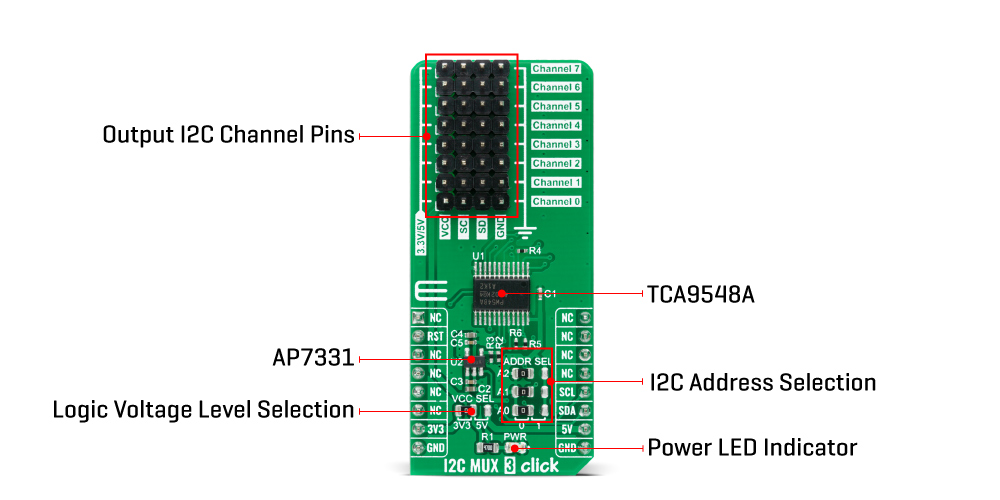
The I2C MUX 3 Click Board™ is based on the TCA9548APWR, a low voltage eight bidirectional translating switches with an active-low reset input controlled through the I2C serial interface from Texas Instruments. The master SCL/SDA signal pair is directed to eight channels of slave devices, SC0/SD0-SC7/SD7, where any individual downstream channel can be selected as well as any combination of the eight channels. It features I2C control using a single 8-bit control register in which each bit controls the enabling and disabling of one of the corresponding 8 switch channels for I2C data flow.
The I2C MUX 3 Click Board™ includes a low dropout linear regulator AP7331 from Diodes Incorporated to provide the 2.45V supply voltage for the TCA9548APWR. When the TCA9548APWR is turned on for the first time or anytime the device needs to be reset by cycling the power supply, which means that the Power-On reset requirements must be followed to ensure the I2C bus logic is initialized properly. Additionally, if communication on the I2C bus enters a fault state, the TCA9548APWR can be reset to resume normal operation using the RST pin feature or by a Power-On reset which results from cycling power to the device.
The I2C MUX 3 Click Board™ communicates with MCU using the standard I2C 2-Wire interface that supports Standard-Mode (100 kHz) and Fast-Mode (400 kHz) operation. The TCA9548APWR has a 7-bit slave address with the first five MSBs fixed to 1110. The address pins A0, A1 and A2 are programmed by the user and determines the value of the last three LSBs of the slave address which can be selected by onboard SMD jumpers labelled as ADDR SEL allowing selection of the slave address LSBs. It also has an active-low reset signal routed on the RST pin of the mikroBUS™ socket used to recover from a bus-fault condition. When this signal is asserted low the TCA9548APWR resets its registers alongside with I2C state machine and deselects all channels.
The I2C MUX 3 Click Board™ is designed to be operated with both 3.3V and 5V logic voltage levels that can be selected via VCC SEL jumper. This allows for both 3.3V and 5V capable MCUs to use the I2C communication lines properly. More information about the TCA9548APWR can be found in the attached datasheet. However, the Click board™ comes equipped with a library that contains easy to use functions and a usage example that may be used as a reference for further development.
| Type | I2C |
| Applications | Can be used with I2C interfaces for applications such as fault isolation, address conflict, level translation, or broadcast communication (servers, routers...). |
| On-board modules | The I2C MUX 3 Click Board™ is based on the TCA9548APWR, a low voltage eight bidirectional translating switches with an active-low reset input controlled through the I2C serial interface from Texas Instruments. |
| Key Features | 1-to-8 bidirectional translating switches, low Stand-By current, support hot insertion, deselected channels during Power-Up, and more. |
| Interface | I2C |
| Compatibility | mikroBUS |
| Click board size | L (57.15 x 25.4 mm) |
| Input Voltage | 3.3V or 5V |
This table shows how the pinout of the I2C MUX 3 Click Board™ corresponds to the pinout on the mikroBUS™ socket (the latter shown in the two middle columns).
| Notes | Pin |  |
Pin | Notes | |||
|---|---|---|---|---|---|---|---|
| NC | 1 | AN | PWM | 16 | NC | ||
| Reset | RST | 2 | RST | INT | 15 | NC | |
| NC | 3 | CS | RX | 14 | NC | ||
| NC | 4 | SCK | TX | 13 | NC | ||
| NC | 5 | MISO | SCL | 12 | SCL | I2C Clock | |
| NC | 6 | MOSI | SDA | 11 | SDA | I2C Data | |
| Power Supply | 3.3V | 7 | 3.3V | 5V | 10 | 5V | Power Supply |
| Ground | GND | 8 | GND | GND | 9 | GND | Ground |
| Label | Name | Default | Description |
|---|---|---|---|
| LD1 | PWR | - | Power LED Indicator |
| JP1 | VCC SEL | Left | Power Supply Voltage Selection 3V3/5V: Left position 3V3, Right position 5V |
| JP2-JP4 | ADDR SEL | Left | Communication interface selection: Left position 0, Right position 1 |
| J1-J8 | - | - | Output I2C Channel Pins |
| Description | Min | Typ | Max | Unit |
|---|---|---|---|---|
| Supply Voltage | -0.5 | - | 7 | V |
| Maximum Output Current | -25 | - | - | mA |
| Maximum Frequency | - | - | 400 | kHz |
| Operating Temperature Range | -40 | - | +125 | °C |
The BME680 is a digital 4-in-1 sensor with gas, humidity, pressure and temperature measurement based on proven sensing principles, housed in an extremely compact metal-lid LGA package. Its small dimensions and its low power consumption enable the integration in battery-powered or frequency-coupled devices, such as handsets or wearables. The BMM150 geomagnetic sensor, a three-axis geomagnetic sensor and the BMI088 sensor module, are both featured prominently and are key parts of this 13DOF Click board™.
13DOF click is based on the BME680 and the BMM150 sensor ICs. Also, the click contains BMI088 - a small, versatile 6DoF sensor module from Bosch. Altogether, this Click board™ integrates a triaxial accelerometer, triaxial gyroscope, triaxial geomagnetic, gas, humidity, pressure and temperature sensors on the single board. This allows very high integration and very small dimensions, at an affordable cost. The output of each MEMS is processed, digitised and available through the I2C communication interface. The data can be over-sampled by the sensor ICs by themselves, in order to achieve as reliable data readings as possible. As already mentioned, the features of this click are numerous.

The BMM150 geomagnetic sensor from Bosch is a standalone sensor for consumer market applications. It allows measurements of the magnetic field in three perpendicular axes. The sensor is carefully tuned and a perfect match for the demanding requirements of all 3-axis mobile apps such as electronic compass, navigation or augmented reality.An application specific circuit (ASIC) converts the output of the geomagnetic sensor to digital results which can be read out over the industry standard digital I2C interface. Package and interfaces of the BMM150 have been designed to match a multitude of hardware requirements. As the sensor features an ultra-small footprint and a flat package, it is ingeniously suited for mobile applications, such as cell phones, handhelds, computer peripherals, man-machine interfaces, virtual reality features, game controllers, and other.
The BMI088 is an inertial measurement unit (IMU) for the detection of movements and rotations in 6 degrees of freedom (6DoF). It reflects the full functionality of a triaxial, low-g acceleration sensor and at the same time it is capable to measure angular rates. Both – acceleration and angular rate – in three perpendicular room dimensions, the x-, y- and z-axis. The BMI088 is designed to meet all requirements for consumer applications such as gaming and pointing devices, HMI and image stabilization (DSC and camera-phone). It also senses tilt, motion, inactivity and shock vibration in cell phones, handhelds, computer peripherals, HMI interfaces, virtual reality features and game controllers. An ASIC converts the output of the MEMS, developed, produced and tested in BOSCH facilities. To provide maximum performance and reliability each device is tested and ready-to-use calibrated.
On the other side, the BME680 - a small, high performance, low power, 4-in-1 sensor is in charge for the gas, humidity, pressure and temperature measurements. It also features very low power consumption, for example, 3.7 µA is typical at 1 Hz humidity, pressure and temperature measurement mode. It also features a very high accuracy humidity sensor (tolerance ±3% r.H. and hysteresis ±1.5% r.H.), pressure sensor with only 0.12 Pa RMS Noise (equivalent to to 1.7 cm of altitude) and a very low temperature offset drift, and a gas sensor with direct indoor air quality (IAQ) index output system. In principle, the IAQ index output is in an index that can have values between 0 and 500 with a resolution of 1 to indicate or quantify the quality of the air available in the surrounding. It greatly simplifies the categorization of the air quality measurements.
13DOF click supports I2C communication interface, allowing it to be used with a wide range of different MCUs. The I2C slave address for the communication can be selected by moving SMD jumpers grouped under the COMM SEL to an appropriate position.
This Click Board™ is designed to be operated only with 3.3V logic level. A proper logic voltage level conversion should be performed before the Click board™ is used with MCUs with logic levels of 5V.
- amazon_main_image: https://www.thedebugstore.com/images/product/lg-i2c-mux-3-click-front.jpg - amazon_other_image_1: https://www.thedebugstore.com/images/product/lg-i2c-mux-3-click-back.jpg - amazon_other_image_2: https://www.thedebugstore.com/images/product/lg-i2c-mux-3-click-fusion.jpg - amazon_other_image_3: https://www.thedebugstore.com/images/product/lg-i2c-mux-3-click-shuttle.jpg - amazon_other_image_4: https://www.thedebugstore.com/images/product/lg-i2c-mux-3-click-clicker.jpg - amazon_other_image_5: https://www.thedebugstore.com/images/product/lg-i2c-mux-3-click-breadboard.jpg - amazon_other_image_6: https://www.thedebugstore.com/images/product/lg-i2c-mux-3-click-breadboard.jpg - amazon_browse_node: 428655031 - related_products: MIKROE-3827,MIKROE-4153,MIKROE-3869 - mpn: MIKROE-4262 - backorder_label: If no stock shown above, check availability - badge: - widget:We provide a library for the I2C MUX 3 Click Board™ on our LibStock page, as well as a demo application (example), developed using MikroElektronika compilers. The demo can run on all the main MikroElektronika development boards.
The library covers all the necessary functions that enables the usage of the I2C MUX 3 Click Board™. User can set one of 8 channels by writing to devices control register and check it by reading, or use the function to set it directly. User can also use sequential read and write function to comunicate with the devices sonnected to the selected channel.
uint8_t n_bytes ); - Function is used to write a sequential data starting from the targeted 8-bit register address of the device connected to the desired channel of the I2C MUX 4 Click Board™ board.uint8_t n_bytes ) - Function is used to read a sequential data starting from the targeted 8-bit register address of the device connected to the desired channel of the I2C MUX 4 Click Board™ board.void i2cmux3_ch_sel ( uint8_t sel_ch ); - Function is used to select communication channel.The application is composed of three sections :
void application_task ( )
{
    mikrobus_logWrite( "-------------------------", _LOG_LINE );
    mikrobus_logWrite( "ID values by click board:", _LOG_LINE );
    mikrobus_logWrite( "-------------------------", _LOG_LINE );
    mikrobus_logWrite( "", _LOG_LINE );

    i2cmux3_ch_sel( 0 );
    i2cmux3_rd_slv ( 0x68, 0x00, &id_val, 1 );
    ByteToHex( id_val, log_txt );
    Ltrim( log_txt );
    mikrobus_logWrite( " 6DOF IMU 12  : 0x", _LOG_TEXT );
    mikrobus_logWrite( log_txt, _LOG_LINE );
    mikrobus_logWrite( "-------------------------", _LOG_LINE );
    Delay_ms( 100 );

    i2cmux3_ch_sel( 1 );
    i2cmux3_rd_slv ( 0x68, 0x0F, &id_val, 1 );
    ByteToHex( id_val, log_txt );
    Ltrim( log_txt );
    mikrobus_logWrite( " RTC 10       : 0x", _LOG_TEXT );
    mikrobus_logWrite( log_txt, _LOG_LINE );
    mikrobus_logWrite( "-------------------------", _LOG_LINE );
    Delay_ms( 100 );

    i2cmux3_ch_sel( 2 );
    i2cmux3_rd_slv ( 0x48, 0x0B, &id_val, 1 );
    ByteToHex( id_val, log_txt );
    Ltrim( log_txt );
    mikrobus_logWrite( " Surface Temp : 0x", _LOG_TEXT );
    mikrobus_logWrite( log_txt, _LOG_LINE );
    mikrobus_logWrite( "-------------------------", _LOG_LINE );
    Delay_ms( 100 );

    i2cmux3_ch_sel( 3 );
    i2cmux3_rd_slv ( 0x39, 0x92, &id_val, 1 );
    ByteToHex( id_val, log_txt );
    Ltrim( log_txt );
    mikrobus_logWrite( " Spectrometer : 0x", _LOG_TEXT );
    mikrobus_logWrite( log_txt, _LOG_LINE );
    mikrobus_logWrite( "-------------------------", _LOG_LINE );
    Delay_ms( 100 );

    i2cmux3_ch_sel( 4 );
    i2cmux3_rd_slv ( 0x30, 0x2F, &id_val, 1 );
    ByteToHex( id_val, log_txt );
    Ltrim( log_txt );
    mikrobus_logWrite( " Compass 3    : 0x", _LOG_TEXT );
    mikrobus_logWrite( log_txt, _LOG_LINE );
    mikrobus_logWrite( "-------------------------", _LOG_LINE );
    Delay_ms( 100 );

    i2cmux3_ch_sel( 5 );
    i2cmux3_rd_slv ( 0x29, 0x12, &id_val, 1 );
    ByteToHex( id_val, log_txt );
    Ltrim( log_txt );
    mikrobus_logWrite( " Color 3      : 0x", _LOG_TEXT );
    mikrobus_logWrite( log_txt, _LOG_LINE );
    mikrobus_logWrite( "-------------------------", _LOG_LINE );
    Delay_ms( 100 );

    i2cmux3_ch_sel( 6 );
    i2cmux3_rd_slv ( 0x0E, 0x00, &id_val, 1 );
    ByteToHex( id_val, log_txt );
    Ltrim( log_txt );
    mikrobus_logWrite( " 6DOF IMU 11  : 0x", _LOG_TEXT );
    mikrobus_logWrite( log_txt, _LOG_LINE );
    mikrobus_logWrite( "-------------------------", _LOG_LINE );
    Delay_ms( 100 );

    i2cmux3_ch_sel( 7 );
    i2cmux3_rd_slv ( 0x57, 0xFF, &id_val, 1 );
    ByteToHex( id_val, log_txt );
    Ltrim( log_txt );
    mikrobus_logWrite( " Heart Rate 4 : 0x", _LOG_TEXT );
    mikrobus_logWrite( log_txt, _LOG_LINE );
    mikrobus_logWrite( "-------------------------", _LOG_LINE );
    Delay_ms( 100 );

    mikrobus_logWrite( "", _LOG_LINE );
    mikrobus_logWrite( "-------------------------", _LOG_LINE );
    Delay_ms( 3000 );
}
The full application code, and ready to use projects can be found on our LibStock page.
Other mikroE Libraries used in the example:
Depending on the development board you are using, you may need USB UART Click Board™, USB UART 2 Click Board™ or RS232 Click Board™ to connect to your PC, for development systems with no UART to USB interface available on the board. The terminal available in all MikroElektronika compilers, or any other terminal application of your choice, can be used to read the message.
The I2C MUX 3 Click Board™ is supported with mikroSDK - MikroElektronika Software Development Kit. To ensure proper operation of mikroSDK compliant Click board™ demo applications, mikroSDK should be downloaded from the LibStock and installed for the compiler you are using.
- attachments: [{"download_file":[{"download_file":"I2C MUX 3 Click Board™ Schematic"}],"download_filetype":[{"download_filetype":"pdf"}]},{"download_file":[{"download_file":"Texas Instruments TCA9548APWR 8-Channel I2C Switch Datasheet"}],"download_filetype":[{"download_filetype":"pdf"}]},{"download_file":[{"download_file":"Diodes Inc AP7331 LDO Regulator Datasheet"}],"download_filetype":[{"download_filetype":"pdf"}]}] - device_vendor: Texas Instruments - device_type: TCA9548APWR - warranty: 12 months - brand: MikroE - key_feature_1: Expands One I2C Signal to Eight - manufacturer: Mikroelektronika d.o.o. - target_keyword: I2C MUX 3 Click Board - brands: gid://shopify/Metaobject/56256004319 - breadcrumbs: ["gid://shopify/Collection/447955239135","gid://shopify/Collection/241680580797","gid://shopify/Collection/241546100925"] - customhs_code: 847330 - detailed_description: {"type":"root","children":[{"type":"heading","level":3,"children":[{"type":"text","value":"How Does The I2C MUX 3 Click Board™ Work?"}]},{"type":"paragraph","children":[{"type":"text","value":"The "},{"type":"text","value":"I2C MUX 3 Click Board™","bold":true,"italic":true},{"type":"text","value":" is based on the TCA9548APWR, a low voltage eight bidirectional translating switches with an active-low reset input controlled through the I2C serial interface from Texas Instruments. The master SCL/SDA signal pair is directed to eight channels of slave devices, SC0/SD0-SC7/SD7, where any individual downstream channel can be selected as well as any combination of the eight channels. It features I2C control using a single 8-bit control register in which each bit controls the enabling and disabling of one of the corresponding 8 switch channels for I2C data flow."}]},{"type":"paragraph","children":[{"type":"text","value":""}]},{"type":"paragraph","children":[{"type":"text","value":"The "},{"type":"text","value":"I2C MUX 3 Click Board™","bold":true},{"type":"text","value":" includes a low dropout linear regulator AP7331 from Diodes Incorporated to provide the 2.45V supply voltage for the TCA9548APWR. When the TCA9548APWR is turned on for the first time or anytime the device needs to be reset by cycling the power supply, which means that the Power-On reset requirements must be followed to ensure the I2C bus logic is initialized properly. Additionally, if communication on the I2C bus enters a fault state, the TCA9548APWR can be reset to resume normal operation using the RST pin feature or by a Power-On reset which results from cycling power to the device."}]},{"type":"paragraph","children":[{"type":"text","value":"The "},{"type":"text","value":"I2C MUX 3 Click Board™","bold":true},{"type":"text","value":" communicates with MCU using the standard I2C 2-Wire interface that supports Standard-Mode (100 kHz) and Fast-Mode (400 kHz) operation. The TCA9548APWR has a 7-bit slave address with the first five MSBs fixed to 1110. The address pins A0, A1 and A2 are programmed by the user and determines the value of the last three LSBs of the slave address which can be selected by onboard SMD jumpers labelled as ADDR SEL allowing selection of the slave address LSBs. It also has an active-low reset signal routed on the RST pin of the mikroBUS™ socket used to recover from a bus-fault condition. When this signal is asserted low the TCA9548APWR resets its registers alongside with I2C state machine and deselects all channels."}]},{"type":"paragraph","children":[{"type":"text","value":"The "},{"type":"text","value":"I2C MUX 3 Click Board™","bold":true},{"type":"text","value":" is designed to be operated with both 3.3V and 5V logic voltage levels that can be selected via VCC SEL jumper. This allows for both 3.3V and 5V capable MCUs to use the I2C communication lines properly. More information about the TCA9548APWR can be found in the attached datasheet. However, the Click board™ comes equipped with a library that contains easy to use functions and a usage example that may be used as a reference for further development."}]},{"type":"heading","level":3,"children":[{"type":"text","value":"SPECIFICATIONS"}]},{"type":"paragraph","children":[{"type":"text","value":"Type\nI2C\nApplications\nCan be used with I2C interfaces for applications such as fault isolation, address conflict, level translation, or broadcast communication (servers, routers...).\nOn-board modules\nThe I2C MUX 3 Click Board™ is based on the TCA9548APWR, a low voltage eight bidirectional translating switches with an active-low reset input controlled through the I2C serial interface from Texas Instruments.\nKey Features\n1-to-8 bidirectional translating switches, low Stand-By current, support hot insertion, deselected channels during Power-Up, and more.\nInterface\nI2C\nCompatibility\nmikroBUS\nClick board size\nL (57.15 x 25.4 mm)\nInput Voltage\n3.3V or 5V"}]},{"type":"heading","level":3,"children":[{"type":"text","value":"PINOUT DIAGRAM"}]},{"type":"paragraph","children":[{"type":"text","value":"This table shows how the pinout of the "},{"type":"text","value":"I2C MUX 3 Click Board™","bold":true},{"type":"text","value":" corresponds to the pinout on the mikroBUS™ socket (the latter shown in the two middle columns)."}]},{"type":"paragraph","children":[{"type":"text","value":"Notes\nPin\nPin\nNotes\nNC\n1\nAN\nPWM\n16\nNC\nReset\nRST\n2\nRST\nINT\n15\nNC\nNC\n3\nCS\nRX\n14\nNC\nNC\n4\nSCK\nTX\n13\nNC\nNC\n5\nMISO\nSCL\n12\nSCL\nI2C Clock\nNC\n6\nMOSI\nSDA\n11\nSDA\nI2C Data\nPower Supply\n3.3V\n7\n3.3V\n5V\n10\n5V\nPower Supply\nGround\nGND\n8\nGND\nGND\n9\nGND\nGround"}]},{"type":"heading","level":3,"children":[{"type":"text","value":"ONBOARD SETTINGS AND INDICATORS"}]},{"type":"paragraph","children":[{"type":"text","value":"Label\nName\nDefault\nDescription\nLD1\nPWR\n-\nPower LED Indicator\nJP1\nVCC SEL\nLeft\nPower Supply Voltage Selection 3V3/5V: Left position 3V3, Right position 5V\nJP2-JP4\nADDR SEL\nLeft\nCommunication interface selection: Left position 0, Right position 1\nJ1-J8\n-\n-\nOutput I2C Channel Pins"}]},{"type":"heading","level":3,"children":[{"type":"text","value":"I2C MUX 3 CLICK ELECTRICAL SPECIFICATIONS"}]},{"type":"paragraph","children":[{"type":"text","value":"Description\nMin\nTyp\nMax\nUnit\nSupply Voltage\n-0.5\n-\n7\nV\nMaximum Output Current\n-25\n-\n-\nmA\nMaximum Frequency\n-\n-\n400\nkHz\nOperating Temperature Range\n-40\n-\n+125\n°C"}]},{"type":"heading","level":3,"children":[{"type":"text","value":" "}]}]} - summary:The I2C MUX 3 Click Board™ is a compact add-on board that contains eight bidirectional translating switches dedicated for applications with I2C slave address conflicts. This board features the TCA9548APWR, a low voltage 8-channel I2C bus switch with an active-low reset input from Texas Instruments. It possesses three programmable address pins that allow up to eight TCA9548APWR devices, supports hot insertion, has a low Stand-by current, and no glitch during Power-Up with all switch channels deselected. This Click Board™ is suitable to work with I2C interfaces for applications such as fault isolation, address conflict, level translation, or broadcast communication (servers, routers...).
The I2C MUX 3 Click Board™ is supported by a mikroSDK compliant library, which includes functions that simplify software development. This Click Board™ comes as a fully tested product, ready to be used on a system equipped with the mikroBUS™ socket.