# Title: 8-Pin I2C Click Board™
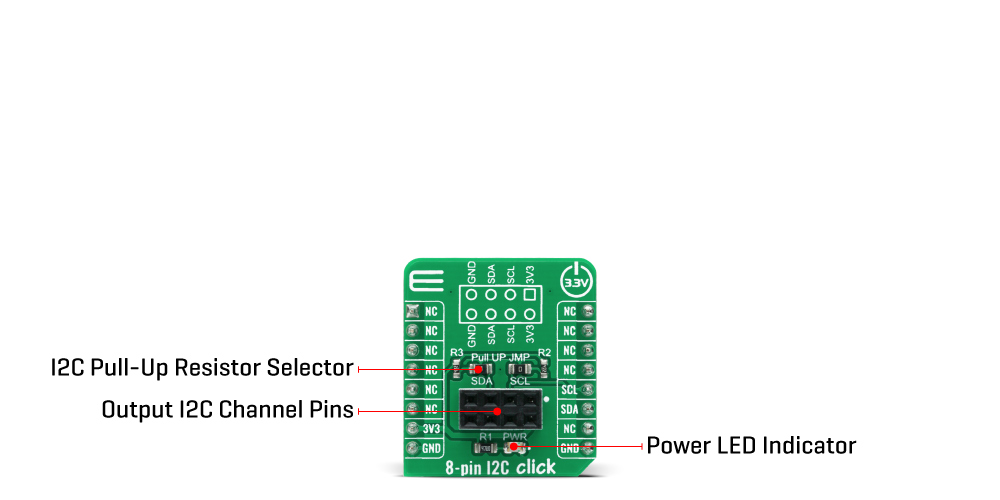
## Description: How Does The 8-Pin I2C Click Board™ Work? The 8-pin I2C Click Board™ is a breakout board that simplifies the connection of add-on boards to the mikroBUS™ socket. This Click board™ represents a small-size PCB that can be connected to the mikroBUS™ socket like any other Click board™, with a 2x4 female header placed on itself. Each of the header pins is corresponding to a pin on the mikroBUS™ socket being used such as I2C lines (SCL, SDA) with two jumpers for the I2C lines pull-up function selection, 3V3 power supply, and ground. This Click board™ allows easy pin access and manipulation while retaining a perfect connection quality at all times. Being compatible with Apple's MFI is the most important feature of the 8-pin I2C Click board™ which ensures its proper operation with additional Apple accessories. The name is a shortened version of the long-form Made for iPod, the original program that ultimately became MFI which refers to peripherals that work with Apple's iPod, iPad, and iPhone. The 8-pin I2C Click Board™ communicates with MCU using the standard I2C 2-Wire interface. Lines of the mikroBUS™ to which this Click board™ is attached, are shared through the top 8-pin female header, which mirrors the pins of the connected mikroBUS™ socket. The 8-pin I2C Click also shares the 3V3 power rails, which makes it compatible with any other power compatible Click board™ and development systems. The 8 pin I2C click Board™ is designed to be operated only with a 3.3V logic voltage level. A proper logic voltage level conversion should be performed before the Click board™ is used with MCUs with different logic voltage levels. However, the Click board™ comes equipped with a library that contains easy to use functions and a usage example that may be used as a reference for the development. SPECIFICATIONS Type Adapter Applications Can be used for for expanding the connectivity of the development system with the mikroBUS™, and ideal for communication with numerous devices that share the identical slave address on the same bus. Compatible with MFI (Made For iPod) On-board modules 8-pin I2C Click is a compact add-on board that represents a breakout board that simplifies the connection of add-on boards with 8 pin Female Connector to mikroBUS™ socket. Key Features MFI compatibility, no regional restrictions, expanding connectivity, retaining a perfect connection quality at all times, and more. Interface I2C Compatibility mikroBUS Click board size S (28.6 x 25.4 mm) Input Voltage 3.3V PINOUT DIAGRAM This table shows how the pinout of the 8 pin I2C click Board™ corresponds to the pinout on the mikroBUS™ socket (the latter shown in the two middle columns). Notes Pin Pin Notes NC 1 AN PWM 16 NC NC 2 RST INT 15 NC NC 3 CS RX 14 NC NC 4 SCK TX 13 NC NC 5 MISO SCL 12 SCL I2C Clock NC 6 MOSI SDA 11 SDA I2C Data Power Supply 3.3V 7 3.3V 5V 10 NC Ground GND 8 GND GND 9 GND Ground ONBOARD SETTINGS AND INDICATORS Label Name Default Description LD1 PWR - Power LED Indicator J1 HF 2x4 - 8 pin Female Connector(MFI) JP1-JP2 - - I2C Pull-Up Resistor Selector
## Product type: Click Board
## Vendor: Mikroelektronika d.o.o.
## Tags: Adapter, Click Board, Interface, MikroE, Serial Interface, Test
## Price range: 5.6 - 5.6 GBP
## Link: https://thedebugstore.com/products/mikroe-4241-8-pin-i2c-click-board-uk
## Compare-at price range: 8.0 - 8.0 GBP
## Options
- Title: Default Title
## Collections
- [New Products](https://thedebugstore.com/a/llms/collections/new-products-debug-store)
- [Mikroelektronika d.o.o. (MikroE)](https://thedebugstore.com/a/llms/collections/mikroelektronika-catalogue-uk)
- [Serial Interface Click Boards™](https://thedebugstore.com/a/llms/collections/serial-interface-click-boards-catalogue)
- [MikroE Click Boards™](https://thedebugstore.com/a/llms/collections/mikroe-click-boards-catalogue-uk)
- [Google Shopping - invalid product](https://thedebugstore.com/a/llms/collections/google-shopping-valid-products)
- [Test Interface Click Boards™](https://thedebugstore.com/a/llms/collections/test-interface-click-boards-catalogue)
- [Interface Click Boards™](https://thedebugstore.com/a/llms/collections/interface-click-boards-catalogue)
- [Adapter Click Boards™](https://thedebugstore.com/a/llms/collections/adapter-click-boards-catalogue)
- [Click Boards™ Summer Sale](https://thedebugstore.com/a/llms/collections/inventory-sale)
- [MikroE Sale](https://thedebugstore.com/a/llms/collections/mikroe-sale)
- [MIKROE Stock](https://thedebugstore.com/a/llms/collections/mikroe-products-in-stock-sale)
## Variants
- Default Title, SKU: MIKROE-4241, Available: yes, Inventory: 1
## Metafields
- full_description: How Does The 8-Pin I2C Click Board™ Work?
The 8-pin I2C Click Board™ is a breakout board that simplifies the connection of add-on boards to the mikroBUS™ socket. This Click board™ represents a small-size PCB that can be connected to the mikroBUS™ socket like any other Click board™, with a 2x4 female header placed on itself. Each of the header pins is corresponding to a pin on the mikroBUS™ socket being used such as I2C lines (SCL, SDA) with two jumpers for the I2C lines pull-up function selection, 3V3 power supply, and ground. This Click board™ allows easy pin access and manipulation while retaining a perfect connection quality at all times.

Being compatible with Apple's MFI is the most important feature of the 8-pin I2C Click board™ which ensures its proper operation with additional Apple accessories. The name is a shortened version of the long-form Made for iPod, the original program that ultimately became MFI which refers to peripherals that work with Apple's iPod, iPad, and iPhone.
The 8-pin I2C Click Board™ communicates with MCU using the standard I2C 2-Wire interface. Lines of the mikroBUS™ to which this Click board™ is attached, are shared through the top 8-pin female header, which mirrors the pins of the connected mikroBUS™ socket. The 8-pin I2C Click also shares the 3V3 power rails, which makes it compatible with any other power compatible Click board™ and development systems.
The 8 pin I2C click Board™ is designed to be operated only with a 3.3V logic voltage level. A proper logic voltage level conversion should be performed before the Click board™ is used with MCUs with different logic voltage levels. However, the Click board™ comes equipped with a library that contains easy to use functions and a usage example that may be used as a reference for the development.
SPECIFICATIONS
| Type |
Adapter |
| Applications |
Can be used for for expanding the connectivity of the development system with the mikroBUS™, and ideal for communication with numerous devices that share the identical slave address on the same bus. Compatible with MFI (Made For iPod) |
| On-board modules |
8-pin I2C Click is a compact add-on board that represents a breakout board that simplifies the connection of add-on boards with 8 pin Female Connector to mikroBUS™ socket. |
| Key Features |
MFI compatibility, no regional restrictions, expanding connectivity, retaining a perfect connection quality at all times, and more. |
| Interface |
I2C |
| Compatibility |
mikroBUS |
| Click board size |
S (28.6 x 25.4 mm) |
| Input Voltage |
3.3V |
PINOUT DIAGRAM
This table shows how the pinout of the 8 pin I2C click Board™ corresponds to the pinout on the mikroBUS™ socket (the latter shown in the two middle columns).
| Notes |
Pin |
 |
Pin |
Notes |
| NC |
1 |
AN |
PWM |
16 |
NC |
| NC |
2 |
RST |
INT |
15 |
NC |
| NC |
3 |
CS |
RX |
14 |
NC |
| NC |
4 |
SCK |
TX |
13 |
NC |
| NC |
5 |
MISO |
SCL |
12 |
SCL |
I2C Clock |
| NC |
6 |
MOSI |
SDA |
11 |
SDA |
I2C Data |
| Power Supply |
3.3V |
7 |
3.3V |
5V |
10 |
NC |
| Ground |
GND |
8 |
GND |
GND |
9 |
GND |
Ground |
ONBOARD SETTINGS AND INDICATORS
| Label |
Name |
Default |
Description |
| LD1 |
PWR |
- |
Power LED Indicator |
| J1 |
HF 2x4 |
- |
8 pin Female Connector(MFI) |
| JP1-JP2 |
- |
- |
I2C Pull-Up Resistor Selector |
- description_tag: The 8-pin I2C Click Board™ is a compact add-on board that represents a breakout board that simplifies the connection of add-on boards with an 8-pin Female Connector to mikroBUS™ socket. Available from Debug Store UK.
- title_tag: MikroE 8-Pin I2C Click Board™ (MIKROE-4241)
- manufacturer: Mikroelektronika d.o.o.
- warranty: 12 months
- amazon_enable: TRUE
- amazon_title: 8-Pin I2C Click Board
- amazon_product_type: computercomponent
- amazon_block: FALSE
- amazon_prime_enable: FALSE
- amazon_search: MikroElektronika Microelectronica MIKROE-1100
- amazon_uk_price: 26.4
- amazon_uk_currency: GBP
- amazon_de_currency: EUR
- amazon_de_price: 29.832
- amazon_fr_currency: EUR
- amazon_fr_price: 29.832
- amazon_es_currency: EUR
- amazon_es_price: 29.832
- amazon_nl_currency: EUR
- amazon_nl_price: 29.832
- amazon_it_currency: EUR
- amazon_it_price: 29.832
- amazon_se_curency: SEK
- amazon_se_price: 300.96
- amazon_product_id: 8606027380525
- amazon_product_id_type: EAN
- amazon_update: Update
- amazon_short_description: The 8-pin I2C Click Board™ is a compact add-on board that represents a breakout board that simplifies the connection of add-on boards with 8 pin Female Connector to mikroBUS™ socket. This board can be used as I2C Adapter with no main component on itself, with only an on-board connector for connection establishing. 8-pin I2C Click has no regional restrictions, no need for special permits, and it is possible to use this Click board™ worldwide. Being compatible with MFI (Made for iPod) is the most important feature of the 8-pin I2C Click board™ which ensures its proper operation with additional Apple accessories. This Click board™ is suitable for expanding the connectivity of the development system with the mikroBUS™, and ideal for communication with numerous devices that share the identical slave address on the same bus.8-pin I2C Click is supported by a mikroSDK compliant library, which includes functions that simplify software development. This Click board™ comes as a fully tested product, ready to be used on a system equipped with the mikroBUS™ socket.
- amazon_main_image: https://www.thedebugstore.com/images/product/lg-8-pin-i2c-click-front.jpg
- amazon_other_image_1: https://www.thedebugstore.com/images/product/lg-8-pin-i2c-click-back.jpg
- amazon_other_image_2: https://www.thedebugstore.com/images/product/lg-8-pin-i2c-click-fusion.jpg
- amazon_other_image_3: https://www.thedebugstore.com/images/product/lg-8-pin-i2c-click-shuttle.jpg
- amazon_other_image_4: https://www.thedebugstore.com/images/product/lg-8-pin-i2c-click-clicker.jpg
- amazon_other_image_5: https://www.thedebugstore.com/images/product/lg-8-pin-i2c-click-breadboard.jpg
- amazon_other_image_6: https://www.thedebugstore.com/images/product/lg-8-pin-i2c-click-breadboard.jpg
- amazon_browse_node: 428655031
- mpn: MIKROE-4241
- backorder_label: If no stock shown above, check availability
- google_product_category: 2082
- attachments: [{"download_file":[{"download_file":"8-Pin I2C Click Board™ Schematic"}],"download_filetype":[{"download_filetype":"pdf"}]}]
- condition: new
- custom_product: false
- mpn: MIKROE-4241
- google_product_category: Electronics
- custom_label_0: Click Board
- examples:
We provide a library for the 8-pin I2C Click on our LibStock page, as well as a demo application (example), developed using MikroElektronika compilers. The demo can run on all the main MikroElektronika development boards.
Library Description
The library contains a basic functions for using 8 pin I2C click Board™.
Key Functions
void c8pini2c_i2c_write(uint8_t slave_addr, uint8_t *data_buf,uint16_t len, uint8_t end_mode) - I2C Write functionvoid c8pini2c_i2c_read(uint8_t slave_addr, uint8_t *data_buf,uint16_t len, uint8_t end_mode) - I2C Read functionvoid c8pini2c_i2c_start ( void ) - I2C Start function
Example Description
The application is composed of three sections :
- System Initialization - Initializes I2C module
- Application Initialization - Initializes driver init and set up another click for test
- Application Task - Reads temperature and logs on the USB UART
- NOTE: Surface temp click board used for demonstrating work 8 pin I2C click-a
void application_task ( )
{
 float temperature;
 char demo_text[ 20 ];
 temperature = surfacetemp_get_temperature( );
 FloatToStr( temperature, demo_text );
 mikrobus_logWrite( "> Temperature : ", _LOG_TEXT );
 mikrobus_logWrite( demo_text, _LOG_LINE );
 Delay_ms( 1500 );
}
The full application code, and ready to use projects can be found on our LibStock page.
Other mikroE Libraries used in the example:
- I2C Library
- UART Library
- Conversions library
Additional Notes and Information
Depending on the development board you are using, you may need a USB UART click, USB UART 2 click or RS232 click to connect to your PC, for development systems with no UART to USB interface available on the board. The terminal available in all MikroElektronika compilers, or any other terminal application of your choice, can be used to read the message.
MIKROSDK
The 8 pin I2C click Board™ is supported with mikroSDK - MikroElektronika Software Development Kit. To ensure proper operation of mikroSDK compliant Click board™ demo applications, mikroSDK should be downloaded from the LibStock and installed for the compiler you are using.
- warranty: 12 months
- brand: MikroE
- key_feature_1: Compatible with MFI (Made For iPod)
- manufacturer: Mikroelektronika d.o.o.
- badge: No reviews
- widget:
- target_keyword: 8-Pin I2C Click Board
- brands: gid://shopify/Metaobject/56256004319
- breadcrumbs: ["gid://shopify/Collection/447955239135","gid://shopify/Collection/241680580797","gid://shopify/Collection/277618426045"]
- customhs_code: 853400
- detailed_description: {"type":"root","children":[{"type":"heading","level":3,"children":[{"type":"text","value":"How Does The 8-Pin I2C Click Board™ Work?"}]},{"type":"paragraph","children":[{"type":"text","value":"The "},{"type":"text","value":"8-pin I2C Click Board™","bold":true,"italic":true},{"type":"text","value":" is a breakout board that simplifies the connection of add-on boards to the mikroBUS™ socket. This Click board™ represents a small-size PCB that can be connected to the mikroBUS™ socket like any other Click board™, with a 2x4 female header placed on itself. Each of the header pins is corresponding to a pin on the mikroBUS™ socket being used such as I2C lines (SCL, SDA) with two jumpers for the I2C lines pull-up function selection, 3V3 power supply, and ground. This Click board™ allows easy pin access and manipulation while retaining a perfect connection quality at all times."}]},{"type":"paragraph","children":[{"type":"text","value":""},{"type":"text","value":""}]},{"type":"paragraph","children":[{"type":"text","value":"Being compatible with Apple's MFI is the most important feature of the 8-pin I2C Click board™ which ensures its proper operation with additional Apple accessories. The name is a shortened version of the long-form Made for iPod, the original program that ultimately became MFI which refers to peripherals that work with Apple's iPod, iPad, and iPhone."}]},{"type":"paragraph","children":[{"type":"text","value":"The "},{"type":"text","value":"8-pin I2C Click Board™","bold":true},{"type":"text","value":" communicates with MCU using the standard I2C 2-Wire interface. Lines of the mikroBUS™ to which this Click board™ is attached, are shared through the top 8-pin female header, which mirrors the pins of the connected mikroBUS™ socket. The 8-pin I2C Click also shares the 3V3 power rails, which makes it compatible with any other power compatible Click board™ and development systems."}]},{"type":"paragraph","children":[{"type":"text","value":"The "},{"type":"text","value":"8 pin I2C click Board™","bold":true},{"type":"text","value":" is designed to be operated only with a 3.3V logic voltage level. A proper logic voltage level conversion should be performed before the Click board™ is used with MCUs with different logic voltage levels. However, the Click board™ comes equipped with a library that contains easy to use functions and a usage example that may be used as a reference for the development."}]},{"type":"heading","level":3,"children":[{"type":"text","value":"SPECIFICATIONS"}]},{"type":"paragraph","children":[{"type":"text","value":"Type\nAdapter\nApplications\nCan be used for for expanding the connectivity of the development system with the mikroBUS™, and ideal for communication with numerous devices that share the identical slave address on the same bus. Compatible with MFI (Made For iPod)\nOn-board modules\n8-pin I2C Click is a compact add-on board that represents a breakout board that simplifies the connection of add-on boards with 8 pin Female Connector to mikroBUS™ socket.\nKey Features\nMFI compatibility, no regional restrictions, expanding connectivity, retaining a perfect connection quality at all times, and more.\nInterface\nI2C\nCompatibility\nmikroBUS\nClick board size\nS (28.6 x 25.4 mm)\nInput Voltage\n3.3V"}]},{"type":"heading","level":3,"children":[{"type":"text","value":"PINOUT DIAGRAM"}]},{"type":"paragraph","children":[{"type":"text","value":"This table shows how the pinout of the "},{"type":"text","value":"8 pin I2C click Board™","bold":true},{"type":"text","value":" corresponds to the pinout on the mikroBUS™ socket (the latter shown in the two middle columns)."}]},{"type":"paragraph","children":[{"type":"text","value":"Notes\nPin\nPin\nNotes\nNC\n1\nAN\nPWM\n16\nNC\nNC\n2\nRST\nINT\n15\nNC\nNC\n3\nCS\nRX\n14\nNC\nNC\n4\nSCK\nTX\n13\nNC\nNC\n5\nMISO\nSCL\n12\nSCL\nI2C Clock\nNC\n6\nMOSI\nSDA\n11\nSDA\nI2C Data\nPower Supply\n3.3V\n7\n3.3V\n5V\n10\nNC\nGround\nGND\n8\nGND\nGND\n9\nGND\nGround"}]},{"type":"heading","level":3,"children":[{"type":"text","value":"ONBOARD SETTINGS AND INDICATORS"}]},{"type":"paragraph","children":[{"type":"text","value":"Label\nName\nDefault\n Description\nLD1\nPWR\n-\nPower LED Indicator\nJ1\nHF 2x4\n-\n8 pin Female Connector(MFI)\nJP1-JP2\n-\n-\nI2C Pull-Up Resistor Selector"}]},{"type":"heading","level":3,"children":[{"type":"text","value":" "}]}]}
- summary: The 8-pin I2C Click Board™ is a compact add-on board that represents a breakout board that simplifies the connection of add-on boards with an 8-pin Female Connector to mikroBUS™ socket. This board can be used as I2C Adapter with no main component on itself, with only an onboard connector for connection establishing. The 8-pin I2C Click Board™ has no regional restrictions, no need for special permits, and it is possible to use this Click Board™ worldwide. Being compatible with MFI (Made for iPod) is the most important feature of the 8-pin I2C Click Board™ which ensures its proper operation with additional Apple accessories. This Click Board™ is suitable for expanding the connectivity of the development system with the mikroBUS™, and ideal for communication with numerous devices that share the identical slave address on the same bus.
The 8-pin I2C Click Board™ is supported by a mikroSDK compliant library, which includes functions that simplify software development. This Click Board™ comes as a fully tested product, ready to be used on a system equipped with the mikroBUS™ socket.