# Title: DAC 8 Click Board™
## Description: How Does The DAC 8 Click Board™ Work? The DAC 8 Click Board™ is based on the DAC8554IPWR, a 16-bit QUAD channel, ultra-low glitch, voltage-output digital to analog converter from Texas Instruments. It offers good linearity, exceptionally low glitch, and it has high precision output amplifier that allows rail-to-rail output swing over a wide range of supply voltage. What this component additionally has is a Power-On reset function, which ensures that DAC outputs power-up at zero-scale and remains there until a proper write operation occurs. Also, it provides a power-down feature that reduces the current consumption to 175nA per channel. To achieve a fully flexible range of the DAC8554IPWR, an external voltage reference is made user-programmable. For this purpose, the Click board™ uses another DAC, DAC60501MDGSR, 12-bit DAC from Texas Instruments, whose output is brought to the VREF pin of the DAC8554IPWR. That way, the reference voltage of the DAC8554IPWR can be set at any value between 0V and 5V, provides high precision and low power consumption as well. That makes the DAC 8 Click fully customizable solution, well suited for applications where the maximum precision from the output 16-bit DAC is needed. DAC60501MDGSR uses the I2C serial interface to communicate with the MCU and operates at clock rate up to 100kHz. The DAC 8 Click Board™ communicates with MCU using the 3-Wire SPI serial interface that is compatible with standard SPI, QSPI™, MICROWIRE™ and operates at clock rates up to 50 MHz. Additional functionality such as software simultaneous update capability is implemented and routed at the PWM pin of the mikroBUS™, which allows when new data enter the device, all of DAC outputs can be updated simultaneously and synchronously with the clock. It also possesses enable function routed at CS pin of the mikroBUS™ that is used to connect the SPI interface to the serial port. The DAC 8 Click Board™ is designed to be operated with both 3.3V and 5V logic levels. The onboard SMD jumper labeled as VCC SEL allows voltage selection for interfacing with both 3.3V and 5V MCUs. More information about the DAC8554IPWR's functionality, electrical specifications, and typical performance can be found in the attached datasheet. However, the Click board™ comes equipped with a library that contains easy-to-use functions, and a usage example that can be used as a reference for the development. SPECIFICATIONS Type DAC Applications Can be used in battery-operated equipment, digital gain and offset adjustment, programmable voltage and current sources, and many more. On-board modules DAC 8 Click is based on the DAC8554IPWR, a 16-bit QUAD channel, ultra-low glitch, voltage-output digital to analog converter from Texas Instruments. Key Features Low power consumption, high precission, ultra-low glitch, rail-to-rail voltage output, accuracy, stability, and more. Interface I2C,SPI,GPIO Compatibility mikroBUS Click board size S (28.6 x 25.4 mm) Input Voltage 3.3V or 5V PINOUT DIAGRAM This table shows how the pinout of the DAC 8 Click Board™ corresponds to the pinout on the mikroBUS™ socket (the latter shown in the two middle columns). Notes Pin Pin Notes NC 1 AN PWM 16 LD Software Update SPI Enable EN 2 RST INT 15 NC SPI Chip Select CS 3 CS RX 14 NC SPI Clock SCK 4 SCK TX 13 NC SPI Data OUT SDO 5 MISO SCL 12 SCL I2C Clock SPI Data IN SDI 6 MOSI SDA 11 SDA I2C Data Power Supply 3.3V 7 3.3V 5V 10 5V Power Supply Ground GND 8 GND GND 9 GND Ground ONBOARD SETTINGS AND INDICATORS Label Name Default Description LD1 PWR - Power LED Indicator JP1 VCC SEL Left Power Supply Voltage Selection 3V3/5V: Left position 3V3, Right position 5V DAC 8 CLICK ELECTRICAL SPECIFICATIONS Description Min Typ Max Unit Supply Voltage -0.3 - 6 V Maximum Current Consumption - - 208 μA SPI Clock Frequency - - 50 MHz Operating Temperature Range -40 - +105 °C
## Product type: Click Board
## Vendor: Mikroelektronika d.o.o.
## Tags: Click Board, DAC, MikroE, Mixed Signal
## Price range: 37.1 - 37.1 GBP
## Link: https://thedebugstore.com/products/mikroe-4229-dac-8-click-board-uk
## Compare-at price range: 53.0 - 53.0 GBP
## Options
- Title: Default Title
## Collections
- [New Products](https://thedebugstore.com/a/llms/collections/new-products-debug-store)
- [Mikroelektronika d.o.o. (MikroE)](https://thedebugstore.com/a/llms/collections/mikroelektronika-catalogue-uk)
- [Mixed Signal Click Boards™](https://thedebugstore.com/a/llms/collections/mixed-signal-click-boards-catalogue-uk)
- [MikroE Click Boards™](https://thedebugstore.com/a/llms/collections/mikroe-click-boards-catalogue-uk)
- [DAC Click Boards™](https://thedebugstore.com/a/llms/collections/dac-click-boards-catalogue)
- [Click Boards™ Summer Sale](https://thedebugstore.com/a/llms/collections/inventory-sale)
- [MikroE Sale](https://thedebugstore.com/a/llms/collections/mikroe-sale)
- [MIKROE Stock](https://thedebugstore.com/a/llms/collections/mikroe-products-in-stock-sale)
## Variants
- Default Title, SKU: MIKROE-4229, Available: yes, Inventory: 1
## Metafields
- full_description: How Does The DAC 8 Click Board™ Work?
The DAC 8 Click Board™ is based on the DAC8554IPWR, a 16-bit QUAD channel, ultra-low glitch, voltage-output digital to analog converter from Texas Instruments. It offers good linearity, exceptionally low glitch, and it has high precision output amplifier that allows rail-to-rail output swing over a wide range of supply voltage. What this component additionally has is a Power-On reset function, which ensures that DAC outputs power-up at zero-scale and remains there until a proper write operation occurs. Also, it provides a power-down feature that reduces the current consumption to 175nA per channel.
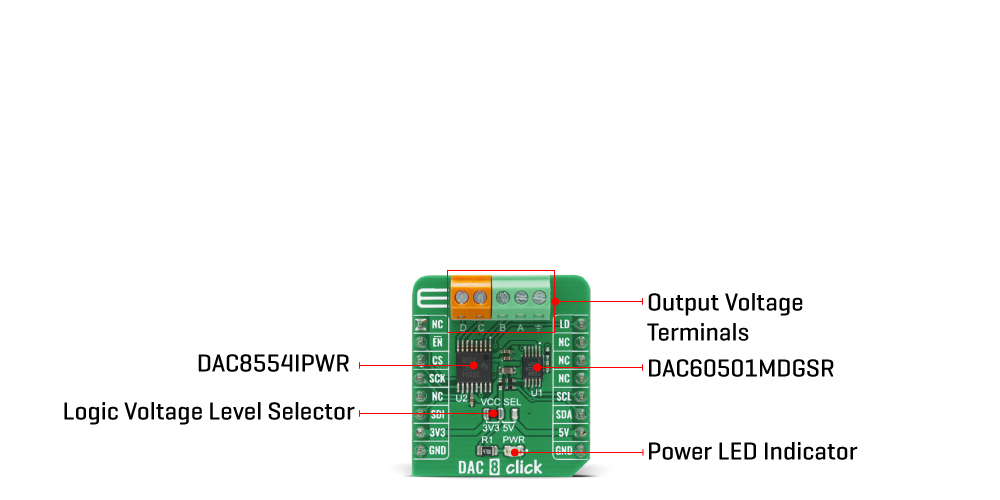
To achieve a fully flexible range of the DAC8554IPWR, an external voltage reference is made user-programmable. For this purpose, the Click board™ uses another DAC, DAC60501MDGSR, 12-bit DAC from Texas Instruments, whose output is brought to the VREF pin of the DAC8554IPWR. That way, the reference voltage of the DAC8554IPWR can be set at any value between 0V and 5V, provides high precision and low power consumption as well. That makes the DAC 8 Click fully customizable solution, well suited for applications where the maximum precision from the output 16-bit DAC is needed. DAC60501MDGSR uses the I2C serial interface to communicate with the MCU and operates at clock rate up to 100kHz.
The DAC 8 Click Board™ communicates with MCU using the 3-Wire SPI serial interface that is compatible with standard SPI, QSPI™, MICROWIRE™ and operates at clock rates up to 50 MHz. Additional functionality such as software simultaneous update capability is implemented and routed at the PWM pin of the mikroBUS™, which allows when new data enter the device, all of DAC outputs can be updated simultaneously and synchronously with the clock. It also possesses enable function routed at CS pin of the mikroBUS™ that is used to connect the SPI interface to the serial port.
The DAC 8 Click Board™ is designed to be operated with both 3.3V and 5V logic levels. The onboard SMD jumper labeled as VCC SEL allows voltage selection for interfacing with both 3.3V and 5V MCUs. More information about the DAC8554IPWR's functionality, electrical specifications, and typical performance can be found in the attached datasheet. However, the Click board™ comes equipped with a library that contains easy-to-use functions, and a usage example that can be used as a reference for the development.
SPECIFICATIONS
| Type |
DAC |
| Applications |
Can be used in battery-operated equipment, digital gain and offset adjustment, programmable voltage and current sources, and many more. |
| On-board modules |
DAC 8 Click is based on the DAC8554IPWR, a 16-bit QUAD channel, ultra-low glitch, voltage-output digital to analog converter from Texas Instruments. |
| Key Features |
Low power consumption, high precission, ultra-low glitch, rail-to-rail voltage output, accuracy, stability, and more. |
| Interface |
I2C,SPI,GPIO |
| Compatibility |
mikroBUS |
| Click board size |
S (28.6 x 25.4 mm) |
| Input Voltage |
3.3V or 5V |
PINOUT DIAGRAM
This table shows how the pinout of the DAC 8 Click Board™ corresponds to the pinout on the mikroBUS™ socket (the latter shown in the two middle columns).
| Notes |
Pin |
 |
Pin |
Notes |
| |
NC |
1 |
AN |
PWM |
16 |
LD |
Software Update |
| SPI Enable |
EN |
2 |
RST |
INT |
15 |
NC |
|
| SPI Chip Select |
CS |
3 |
CS |
RX |
14 |
NC |
|
| SPI Clock |
SCK |
4 |
SCK |
TX |
13 |
NC |
|
| SPI Data OUT |
SDO |
5 |
MISO |
SCL |
12 |
SCL |
I2C Clock |
| SPI Data IN |
SDI |
6 |
MOSI |
SDA |
11 |
SDA |
I2C Data |
| Power Supply |
3.3V |
7 |
3.3V |
5V |
10 |
5V |
Power Supply |
| Ground |
GND |
8 |
GND |
GND |
9 |
GND |
Ground |
ONBOARD SETTINGS AND INDICATORS
| Label |
Name |
Default |
Description |
| LD1 |
PWR |
- |
Power LED Indicator |
| JP1 |
VCC SEL |
Left |
Power Supply Voltage Selection 3V3/5V: Left position 3V3, Right position 5V |
DAC 8 CLICK ELECTRICAL SPECIFICATIONS
| Description |
Min |
Typ |
Max |
Unit |
| Supply Voltage |
-0.3 |
- |
6 |
V |
| Maximum Current Consumption |
- |
- |
208 |
μA |
| SPI Clock Frequency |
- |
- |
50 |
MHz |
| Operating Temperature Range |
-40 |
- |
+105 |
°C |
- description_tag: The DAC 8 Click Board™ is a compact add-on board that contains a fully-featured, general-purpose voltage-output digital-to-analogue converter. Available from Debug Store UK.
- title_tag: MikroE DAC 8 Click Board™ (MIKROE-4229)
- manufacturer: Mikroelektronika d.o.o.
- warranty: 12 months
- amazon_enable: TRUE
- amazon_title: DAC 8 Click Board
- amazon_product_type: computercomponent
- amazon_block: FALSE
- amazon_prime_enable: FALSE
- amazon_search: MikroElektronika Microelectronica MIKROE-1100
- amazon_uk_price: 30.8
- amazon_uk_currency: GBP
- amazon_de_currency: EUR
- amazon_de_price: 34.804
- amazon_fr_currency: EUR
- amazon_fr_price: 34.804
- amazon_es_currency: EUR
- amazon_es_price: 34.804
- amazon_nl_currency: EUR
- amazon_nl_price: 34.804
- amazon_it_currency: EUR
- amazon_it_price: 34.804
- amazon_se_curency: SEK
- amazon_se_price: 351.12
- amazon_product_id: 8606018718924
- amazon_product_id_type: EAN
- amazon_update: Update
- amazon_short_description: DAC 8 Click Board™ is a compact add-on board that contains a fully-featured, general-purpose voltage-output digital-to-analog converter. This board features the DAC8554IPWR, a 16-bit QUAD channel voltage-output digital to analog converter from Texas Instruments. It offers the low-power operation, good linearity, exceptionally low glitch, and supports a 3-wire SPI serial interface with a clock rate up to 50MHz. Requires an external reference voltage provided by I2C compatible DAC60501MDGSR to set the output range of each DAC channel. It has many features that make it attractive for various applications such as battery-operated equipment, digital gain and offset adjustment, programmable voltage and current sources, and many more.DAC 8 Click is supported by a mikroSDK compliant library, which includes functions that simplify software development. This Click board™ comes as a fully tested product, ready to be used on a system equipped with the mikroBUS™ socket.
- amazon_main_image: https://www.thedebugstore.com/images/product/lg-dac-8-click-front.jpg
- amazon_other_image_1: https://www.thedebugstore.com/images/product/lg-dac-8-click-back.jpg
- amazon_other_image_2: https://www.thedebugstore.com/images/product/lg-dac-8-click-fusion.jpg
- amazon_other_image_3: https://www.thedebugstore.com/images/product/lg-dac-8-click-shuttle.jpg
- amazon_other_image_4: https://www.thedebugstore.com/images/product/lg-dac-8-click-clicker.jpg
- amazon_other_image_5: https://www.thedebugstore.com/images/product/lg-dac-8-click-breadboard.jpg
- amazon_other_image_6: https://www.thedebugstore.com/images/product/lg-dac-8-click-breadboard.jpg
- amazon_browse_node: 428655031
- related_products: MIKROE-3827,MIKROE-4153,MIKROE-3869
- mpn: MIKROE-4229
- backorder_label: If no stock shown above, check availability
- google_product_category: 386
- examples:
We provide a library for the DAC 8 Click Board™ on our LibStock page, as well as a demo application (example), developed using MikroElektronika compilers. The demo can run on all the main MikroElektronika development boards.
Library Description
The library covers all the necessary functions to control the DAC 8 Click Board™. A library performs the communication with the DAC60501 via I2C and communication with DAC8554 the SPI interface.
Key Functions
void dac8_generic_i2c_write ( uint8_t reg, uint16_t tx_data ) - Generic I2C ( DAC60501 ) write function.uint16_t dac8_generic_i2c_read ( uint8_t reg ) - Generic I2C ( DAC60501 ) read function.void dac8_generic_spi_write ( uint32_t tx_data ) - Generic SPI ( DAC8554 ) write function.
Example Description
The application is composed of three sections :
- System Initialization - Initializes I2C and SPI and start to write log.
- Application Initialization - Initialization driver enables - I2C. Configure DAC60501: executes call software reset, disable sync and internal reference and disable Power-down mode, the set reference voltage is internally divided by a factor of 2, amplifier for corresponding DAC has a gain of 2. Initialization driver enables - SPI, enable DAC8554, also write log.
- Application Task - (code snippet) This is an example that demonstrates the use of the DAC 8 Click board. DAC 8 board changeing output values: Channel A ~ 2500 mV, Channel B ~ 1250 mV, Channel C ~ 625 mV, Channel D ~ 312 mV. All data logs write on USB uart changes every 5 sec.
void application_task ( )
{
    mikrobus_logWrite( "---------------------", _LOG_LINE );

    cfg_dac.addr = DAC8_ADDR_DEFAULT;
    cfg_dac.ctrl_upd_an_out = DAC8_CTRL_UPD_AN_OUT_SINGLE_CH_STORE;
    cfg_dac.dac_sel = DAC8_DAC_SEL_CH_A;
    cfg_dac.pwr_mode = DAC8_PWR_MODE_POWER_UP;
    cfg_dac.dac_val = 0xFFFF;

    mikrobus_logWrite( " Channel A ~ 2500 mV ", _LOG_LINE );
    dac8_device_config( cfg_dac );
    dac8_load_dac( );
    Delay_ms( 5000 );

    mikrobus_logWrite( "---------------------", _LOG_LINE );

    cfg_dac.addr = DAC8_ADDR_DEFAULT;
    cfg_dac.ctrl_upd_an_out = DAC8_CTRL_UPD_AN_OUT_SINGLE_CH_STORE;
    cfg_dac.dac_sel = DAC8_DAC_SEL_CH_B;
    cfg_dac.pwr_mode = DAC8_PWR_MODE_POWER_UP;
    cfg_dac.dac_val = 0x7FFF;

    mikrobus_logWrite( " Channel B ~ 1250 mV ", _LOG_LINE );
    dac8_device_config( cfg_dac );
    dac8_load_dac( );
    Delay_ms( 5000 );

    mikrobus_logWrite( "---------------------", _LOG_LINE );

    cfg_dac.addr = DAC8_ADDR_DEFAULT;
    cfg_dac.ctrl_upd_an_out = DAC8_CTRL_UPD_AN_OUT_SINGLE_CH_STORE;
    cfg_dac.dac_sel = DAC8_DAC_SEL_CH_C;
    cfg_dac.pwr_mode = DAC8_PWR_MODE_POWER_UP;
    cfg_dac.dac_val = 0x3FFF;

    mikrobus_logWrite( " Channel C ~  625 mV ", _LOG_LINE );
    dac8_device_config( cfg_dac );
    dac8_load_dac( );
    Delay_ms( 5000 );

    mikrobus_logWrite( "---------------------", _LOG_LINE );

    cfg_dac.addr = DAC8_ADDR_DEFAULT;
    cfg_dac.ctrl_upd_an_out = DAC8_CTRL_UPD_AN_OUT_SINGLE_CH_STORE;
    cfg_dac.dac_sel = DAC8_DAC_SEL_CH_D;
    cfg_dac.pwr_mode = DAC8_PWR_MODE_POWER_UP;
    cfg_dac.dac_val = 0x1FFF;

    mikrobus_logWrite( " Channel D ~  312 mV", _LOG_LINE );
    dac8_device_config( cfg_dac );
    dac8_load_dac( );
    Delay_ms( 5000 );
}
The full application code, and ready to use projects can be found on our LibStock page.
Other mikroE Libraries used in the example:
Additional Notes and Information
Depending on the development board you are using, you may need USB UART click, USB UART 2 click or RS232 click to connect to your PC, for development systems with no UART to USB interface available on the board. The terminal available in all MikroElektronika compilers, or any other terminal application of your choice, can be used to read the message.
MIKROSDK
The DAC 8 Click Board™ is supported with mikroSDK - MikroElektronika Software Development Kit. To ensure proper operation of mikroSDK compliant Click board™ demo applications, mikroSDK should be downloaded from the LibStock and installed for the compiler you are using.
- attachments: [{"download_file":[{"download_file":"DAC 8 Click Board™ Schematic"}],"download_filetype":[{"download_filetype":"pdf"}]},{"download_file":[{"download_file":"Texas Instruments DAC60501MDGSR 16-Bit DAC Datasheet"}],"download_filetype":[{"download_filetype":"pdf"}]},{"download_file":[{"download_file":"Texas Instruments DAC8554IPWR Quad, 16-Bit DAC Datasheet"}],"download_filetype":[{"download_filetype":"pdf"}]}]
- condition: new
- custom_product: false
- mpn: MIKROE-4229
- google_product_category: Electronics
- custom_label_0: Click Board
- key_feature_1: Quad, 16-Bit D/A Converter
- key_feature_2: Low power consumption, high precission, ultra-low glitch, rail-to-rail voltage output, accuracy, stability, and more.
- key_feature_3: Based on the DAC 8 Click is based on the DAC8554IPWR, a 16-bit QUAD channel, ultra-low glitch, voltage-output digital to analogue converter from Texas Instruments.
- key_feature_4: Can be used in battery-operated equipment, digital gain and offset adjustment, programmable voltage and current sources, and many more.
- key_feature_5: mikroBUS: I2C, SPI and GPIO Interfaces
- device_vendor: Texas Instruments
- device_type: DAC60501MDGSR, DAC8554IPWR
- warranty: 12 months
- brand: MikroE
- manufacturer: Mikroelektronika d.o.o.
- badge: No reviews
- widget:
- target_keyword: DAC 8 Click Board
- brands: gid://shopify/Metaobject/56256004319
- breadcrumbs: ["gid://shopify/Collection/447955239135","gid://shopify/Collection/241680580797","gid://shopify/Collection/241545314493"]
- customhs_code: 847330
- detailed_description: {"type":"root","children":[{"type":"heading","level":3,"children":[{"type":"text","value":"How Does The DAC 8 Click Board™ Work?"}]},{"type":"paragraph","children":[{"type":"text","value":"The "},{"type":"text","value":"DAC 8 Click Board™","bold":true,"italic":true},{"type":"text","value":" is based on the DAC8554IPWR, a 16-bit QUAD channel, ultra-low glitch, voltage-output digital to analog converter from Texas Instruments. It offers good linearity, exceptionally low glitch, and it has high precision output amplifier that allows rail-to-rail output swing over a wide range of supply voltage. What this component additionally has is a Power-On reset function, which ensures that DAC outputs power-up at zero-scale and remains there until a proper write operation occurs. Also, it provides a power-down feature that reduces the current consumption to 175nA per channel."}]},{"type":"paragraph","children":[{"type":"text","value":""}]},{"type":"paragraph","children":[{"type":"text","value":"To achieve a fully flexible range of the DAC8554IPWR, an external voltage reference is made user-programmable. For this purpose, the Click board™ uses another DAC, DAC60501MDGSR, 12-bit DAC from Texas Instruments, whose output is brought to the VREF pin of the DAC8554IPWR. That way, the reference voltage of the DAC8554IPWR can be set at any value between 0V and 5V, provides high precision and low power consumption as well. That makes the DAC 8 Click fully customizable solution, well suited for applications where the maximum precision from the output 16-bit DAC is needed. DAC60501MDGSR uses the I2C serial interface to communicate with the MCU and operates at clock rate up to 100kHz."}]},{"type":"paragraph","children":[{"type":"text","value":"The "},{"type":"text","value":"DAC 8 Click Board™","bold":true},{"type":"text","value":" communicates with MCU using the 3-Wire SPI serial interface that is compatible with standard SPI, QSPI™, MICROWIRE™ and operates at clock rates up to 50 MHz. Additional functionality such as software simultaneous update capability is implemented and routed at the PWM pin of the mikroBUS™, which allows when new data enter the device, all of DAC outputs can be updated simultaneously and synchronously with the clock. It also possesses enable function routed at CS pin of the mikroBUS™ that is used to connect the SPI interface to the serial port."}]},{"type":"paragraph","children":[{"type":"text","value":"The "},{"type":"text","value":"DAC 8 Click Board™","bold":true},{"type":"text","value":" is designed to be operated with both 3.3V and 5V logic levels. The onboard SMD jumper labeled as VCC SEL allows voltage selection for interfacing with both 3.3V and 5V MCUs. More information about the DAC8554IPWR's functionality, electrical specifications, and typical performance can be found in the attached datasheet. However, the Click board™ comes equipped with a library that contains easy-to-use functions, and a usage example that can be used as a reference for the development."}]},{"type":"heading","level":3,"children":[{"type":"text","value":"SPECIFICATIONS"}]},{"type":"paragraph","children":[{"type":"text","value":"Type\nDAC\nApplications\nCan be used in battery-operated equipment, digital gain and offset adjustment, programmable voltage and current sources, and many more.\nOn-board modules\nDAC 8 Click is based on the DAC8554IPWR, a 16-bit QUAD channel, ultra-low glitch, voltage-output digital to analog converter from Texas Instruments.\nKey Features\nLow power consumption, high precission, ultra-low glitch, rail-to-rail voltage output, accuracy, stability, and more.\nInterface\nI2C,SPI,GPIO\nCompatibility\nmikroBUS\nClick board size\nS (28.6 x 25.4 mm)\nInput Voltage\n3.3V or 5V"}]},{"type":"paragraph","children":[{"type":"text","value":" "}]},{"type":"heading","level":3,"children":[{"type":"text","value":"PINOUT DIAGRAM"}]},{"type":"paragraph","children":[{"type":"text","value":"This table shows how the pinout of the "},{"type":"text","value":"DAC 8 Click Board™","bold":true},{"type":"text","value":" corresponds to the pinout on the mikroBUS™ socket (the latter shown in the two middle columns)."}]},{"type":"paragraph","children":[{"type":"text","value":"Notes\nPin\nPin\nNotes\nNC\n1\nAN\nPWM\n16\nLD\nSoftware Update\nSPI Enable\nEN\n2\nRST\nINT\n15\nNC\nSPI Chip Select\nCS\n3\nCS\nRX\n14\nNC\nSPI Clock\nSCK\n4\nSCK\nTX\n13\nNC\nSPI Data OUT\nSDO\n5\nMISO\nSCL\n12\nSCL\nI2C Clock\nSPI Data IN\nSDI\n6\nMOSI\nSDA\n11\nSDA\nI2C Data\nPower Supply\n3.3V\n7\n3.3V\n5V\n10\n5V\nPower Supply\nGround\nGND\n8\nGND\nGND\n9\nGND\nGround"}]},{"type":"heading","level":3,"children":[{"type":"text","value":"ONBOARD SETTINGS AND INDICATORS"}]},{"type":"paragraph","children":[{"type":"text","value":"Label\nName\nDefault\n Description\nLD1\nPWR\n-\nPower LED Indicator\nJP1\nVCC SEL\nLeft\nPower Supply Voltage Selection 3V3/5V: Left position 3V3, Right position 5V"}]},{"type":"heading","level":3,"children":[{"type":"text","value":"DAC 8 CLICK ELECTRICAL SPECIFICATIONS"}]},{"type":"paragraph","children":[{"type":"text","value":"Description\nMin\nTyp\nMax\nUnit\nSupply Voltage\n-0.3\n-\n6\nV\nMaximum Current Consumption\n-\n-\n208\nμA\nSPI Clock Frequency\n-\n-\n50\nMHz\nOperating Temperature Range\n-40\n-\n+105\n°C"}]},{"type":"heading","level":3,"children":[{"type":"text","value":" "}]}]}
- summary: The DAC 8 Click Board™ is a compact add-on board that contains a fully-featured, general-purpose voltage-output digital-to-analogue converter. This board features the DAC8554IPWR, a 16-bit QUAD channel voltage-output digital to analogue converter from Texas Instruments. It offers a low-power operation, good linearity, exceptionally low glitch, and supports a 3-wire SPI serial interface with a clock rate up to 50MHz. Requires an external reference voltage provided by I2C compatible DAC60501MDGSR to set the output range of each DAC channel. It has many features that make it attractive for various applications such as battery-operated equipment, digital gain and offset adjustment, programmable voltage and current sources, and many more.
The DAC 8 Click Board™ is supported by a mikroSDK compliant library, which includes functions that simplify software development. This Click Board™ comes as a fully tested product, ready to be used on a system equipped with the mikroBUS™ socket.