# Title: Force 4 Click Board™
## Description: How Does The Force 4 Click Board™ Work? The Force 4 Click Board™ work in the same way as our air (atmospheric) pressure sensors, using the piezoresistive method. They detect loads (force) with a piezoresistive element manufactured using MEMS processes. Force sensors differ from air pressure sensors in that they have a thicker diaphragm, allowing detection of only relatively large changes in pressure, like from loads, while very subtle fluctuations, such as changes in air pressure, do not affect the output. Force 4 Click utilizes an additional IC. It uses the MCP3221, a 12-bit successive approximation A/D converter (ADC) with I2C Interface, from Microchip. It is used to sample the output voltage from the sensor, providing data for the microcontroller (MCU) or some other device capable of communicating over the I2C bus. The voltage is sampled to a 12-bit value using the MCP1101-33 as the voltage reference. If analog voltage is preferred to be red directly by the MCU, it can be easily done by adding 0 ohm resistor on J1 marked position on PCB, and the sensor output voltage will be available for reading on AN pin of mikroBUS™. The Force 4 Click Board™ features the smallest force sensors in the industry with dimensions compact enough which makes it a perfect solution for developing a fine-diameter stylus pen. SPECIFICATIONS Type Force Applications Fine-diameter stylus pen development, load and compression sensing, variable tension control and many more On-board modules HSFPAR003A Key Features High sensitivity and good linearity, precisely detect micro force less than 0.01 N. no characteristics change after 1 million cycles Interface Analog,I2C Compatibility mikroBUS Click board size S (28.6 x 25.4 mm) Input Voltage 3.3V PINOUT DIAGRAM This table shows how the pinout of the Force 4 Click Board™ corresponds to the pinout on the mikroBUS™ socket (the latter shown in the two middle columns). Notes Pin Pin Notes Analog AN 1 AN PWM 16 NC NC 2 RST INT 15 NC NC 3 CS RX 14 NC NC 4 SCK TX 13 NC NC 5 MISO SCL 12 SCL I2C Clock NC 6 MOSI SDA 11 SDA I2C Data Power Supply 3.3V 7 3.3V 5V 10 NC Ground GND 8 GND GND 9 GND Ground ONBOARD SETTINGS AND INDICATORS Label Name Default Description PWR LD1 - Power LED Indicator J1 - NP Jumper for direct analog voltage reading from sensor
## Product type: Click Board
## Vendor: Mikroelektronika d.o.o.
## Tags: Click Board, Force, MikroE, Sensor
## Price range: 18.2 - 18.2 GBP
## Link: https://thedebugstore.com/products/mikroe-4193-force-4-click-board-uk
## Compare-at price range: 26.0 - 26.0 GBP
## Options
- Title: Default Title
## Collections
- [New Products](https://thedebugstore.com/a/llms/collections/new-products-debug-store)
- [Mikroelektronika d.o.o. (MikroE)](https://thedebugstore.com/a/llms/collections/mikroelektronika-catalogue-uk)
- [Sensor Click Boards™](https://thedebugstore.com/a/llms/collections/sensor-click-boards-catalogue)
- [MikroE Click Boards™](https://thedebugstore.com/a/llms/collections/mikroe-click-boards-catalogue-uk)
- [Force Sensor Click Boards™](https://thedebugstore.com/a/llms/collections/force-sensor-click-boards-catalogue)
- [Click Boards™ Summer Sale](https://thedebugstore.com/a/llms/collections/inventory-sale)
- [MikroE Sale](https://thedebugstore.com/a/llms/collections/mikroe-sale)
- [MIKROE Stock](https://thedebugstore.com/a/llms/collections/mikroe-products-in-stock-sale)
## Variants
- Default Title, SKU: MIKROE-4193, Available: yes, Inventory: 1
## Metafields
- full_description: How Does The Force 4 Click Board™ Work?
The Force 4 Click Board™ work in the same way as our air (atmospheric) pressure sensors, using the piezoresistive method. They detect loads (force) with a piezoresistive element manufactured using MEMS processes. Force sensors differ from air pressure sensors in that they have a thicker diaphragm, allowing detection of only relatively large changes in pressure, like from loads, while very subtle fluctuations, such as changes in air pressure, do not affect the output.
.jpg)
Force 4 Click utilizes an additional IC. It uses the MCP3221, a 12-bit successive approximation A/D converter (ADC) with I2C Interface, from Microchip. It is used to sample the output voltage from the sensor, providing data for the microcontroller (MCU) or some other device capable of communicating over the I2C bus. The voltage is sampled to a 12-bit value using the MCP1101-33 as the voltage reference.
If analog voltage is preferred to be red directly by the MCU, it can be easily done by adding 0 ohm resistor on J1 marked position on PCB, and the sensor output voltage will be available for reading on AN pin of mikroBUS™.
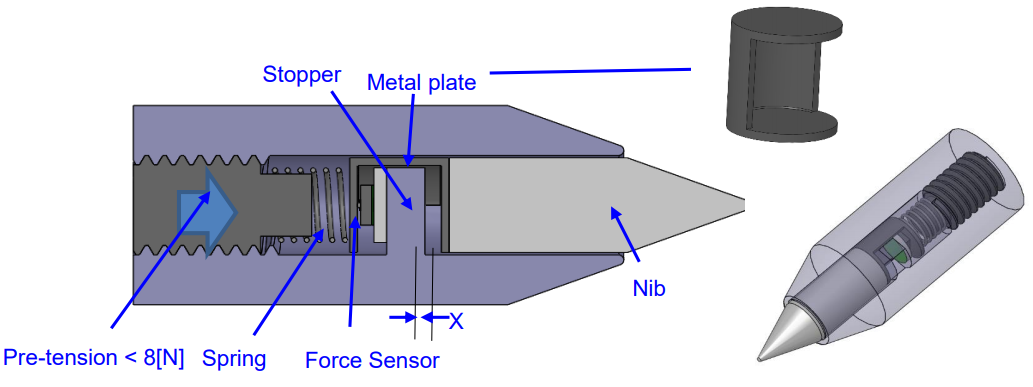
The Force 4 Click Board™ features the smallest force sensors in the industry with dimensions compact enough which makes it a perfect solution for developing a fine-diameter stylus pen.
SPECIFICATIONS
| Type |
Force |
| Applications |
Fine-diameter stylus pen development, load and compression sensing, variable tension control and many more |
| On-board modules |
HSFPAR003A |
| Key Features |
High sensitivity and good linearity, precisely detect micro force less than 0.01 N. no characteristics change after 1 million cycles |
| Interface |
Analog,I2C |
| Compatibility |
mikroBUS |
| Click board size |
S (28.6 x 25.4 mm) |
| Input Voltage |
3.3V |
PINOUT DIAGRAM
This table shows how the pinout of the Force 4 Click Board™ corresponds to the pinout on the mikroBUS™ socket (the latter shown in the two middle columns).
| Notes |
Pin |
 |
Pin |
Notes |
| Analog |
AN |
1 |
AN |
PWM |
16 |
NC |
| NC |
2 |
RST |
INT |
15 |
NC |
| NC |
3 |
CS |
RX |
14 |
NC |
| NC |
4 |
SCK |
TX |
13 |
NC |
| NC |
5 |
MISO |
SCL |
12 |
SCL |
I2C Clock |
| NC |
6 |
MOSI |
SDA |
11 |
SDA |
I2C Data |
| Power Supply |
3.3V |
7 |
3.3V |
5V |
10 |
NC |
| Ground |
GND |
8 |
GND |
GND |
9 |
GND |
Ground |
ONBOARD SETTINGS AND INDICATORS
| Label |
Name |
Default |
Description |
| PWR |
LD1 |
- |
Power LED Indicator |
| J1 |
- |
NP |
Jumper for direct analog voltage reading from sensor |
- description_tag: The Force 4 Click Board™ Board is based on HSFPAR003A piezoresistive force sensor from Alpsalpine. This product is a force sensor using the effect of a piezoresistive bridge circuit formed on a silicon diaphragm. Available from Debug Store UK.
- title_tag: MikroE Force 4 Click Board™ (MIKROE-4193)
- manufacturer: Mikroelektronika d.o.o.
- warranty: 12 months
- amazon_enable: TRUE
- amazon_title: Force 4 Click Board
- amazon_product_type: computercomponent
- amazon_block: FALSE
- amazon_prime_enable: FALSE
- amazon_search: MikroElektronika Microelectronica MIKROE-1100
- amazon_uk_price: 25.52
- amazon_uk_currency: GBP
- amazon_de_currency: EUR
- amazon_de_price: 28.8376
- amazon_fr_currency: EUR
- amazon_fr_price: 28.8376
- amazon_es_currency: EUR
- amazon_es_price: 28.8376
- amazon_nl_currency: EUR
- amazon_nl_price: 28.8376
- amazon_it_currency: EUR
- amazon_it_price: 28.8376
- amazon_se_curency: SEK
- amazon_se_price: 290.928
- amazon_product_id: 8606018717934
- amazon_product_id_type: EAN
- amazon_update: Update
- amazon_short_description: The Force 4 Click Board™ Board is based on HSFPAR003A piezoresistive force sensor from Alpsalpine. This product is a force sensor using the effect of a piezoresistive bridge circuit formed on silicon diaphragm. Piezoresistive force sensors achieve higher linearity than other force sensors. To help with stability and accuracy Force 4 Click Board™ also includes MCP1101-33 a high precision buffered voltage reference as a power supply to a force sensor that allows high stability and accuracy of output voltage readings.
- amazon_long_description: How Does The Force 4 Click Board Work?
The Force 4 Click Board works in the same way as our air (atmospheric) pressure sensors, using the piezoresistive method. They detect loads (force) with a piezoresistive element manufactured using MEMS processes. Force sensors differ from air pressure sensors in that they have a thicker diaphragm, allowing detection of only relatively large changes in pressure, like from loads, while very subtle fluctuations, such as changes in air pressure, do not affect the output.

Force 4 Click utilizes an additional IC. It uses the MCP3221, a 12-bit successive approximation A/D converter (ADC) with I2C Interface, from Microchip. It is used to sample the output voltage from the sensor, providing data for the microcontroller (MCU) or some other device capable of communicating over the I2C bus. The voltage is sampled to a 12-bit value using the MCP1101-33 as the voltage reference.
If analog voltage is preferred to be red directly by the MCU, it can be easily done by adding 0 ohm resistor on J1 marked position on PCB, and the sensor output voltage will be available for reading on AN pin of mikroBUS™.

Force 4 Click features the smallest force sensors in the industry with dimensions compact enough which makes it a perfect solution for developing a fine-diameter stylus pen.
- amazon_main_image: https://www.thedebugstore.com/images/product/lg-force-4-click-front.jpg
- amazon_other_image_1: https://www.thedebugstore.com/images/product/lg-force-4-click-back.jpg
- amazon_other_image_2: https://www.thedebugstore.com/images/product/lg-force-4-click-fusion.jpg
- amazon_other_image_3: https://www.thedebugstore.com/images/product/lg-force-4-click-clicker.jpg
- amazon_other_image_4: https://www.thedebugstore.com/images/product/lg-force-4-click-shuttle.jpg
- amazon_other_image_5: https://www.thedebugstore.com/images/product/lg-force-4-click-breadboard.jpg
- amazon_other_image_6: https://www.thedebugstore.com/images/product/lg-force-4-click-breadboard.jpg
- amazon_browse_node: 428655031
- mpn: MIKROE-4193
- backorder_label: If no stock shown above, check availability
- google_product_category: 222
- condition: new
- custom_product: false
- mpn: MIKROE-4193
- google_product_category: Electronics
- custom_label_0: Click Board
- examples:
We provide a library for the Force 4 Click Board™ on our LibStock page, as well as a demo application (example), developed using MikroElektronika compilers. The demo can run on all the main MikroElektronika development boards.
Library Description
Library provides function for reading raw ADC data from device.
Key Functions
uint16_t force4_read_adc( void ) - Reading raw 12 bit ADC data
Example Description
The application is composed of three sections :
- System Initialization - Initialization of I2C communication
- Application Initialization - Mapping pins on selected MIKROBUS
- Application Task - Every 100ms read 12bit adc value from dev
void application_task ( )
{
 uint16_t adc_val;
 char demo_txt[ 30 ] = "";
 adc_val = force4_read_adc( );
 WordToStr( adc_val, demo_txt );
 mikrobus_logWrite( "-ADC: ", _LOG_TEXT );
 mikrobus_logWrite( demo_txt, _LOG_LINE );

 Delay_ms( 100 );
}
The full application code, and ready to use projects can be found on our LibStock page.
Other mikroE Libraries used in the example:
Additional Notes and Information
Depending on the development board you are using, you may need USB UART Click Board™, USB UART 2 Click Board™ or RS232 Click Board™ to connect to your PC, for development systems with no UART to USB interface available on the board. The terminal available in all MikroElektronika compilers, or any other terminal application of your choice, can be used to read the message.
MIKROSDK
The Force 4 Click Board™ is supported with mikroSDK - MikroElektronika Software Development Kit. To ensure proper operation of mikroSDK compliant Click board™ demo applications, mikroSDK should be downloaded from the LibStock and installed for the compiler you are using.
- attachments: [{"download_file":[{"download_file":"Force 4 Click Board™ Schematic"}],"download_filetype":[{"download_filetype":"pdf"}]},{"download_file":[{"download_file":"Alpsalpine HSFPAR003A Piezoresistive Force Sensor Datasheet"}],"download_filetype":[{"download_filetype":"pdf"}]}]
- device_vendor: ALPS, Microchip Technology
- device_type: HSFPAR003A, MCP1501T-33E/RW, MCP3221A5T-E/OT
- warranty: 12 months
- brand: MikroE
- manufacturer: Mikroelektronika d.o.o.
- badge: No reviews
- widget:
- target_keyword: Force 4 Click Board
- brands: gid://shopify/Metaobject/56256004319
- breadcrumbs: ["gid://shopify/Collection/447955239135","gid://shopify/Collection/241680580797","gid://shopify/Collection/241545969853"]
- customhs_code: 847330
- detailed_description: {"type":"root","children":[{"type":"heading","level":3,"children":[{"type":"text","value":"How Does The Force 4 Click Board™ Work?"}]},{"type":"paragraph","children":[{"type":"text","value":"The "},{"type":"text","value":"Force 4 Click Board™","bold":true},{"type":"text","value":" work in the same way as our air (atmospheric) pressure sensors, using the piezoresistive method. They detect loads (force) with a piezoresistive element manufactured using MEMS processes. Force sensors differ from air pressure sensors in that they have a thicker diaphragm, allowing detection of only relatively large changes in pressure, like from loads, while very subtle fluctuations, such as changes in air pressure, do not affect the output."}]},{"type":"paragraph","children":[{"type":"text","value":""}]},{"type":"paragraph","children":[{"type":"text","value":"Force 4 Click utilizes an additional IC. It uses the MCP3221, a 12-bit successive approximation A/D converter (ADC) with I2C Interface, from Microchip. It is used to sample the output voltage from the sensor, providing data for the microcontroller (MCU) or some other device capable of communicating over the I2C bus. The voltage is sampled to a 12-bit value using the MCP1101-33 as the voltage reference."}]},{"type":"paragraph","children":[{"type":"text","value":"If analog voltage is preferred to be red directly by the MCU, it can be easily done by adding 0 ohm resistor on J1 marked position on PCB, and the sensor output voltage will be available for reading on AN pin of mikroBUS™."}]},{"type":"paragraph","children":[{"type":"text","value":""}]},{"type":"paragraph","children":[{"type":"text","value":"The "},{"type":"text","value":"Force 4 Click Board™","bold":true},{"type":"text","value":" features the smallest force sensors in the industry with dimensions compact enough which makes it a perfect solution for developing a fine-diameter stylus pen."}]},{"type":"heading","level":3,"children":[{"type":"text","value":"SPECIFICATIONS"}]},{"type":"paragraph","children":[{"type":"text","value":"Type\nForce\nApplications\nFine-diameter stylus pen development, load and compression sensing, variable tension control and many more\nOn-board modules\nHSFPAR003A\nKey Features\nHigh sensitivity and good linearity, precisely detect micro force less than 0.01 N. no characteristics change after 1 million cycles\nInterface\nAnalog,I2C\nCompatibility\nmikroBUS\nClick board size\nS (28.6 x 25.4 mm)\nInput Voltage\n3.3V"}]},{"type":"heading","level":3,"children":[{"type":"text","value":"PINOUT DIAGRAM"}]},{"type":"paragraph","children":[{"type":"text","value":"This table shows how the pinout of the "},{"type":"text","value":"Force 4 Click Board™","bold":true},{"type":"text","value":" corresponds to the pinout on the mikroBUS™ socket (the latter shown in the two middle columns)."}]},{"type":"paragraph","children":[{"type":"text","value":"Notes\nPin\nPin\nNotes\nAnalog\nAN\n1\nAN\nPWM\n16\nNC\nNC\n2\nRST\nINT\n15\nNC\nNC\n3\nCS\nRX\n14\nNC\nNC\n4\nSCK\nTX\n13\nNC\nNC\n5\nMISO\nSCL\n12\nSCL\nI2C Clock\nNC\n6\nMOSI\nSDA\n11\nSDA\nI2C Data\nPower Supply\n3.3V\n7\n3.3V\n5V\n10\nNC\nGround\nGND\n8\nGND\nGND\n9\nGND\nGround"}]},{"type":"heading","level":3,"children":[{"type":"text","value":"ONBOARD SETTINGS AND INDICATORS"}]},{"type":"paragraph","children":[{"type":"text","value":"Label\nName\nDefault\nDescription\nPWR\nLD1\n-\nPower LED Indicator\nJ1\n-\nNP\nJumper for direct analog voltage reading from sensor"}]},{"type":"heading","level":3,"children":[{"type":"text","value":" "}]}]}
- summary: The Force 4 Click Board™ is based on HSFPAR003A piezoresistive force sensor from Alpsalpine. This product is a force sensor using the effect of a piezoresistive bridge circuit formed on a silicon diaphragm. Piezoresistive force sensors achieve higher linearity than other force sensors.
To help with stability and accuracy Force 4 Click Board™ also includes MCP1101-33 a high precision buffered voltage reference as a power supply to a force sensor that allows high stability and accuracy of output voltage readings.