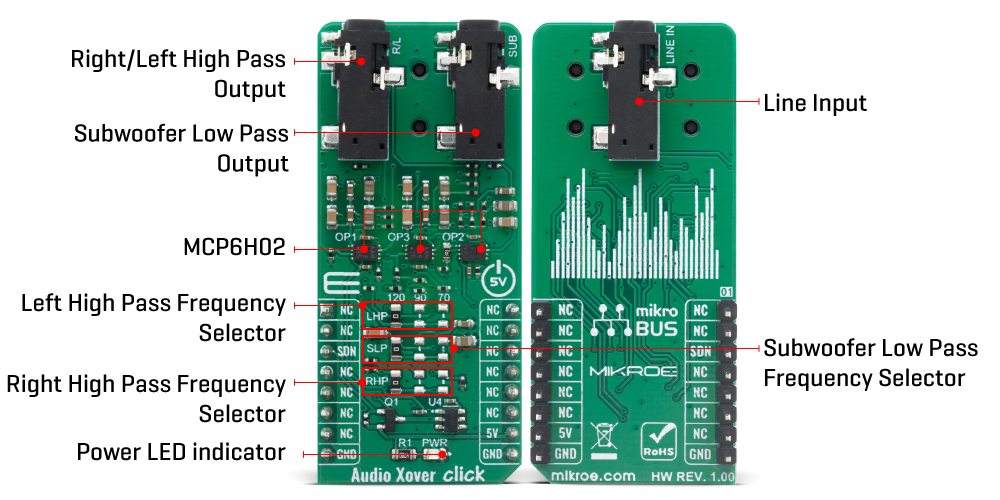
The Audio Xover Click Board™ uses three Butterworth filters (one for each speaker) with possibility of changing cutoff frequency between 120Hz, 90Hz and 70Hz. Butterworth filters are called maximally flat filters because, for a given order, they have the sharpest roll-off possible without inducing peaking in the Bode plot. The two-pole filter with a damping ratio of 0.707 is the second-order Butterworth filter.
Audio crossovers are a type of electronic filter circuitry used in a range of audio applications, to split up an audio signal into two or more frequency ranges, so that the signals can be sent to drivers that are designed for different frequency ranges.
Active crossovers are distinguished from passive crossovers in that whereas passive crossovers split up an amplified signal coming from one power amplifier so that it can be sent to two or more drivers (e.g., a woofer and a very low frequency subwoofer, or a woofer and a tweeter), an active crossover splits up audio signal prior to amplification, so that it can be sent to two or more power amplifiers, each of which is connected to a separate driver type.
Active crossovers as Audio Xover Click don't care how powerful your amplifiers are because they process the signal before it enters the amplifier. Active crossovers are also not very sensitive to temperature variations, so they can be very accurate, all the time. If one of the amplifiers channels in an active crossover system clips, the distortion only affects that single channel.
| Type | Signal Processing |
| Applications | Audio crossover |
| On-board modules | MCP6H012 |
| Key Features | A frequency response independent of the dynamic changes in a driver's electrical characteristics, power amplifiers are directly connected to the speaker drivers, individual channel cutoff frequency selection... |
| Interface | GPIO |
| Compatibility | mikroBUS |
| Click board size | L (57.15 x 25.4 mm) |
| Input Voltage | 5V |
This table shows how the pinout on Audio Xover Click corresponds to the pinout on the mikroBUS™ socket (the latter shown in the two middle columns).
| Notes | Pin |  |
Pin | Notes | |||
|---|---|---|---|---|---|---|---|
| NC | 1 | AN | PWM | 16 | NC | ||
| NC | 2 | RST | INT | 15 | NC | ||
| Shutdown | SDN | 3 | CS | RX | 14 | NC | |
| NC | 4 | SCK | TX | 13 | NC | ||
| NC | 5 | MISO | SCL | 12 | NC | ||
| NC | 6 | MOSI | SDA | 11 | NC | ||
| NC | 7 | 3.3V | 5V | 10 | 5V | Power Supply | |
| Ground | GND | 8 | GND | GND | 9 | GND | Ground |
| Label | Name | Default | Description |
|---|---|---|---|
| PWR | LED GREEN | - | Power LED Indicator |
| LHP | SL1 | Left | Left channel high pass cutoff frequency selector; Left: 120Hz |
| SLP | SW1 | Left | Subwoofer channel low pass cutoff frequency selector; Middle: 90Hz |
| RHP | SR1 | Left | Right channel high pass cutoff frequency selector; Right: 70Hz |
We provide a library for the Audio Xover Click on our LibStock page, as well as a demo application (example), developed using MikroElektronika compilers. The demo can run on all the main MikroElektronika development boards.
Library contains function for enable and disable module.
void audioxover_set_mode( uint8_t state ) - This function set CS pin on 1 ( ENABLE ) and 0 ( DISABLE )The application is composed of three sections :
void application_task ( )
{
 mikrobus_logWrite( "***ENABLE****", _LOG_LINE );
 audioxover_set_mode( AUDIOXOVER_ENABLE );
 Delay_ms( 3000 );
 mikrobus_logWrite( "***DISABLE****", _LOG_LINE );
 audioxover_set_mode( AUDIOXOVER_DISABLE );
 Delay_ms( 3000 );
}
The full application code, and ready to use projects can be found on our LibStock page.
Other mikroE Libraries used in the example:
Depending on the development board you are using, you may need USB UART click, USB UART 2 click or RS232 click to connect to your PC, for development systems with no UART to USB interface available on the board. The terminal available in all MikroElektronika compilers, or any other terminal application of your choice, can be used to read the message.
This Click board™ is supported with mikroSDK - MikroElektronika Software Development Kit. To ensure proper operation of mikroSDK compliant Click board™ demo applications, mikroSDK should be downloaded from the LibStock and installed for the compiler you are using.
- attachments: [{"download_file":[{"download_file":"Audio XOver Click Board™ Schematic"}],"download_filetype":[{"download_filetype":"pdf"}]},{"download_file":[{"download_file":"Microchip MCP6G012 Operational Amplifier Datasheet"}],"download_filetype":[{"download_filetype":"pdf"}]}] - condition: new - custom_product: false - mpn: MIKROE-4104 - google_product_category: Electronics - custom_label_0: Click Board - device_vendor: Analog Devices Inc., Microchip Technology - device_type: ADM8829ARTZ-REEL7, MCP6H02T-E/MNY - warranty: 12 months - brand: MikroE - key_feature_1: Active Loudspeaker Crossover - manufacturer: Mikroelektronika d.o.o. - target_keyword: Audio XOver Click Board - brands: gid://shopify/Metaobject/56256004319 - breadcrumbs: ["gid://shopify/Collection/447955239135","gid://shopify/Collection/241680580797","gid://shopify/Collection/241544298685"] - customhs_code: 847330 - detailed_description: {"type":"root","children":[{"type":"heading","level":3,"children":[{"type":"text","value":"How Does The Audio Xover Click Board™ Work"}]},{"type":"paragraph","children":[{"type":"text","value":"The "},{"type":"text","value":"Audio Xover Click Board™","bold":true},{"type":"text","value":" uses three Butterworth filters (one for each speaker) with possibility of changing cutoff frequency between 120Hz, 90Hz and 70Hz. Butterworth filters are called maximally flat filters because, for a given order, they have the sharpest roll-off possible without inducing peaking in the Bode plot. The two-pole filter with a damping ratio of 0.707 is the second-order Butterworth filter."}]},{"type":"paragraph","children":[{"type":"text","value":""}]},{"type":"paragraph","children":[{"type":"text","value":"Audio crossovers are a type of electronic filter circuitry used in a range of audio applications, to split up an audio signal into two or more frequency ranges, so that the signals can be sent to drivers that are designed for different frequency ranges."}]},{"type":"paragraph","children":[{"type":"text","value":"Active crossovers are distinguished from passive crossovers in that whereas passive crossovers split up an amplified signal coming from one power amplifier so that it can be sent to two or more drivers (e.g., a woofer and a very low frequency subwoofer, or a woofer and a tweeter), an active crossover splits up audio signal prior to amplification, so that it can be sent to two or more power amplifiers, each of which is connected to a separate driver type."}]},{"type":"paragraph","children":[{"type":"text","value":"Active crossovers as Audio Xover Click don't care how powerful your amplifiers are because they process the signal before it enters the amplifier. Active crossovers are also not very sensitive to temperature variations, so they can be very accurate, all the time. If one of the amplifiers channels in an active crossover system clips, the distortion only affects that single channel."}]},{"type":"heading","level":3,"children":[{"type":"text","value":"SPECIFICATIONS"}]},{"type":"paragraph","children":[{"type":"text","value":"Type\nSignal Processing\nApplications\nAudio crossover\nOn-board modules\nMCP6H012\nKey Features\nA frequency response independent of the dynamic changes in a driver's electrical characteristics, power amplifiers are directly connected to the speaker drivers, individual channel cutoff frequency selection...\nInterface\nGPIO\nCompatibility\nmikroBUS\nClick board size\nL (57.15 x 25.4 mm)\nInput Voltage\n5V"}]},{"type":"paragraph","children":[{"type":"text","value":" "}]},{"type":"heading","level":3,"children":[{"type":"text","value":"PINOUT DIAGRAM"}]},{"type":"paragraph","children":[{"type":"text","value":"This table shows how the pinout on Audio Xover Click corresponds to the pinout on the mikroBUS™ socket (the latter shown in the two middle columns)."}]},{"type":"paragraph","children":[{"type":"text","value":"Notes\nPin\nPin\nNotes\nNC\n1\nAN\nPWM\n16\nNC\nNC\n2\nRST\nINT\n15\nNC\nShutdown\nSDN\n3\nCS\nRX\n14\nNC\nNC\n4\nSCK\nTX\n13\nNC\nNC\n5\nMISO\nSCL\n12\nNC\nNC\n6\nMOSI\nSDA\n11\nNC\nNC\n7\n3.3V\n5V\n10\n5V\nPower Supply\nGround\nGND\n8\nGND\nGND\n9\nGND\nGround"}]},{"type":"heading","level":3,"children":[{"type":"text","value":"ONBOARD SETTINGS AND INDICATORS"}]},{"type":"paragraph","children":[{"type":"text","value":"Label\nName\nDefault\n Description\nPWR\nLED GREEN\n-\nPower LED Indicator\nLHP\nSL1\nLeft\nLeft channel high pass cutoff frequency selector; Left: 120Hz\nSLP\nSW1\nLeft\nSubwoofer channel low pass cutoff frequency selector; Middle: 90Hz\nRHP\nSR1\nLeft\nRight channel high pass cutoff frequency selector; Right: 70Hz"}]},{"type":"heading","level":3,"children":[{"type":"text","value":" "}]}]} - summary:The Audio Xover Click Board™ is an analogue active crossover solution for two-way loudspeakers. The primary purpose of the crossover circuit in a loudspeaker is to split an incoming audio signal into frequency bands that are passed to the speaker or “driver” best suited. Audio Xover Click is based on Microchip’s MCP6H012 operational amplifier with rail-to-rail output operation, connected in configuration for 2nd order Butterworth filter for both low pass and high pass filters. With a frequency response independent of the dynamic changes in a driver's electrical characteristics and individual channel cutoff frequency selection, it's an excellent solution for crossover.
The Audio Xover Click Board™ is supported by a mikroSDK compliant library, which includes functions that simplify software development. This Click Board™ comes as a thoroughly tested product, ready to be used on a system equipped with the mikroBUS™ socket.