# Title: DAC 7 Click Board™
## Description: How Does The DAC 7 Click Board™ Work? The DAC 7 Click Board™ is an advanced 12-bit, four-channel digital to analogue converter (DAC). This device communicates with the main MCU through the is compatible with standard SPI, QSPI™, MICROWIRE™, and DSP interface standards. Also, there is a selectable voltage reference as well with onboard jumpers which makes this click more open for specific projects. The main active component on the DAC 7 Click Board™ is the AD5624R from Analog Devices. This is a low power, four-channel, 12-bit voltage output Digital-To-Analog Converter (DAC). It is specified monotonic by design across a wide power supply range from 2.7 V to 5.5 V. Using an external reference, the AD5624R provides a full-scale output voltage in the range from 0V to Vref, while consuming 0.1 mA quiescent current per channel. The AD5624R also includes per channel, user-programmable, power down registers facilitate the DAC output buffers to start in a power down to 10K state and remain in this state until a power-up command is issued to these output buffers. The DAC 7 Click Board™ has a high precision voltage reference included onboard. For that purpose, we have used 4.096V precision voltage reference MCP1541 from Microchip. This little SOT23 device is stable with capacitive loads. It has regulations for both sink and source and is very accurate. This gives DAC 7 click good flexibility for use in various applications. Low quiescent current, wide power supply range, and per-channel power down option makes AD5624R ideal for low power, battery-operated system. The device communicates through the SPI interface. Besides the standard SPI, QSPI™, MICROWIRE™, and DSP interface standards are also supported. However, this click board™ is using standard SPI communication with the main MCU. The reference voltage level can be selected via VREF SEL jumper, between 4.096V and 5V. This allows for both 4.096V and 5V Voltage outputs from DAC 7 click can be connected through a 9-terminal block where the first is common GND and the last eight are VOUTA to VOUTH. The DAC 7 Click Board™ is designed to be operated only with a 5V logic level. A proper logic voltage level conversion should be performed before the Click board™ is used with MCUs with logic levels of 3.3V. Specifications Type DAC Applications Suitable for programmable power supplies, programable window comparator, VCOM biasing in display panel, laser driver in multifunction printers, autofocus digital still camera lens, ATM machines, currency counters, barcode readers, IP network cameras, projectors On-board modules AD5624R- a low power, four-channel, 12-bit voltage output Digital-To-Analog Converter (DAC) from Analog Devices; and MCP1541 - a 4.096V precision voltage reference IC, from Microchip. Key Features High precision voltage reference, low power consumption, high-speed SPI interface, 12bit resolution, reference voltage selection Interface SPI Compatibility mikroBUS Click board size M (42.9 x 25.4 mm) Input Voltage 5V Pinout Diagram This table shows how the pinout on the DAC 7 Click Board™ corresponds to the pinout on the mikroBUS™ socket (the latter shown in the two middle columns). Notes Pin Pin Notes NC 1 AN PWM 16 NC NC 2 RST INT 15 NC SPI Chip Select CS 3 CS RX 14 NC SPI Clock SCK 4 SCK TX 13 NC NC 5 MISO SCL 12 NC SPI Data IN SDI 6 MOSI SDA 11 NC NC 7 3.3V 5V 10 5V Power Supply Ground GND 8 GND GND 9 GND Ground Onboard settings and indicators Label Name Default Description JP1 VREF SEL Left DAC Reference Voltage Selection 4.096/5V, left position 4.096, right position 5V LD1 PWR - Power LED indicator
## Product type: Click Board
## Vendor: Mikroelektronika d.o.o.
## Tags: Analog Devices, Click Board, DAC, MikroE, Mixed Signal
## Price range: 21.7 - 21.7 GBP
## Link: https://thedebugstore.com/products/mikroe-3886-dac-7-click-board-uk
## Compare-at price range: 31.0 - 31.0 GBP
## Options
- Title: Default Title
## Collections
- [New Products](https://thedebugstore.com/a/llms/collections/new-products-debug-store)
- [Mikroelektronika d.o.o. (MikroE)](https://thedebugstore.com/a/llms/collections/mikroelektronika-catalogue-uk)
- [Analog Devices Development Boards and Support Tools | Debug Store](https://thedebugstore.com/a/llms/collections/analog-devices-device-support-uk)
- [Mixed Signal Click Boards™](https://thedebugstore.com/a/llms/collections/mixed-signal-click-boards-catalogue-uk)
- [MikroE Click Boards™](https://thedebugstore.com/a/llms/collections/mikroe-click-boards-catalogue-uk)
- [DAC Click Boards™](https://thedebugstore.com/a/llms/collections/dac-click-boards-catalogue)
- [Click Boards™ Summer Sale](https://thedebugstore.com/a/llms/collections/inventory-sale)
- [MikroE Sale](https://thedebugstore.com/a/llms/collections/mikroe-sale)
- [MIKROE Stock](https://thedebugstore.com/a/llms/collections/mikroe-products-in-stock-sale)
## Variants
- Default Title, SKU: MIKROE-3886, Available: yes, Inventory: 1
## Metafields
- full_description: How Does The DAC 7 Click Board™ Work?
The DAC 7 Click Board™ is an advanced 12-bit, four-channel digital to analogue converter (DAC). This device communicates with the main MCU through the is compatible with standard SPI, QSPI™, MICROWIRE™, and DSP interface standards. Also, there is a selectable voltage reference as well with onboard jumpers which makes this click more open for specific projects.
The main active component on the DAC 7 Click Board™ is the AD5624R from Analog Devices. This is a low power, four-channel, 12-bit voltage output Digital-To-Analog Converter (DAC). It is specified monotonic by design across a wide power supply range from 2.7 V to 5.5 V. Using an external reference, the AD5624R provides a full-scale output voltage in the range from 0V to Vref, while consuming 0.1 mA quiescent current per channel. The AD5624R also includes per channel, user-programmable, power down registers facilitate the DAC output buffers to start in a power down to 10K state and remain in this state until a power-up command is issued to these output buffers.
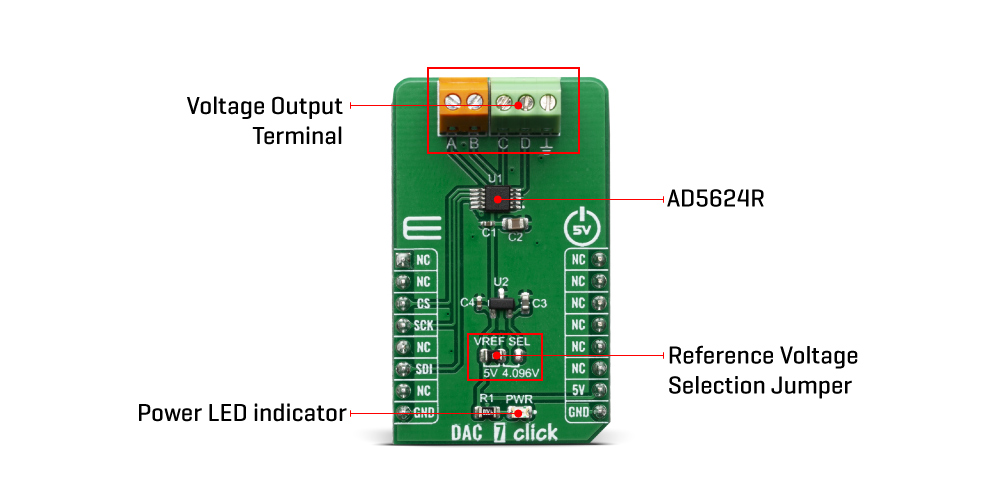
The DAC 7 Click Board™ has a high precision voltage reference included onboard. For that purpose, we have used 4.096V precision voltage reference MCP1541 from Microchip. This little SOT23 device is stable with capacitive loads. It has regulations for both sink and source and is very accurate. This gives DAC 7 click good flexibility for use in various applications.
Low quiescent current, wide power supply range, and per-channel power down option makes AD5624R ideal for low power, battery-operated system. The device communicates through the SPI interface. Besides the standard SPI, QSPI™, MICROWIRE™, and DSP interface standards are also supported. However, this click board™ is using standard SPI communication with the main MCU.
The reference voltage level can be selected via VREF SEL jumper, between 4.096V and 5V. This allows for both 4.096V and 5V Voltage outputs from DAC 7 click can be connected through a 9-terminal block where the first is common GND and the last eight are VOUTA to VOUTH.
The DAC 7 Click Board™ is designed to be operated only with a 5V logic level. A proper logic voltage level conversion should be performed before the Click board™ is used with MCUs with logic levels of 3.3V.
Specifications
| Type |
DAC |
| Applications |
Suitable for programmable power supplies, programable window comparator, VCOM biasing in display panel, laser driver in multifunction printers, autofocus digital still camera lens, ATM machines, currency counters, barcode readers, IP network cameras, projectors |
| On-board modules |
AD5624R- a low power, four-channel, 12-bit voltage output Digital-To-Analog Converter (DAC) from Analog Devices; and MCP1541 - a 4.096V precision voltage reference IC, from Microchip. |
| Key Features |
High precision voltage reference, low power consumption, high-speed SPI interface, 12bit resolution, reference voltage selection |
| Interface |
SPI |
| Compatibility |
mikroBUS |
| Click board size |
M (42.9 x 25.4 mm) |
| Input Voltage |
5V |
Pinout Diagram
This table shows how the pinout on the DAC 7 Click Board™ corresponds to the pinout on the mikroBUS™ socket (the latter shown in the two middle columns).
| Notes |
Pin |
 |
Pin |
Notes |
| NC |
1 |
AN |
PWM |
16 |
NC |
| NC |
2 |
RST |
INT |
15 |
NC |
| SPI Chip Select |
CS |
3 |
CS |
RX |
14 |
NC |
| SPI Clock |
SCK |
4 |
SCK |
TX |
13 |
NC |
| NC |
5 |
MISO |
SCL |
12 |
NC |
| SPI Data IN |
SDI |
6 |
MOSI |
SDA |
11 |
NC |
| NC |
7 |
3.3V |
5V |
10 |
5V |
Power Supply |
| Ground |
GND |
8 |
GND |
GND |
9 |
GND |
Ground |
Onboard settings and indicators
| Label |
Name |
Default |
Description |
| JP1 |
VREF SEL |
Left |
DAC Reference Voltage Selection 4.096/5V, left position 4.096, right position 5V |
| LD1 |
PWR |
- |
Power LED indicator |
- description_tag: The DAC 7 Click Board™ carries the AD5624R, a low-power four-channel, 12-bit buffered Digital-to-Analog Converter. AD5624R converts the digital value to the corresponding voltage level using an external voltage reference. Available from Debug Store UK.
- title_tag: MikroE DAC 7 Click Board™ (MIKROE-3886)
- manufacturer: Mikroelektronika d.o.o.
- warranty: 12 months
- amazon_enable: TRUE
- amazon_title: DAC 7 Click Board
- amazon_product_type: computercomponent
- amazon_block: FALSE
- amazon_prime_enable: FALSE
- amazon_search: MikroElektronika Microelectronica MIKROE-1100
- amazon_uk_price: 22.88
- amazon_uk_currency: GBP
- amazon_de_currency: EUR
- amazon_de_price: 25.8544
- amazon_fr_currency: EUR
- amazon_fr_price: 25.8544
- amazon_es_currency: EUR
- amazon_es_price: 25.8544
- amazon_nl_currency: EUR
- amazon_nl_price: 25.8544
- amazon_it_currency: EUR
- amazon_it_price: 25.8544
- amazon_se_curency: SEK
- amazon_se_price: 260.832
- amazon_product_id: 8606018719273
- amazon_product_id_type: EAN
- amazon_update: Update
- amazon_short_description: The DAC 7 Click Board™ carries the AD5624R, a low-power four-channel, 12-bit buffered Digital-to-Analog Converter. AD5624R converts digital value to the corresponding voltage level using external voltage reference. This will help you convert digital information from the main board to four analog outputs on the DAC 7 Click Board™. For that purpose, DAC 7 Click Board™ uses MCP1541, which is a low-dropout precision voltage reference with 4.096V output voltage. With all those possibilities on board, DAC 7 Click Board™ makes a perfect choice for an accurate and simple generation of analog signals for various purposes, such as programmable Power Supplies, Laser Drivers, Projectors, IP Network cameras, auto focus digital still camera lens, and more
- amazon_main_image: https://www.thedebugstore.com/images/product/lg-dac-7-click-front.jpg
- amazon_other_image_1: https://www.thedebugstore.com/images/product/lg-dac-7-click-back.jpg
- amazon_other_image_2: https://www.thedebugstore.com/images/product/lg-dac-7-click-fusion.jpg
- amazon_other_image_3: https://www.thedebugstore.com/images/product/lg-dac-7-click-shuttle.jpg
- amazon_other_image_4: https://www.thedebugstore.com/images/product/lg-dac-7-click-clicker.jpg
- amazon_other_image_5: https://www.thedebugstore.com/images/product/lg-dac-7-click-breadboard.jpg
- amazon_other_image_6: https://www.thedebugstore.com/images/product/lg-dac-7-click-breadboard.jpg
- amazon_browse_node: 428655031
- related_products: MIKROE-4206
- mpn: MIKROE-3886
- backorder_label: If no stock shown above, check availability
- google_product_category: 1801
- examples:
We provide a library for the DAC 7 Click Board™ on our LibStock page, as well as a demo application (example), developed using MikroElektronika compilers. The demo can run on all the main MikroElektronika development boards.
Library Description
The library covers all the necessary functions to control DAC 7 click board. The library performs a standard SPI interface communication.
Key Functions
DAC7_RETVAL_T dac7_set_ch_voltage ( uint8_t addr_ch, uint16_t vol_val, uint16_t v_ref_mv ) - Set the voltage values of the specified channel function.DAC7_RETVAL_T dac7_set_power ( uint8_t pwr_en, uint8_t sel_ch ) - Set power mode function.DAC7_RETVAL_T dac7_sw_reset ( void ) - Software reset function.
Example Description
The application is composed of three sections :
- System Initialization - Initializes SPI, set CS pin as output and start to write log.
- Application Initialization - Initialization driver enables - SPI, executes call software reset and all channels power on, also write log.
- Application Task - (code snippet) This is an example that demonstrates the use of the DAC 7 Click Board™. In this example, we adjust the DAC output voltage from 1000 mV to 4000 mV for the channels, starting from channel A to channel D and set the DAC output voltage to 5000 mV for all channels. Results are being sent to the Usart Terminal where you can track their changes. All data logs write on USB uart change every 5 sec.
void application_task ( )
{
    if ( dac7_set_ch_voltage ( DAC7_CHANNEL_A, 1000, v_ref_sel ) == DAC7_SUCCESS )
    {
        mikrobus_logWrite( "  Channel A : 1000 mV  ", _LOG_LINE );
    }
    else
    {
        mikrobus_logWrite( "        ERROR          ", _LOG_LINE );
        for ( ; ; );
    }

    Delay_ms( 5000 );
    mikrobus_logWrite( "-----------------------", _LOG_LINE );

    if ( dac7_set_ch_voltage ( DAC7_CHANNEL_B, 2000, v_ref_sel ) == DAC7_SUCCESS )
    {
        mikrobus_logWrite( "  Channel B : 2000 mV  ", _LOG_LINE );
    }
    else
    {
        mikrobus_logWrite( "        ERROR          ", _LOG_LINE );
        for ( ; ; );
    }

    Delay_ms( 5000 );
    mikrobus_logWrite( "-----------------------", _LOG_LINE );

    if ( dac7_set_ch_voltage ( DAC7_CHANNEL_C, 3000, v_ref_sel ) == DAC7_SUCCESS )
    {
        mikrobus_logWrite( "  Channel C : 3000 mV  ", _LOG_LINE );
    }
    else
    {
        mikrobus_logWrite( "        ERROR          ", _LOG_LINE );
        for ( ; ; );
    }

    Delay_ms( 5000 );
    mikrobus_logWrite( "-----------------------", _LOG_LINE );

    if ( dac7_set_ch_voltage ( DAC7_CHANNEL_D, 4000, v_ref_sel ) == DAC7_SUCCESS )
    {
        mikrobus_logWrite( "  Channel D : 4000 mV  ", _LOG_LINE );
    }
    else
    {
        mikrobus_logWrite( "        ERROR          ", _LOG_LINE );
        for ( ; ; );
    }

    Delay_ms( 5000 );
    mikrobus_logWrite( "-----------------------", _LOG_LINE );

    if ( dac7_set_ch_voltage ( DAC7_CHANNEL_ALL, 5000, v_ref_sel ) == DAC7_SUCCESS )
    {
        mikrobus_logWrite( " All Channels: 5000 mV ", _LOG_LINE );
    }
    else
    {
        mikrobus_logWrite( "        ERROR          ", _LOG_LINE );
        for ( ; ; );
    }

    Delay_ms( 5000 );
    mikrobus_logWrite( "-----------------------", _LOG_LINE );
}
The full application code, and ready to use projects can be found on our LibStock page.
Other mikroE Libraries used in the example:
Additional Notes and Information
Depending on the development board you are using, you may need a USB UART click, USB UART 2 click or RS232 click to connect to your PC, for development systems with no UART to USB interface available on the board. The terminal available in all MikroElektronika compilers, or any other terminal application of your choice, can be used to read the message.
mikroSDK
The DAC 7 Click Board™ is supported with mikroSDK - MikroElektronika Software Development Kit. To ensure proper operation of mikroSDK compliant Click board™ demo applications, mikroSDK should be downloaded from the LibStock and installed for the compiler you are using.
- attachments: [{"download_file":[{"download_file":"DAC 7 Click Board™ Schematic"}],"download_filetype":[{"download_filetype":"pdf"}]},{"download_file":[{"download_file":"Analog Devices AD5624R 12-bit DAC Datasheet"}],"download_filetype":[{"download_filetype":"pdf"}]}]
- condition: new
- custom_product: false
- mpn: MIKROE-3886
- google_product_category: Electronics
- custom_label_0: Click Board
- device_vendor: Analog Devices Inc.
- device_type: AD5624RBRMZ-5
- warranty: 12 months
- brand: MikroE
- key_feature_1: 12-bit Analog to Digital Converter
- manufacturer: Mikroelektronika d.o.o.
- badge: No reviews
- widget:
- target_keyword: DAC 7 Click Board
- brands: gid://shopify/Metaobject/56256004319
- breadcrumbs: ["gid://shopify/Collection/447955239135","gid://shopify/Collection/241680580797","gid://shopify/Collection/241545314493"]
- customhs_code: 847330
- detailed_description: {"type":"root","children":[{"type":"heading","level":3,"children":[{"type":"text","value":"How Does The DAC 7 Click Board™ Work?"}]},{"type":"paragraph","children":[{"type":"text","value":"The "},{"type":"text","value":"DAC 7 Click Board™","bold":true,"italic":true},{"type":"text","value":" is an advanced 12-bit, four-channel digital to analogue converter (DAC). This device communicates with the main MCU through the is compatible with standard SPI, QSPI™, MICROWIRE™, and DSP interface standards. Also, there is a selectable voltage reference as well with onboard jumpers which makes this click more open for specific projects."}]},{"type":"paragraph","children":[{"type":"text","value":"The main active component on the "},{"type":"text","value":"DAC 7 Click Board™","bold":true},{"type":"text","value":" is the AD5624R from Analog Devices. This is a low power, four-channel, 12-bit voltage output Digital-To-Analog Converter (DAC). It is specified monotonic by design across a wide power supply range from 2.7 V to 5.5 V. Using an external reference, the AD5624R provides a full-scale output voltage in the range from 0V to Vref, while consuming 0.1 mA quiescent current per channel. The AD5624R also includes per channel, user-programmable, power down registers facilitate the DAC output buffers to start in a power down to 10K state and remain in this state until a power-up command is issued to these output buffers."}]},{"type":"paragraph","children":[{"type":"text","value":""}]},{"type":"paragraph","children":[{"type":"text","value":"The "},{"type":"text","value":"DAC 7 Click Board™","bold":true},{"type":"text","value":" has a high precision voltage reference included onboard. For that purpose, we have used 4.096V precision voltage reference MCP1541 from Microchip. This little SOT23 device is stable with capacitive loads. It has regulations for both sink and source and is very accurate. This gives DAC 7 click good flexibility for use in various applications."}]},{"type":"paragraph","children":[{"type":"text","value":"Low quiescent current, wide power supply range, and per-channel power down option makes AD5624R ideal for low power, battery-operated system. The device communicates through the SPI interface. Besides the standard SPI, QSPI™, MICROWIRE™, and DSP interface standards are also supported. However, this click board™ is using standard SPI communication with the main MCU."}]},{"type":"paragraph","children":[{"type":"text","value":"The reference voltage level can be selected via VREF SEL jumper, between 4.096V and 5V. This allows for both 4.096V and 5V Voltage outputs from DAC 7 click can be connected through a 9-terminal block where the first is common GND and the last eight are VOUTA to VOUTH."}]},{"type":"paragraph","children":[{"type":"text","value":"The "},{"type":"text","value":"DAC 7 Click Board™","bold":true},{"type":"text","value":" is designed to be operated only with a 5V logic level. A proper logic voltage level conversion should be performed before the Click board™ is used with MCUs with logic levels of 3.3V."}]},{"type":"heading","level":3,"children":[{"type":"text","value":"Specifications"}]},{"type":"paragraph","children":[{"type":"text","value":"Type\nDAC\nApplications\nSuitable for programmable power supplies, programable window comparator, VCOM biasing in display panel, laser driver in multifunction printers, autofocus digital still camera lens, ATM machines, currency counters, barcode readers, IP network cameras, projectors\nOn-board modules\nAD5624R- a low power, four-channel, 12-bit voltage output Digital-To-Analog Converter (DAC) from Analog Devices; and MCP1541 - a 4.096V precision voltage reference IC, from Microchip.\nKey Features\nHigh precision voltage reference, low power consumption, high-speed SPI interface, 12bit resolution, reference voltage selection\nInterface\nSPI\nCompatibility\nmikroBUS\nClick board size\nM (42.9 x 25.4 mm)\nInput Voltage\n5V"}]},{"type":"heading","level":3,"children":[{"type":"text","value":"Pinout Diagram"}]},{"type":"paragraph","children":[{"type":"text","value":"This table shows how the pinout on the "},{"type":"text","value":"DAC 7 Click Board™","bold":true},{"type":"text","value":" corresponds to the pinout on the mikroBUS™ socket (the latter shown in the two middle columns)."}]},{"type":"paragraph","children":[{"type":"text","value":"Notes\nPin\nPin\nNotes\nNC\n1\nAN\nPWM\n16\nNC\nNC\n2\nRST\nINT\n15\nNC\nSPI Chip Select\nCS\n3\nCS\nRX\n14\nNC\nSPI Clock\nSCK\n4\nSCK\nTX\n13\nNC\nNC\n5\nMISO\nSCL\n12\nNC\nSPI Data IN\nSDI\n6\nMOSI\nSDA\n11\nNC\nNC\n7\n3.3V\n5V\n10\n5V\nPower Supply\nGround\nGND\n8\nGND\nGND\n9\nGND\nGround"}]},{"type":"heading","level":3,"children":[{"type":"text","value":"Onboard settings and indicators"}]},{"type":"paragraph","children":[{"type":"text","value":"Label\nName\nDefault\n Description\nJP1\nVREF SEL\nLeft\nDAC Reference Voltage Selection 4.096/5V, left position 4.096, right position 5V\nLD1\nPWR\n-\nPower LED indicator"}]},{"type":"heading","level":3,"children":[{"type":"text","value":" "}]}]}
- summary: The DAC 7 Click Board™ carries the AD5624R, a low-power four-channel, 12-bit buffered Digital-to-Analog Converter. AD5624R converts the digital value to the corresponding voltage level using an external voltage reference. This will help you convert digital information from the mainboard to four analogue outputs on the DAC 7 Click Board™. For that purpose, DAC 7 Click Board™ uses MCP1541, which is a low-dropout precision voltage reference with a 4.096V output voltage.
With all those possibilities on board, DAC 7 Click Board™ makes a perfect choice for an accurate and simple generation of analogue signals for various purposes, such as programmable Power Supplies, Laser Drivers, Projectors, IP Network cameras, autofocus digital still camera lens, and more