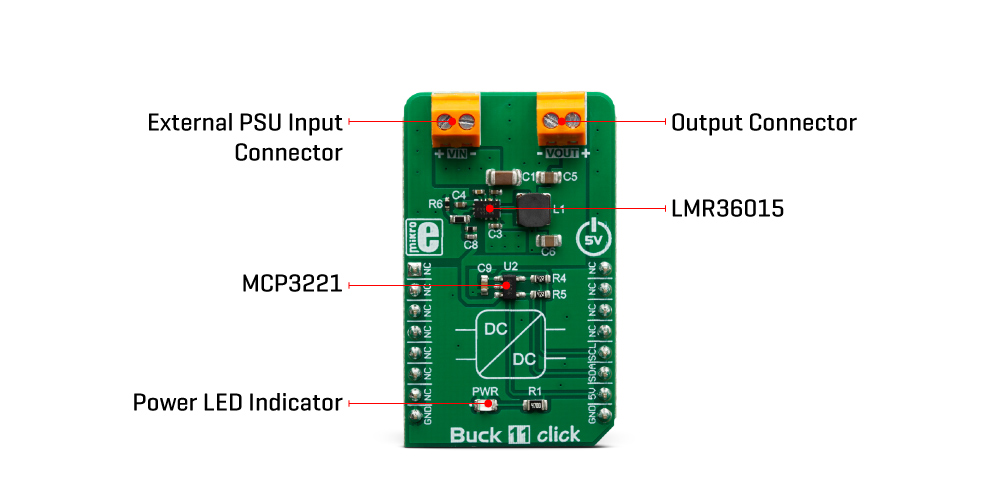
The LMR36015 has a wide voltage input range, which is one of its key features. It can sustain transients up to 66V at its input, making it compliant with the surge immunity requirements of IEC 61000-4-5. It also features a set of standard protection options, found on many similar devices: under-voltage lockout, short circuit protection, thermal shutdown, etc. The Buck 11 Click Board™ can be used for a wide range of applications that require 3.3V, including field embedded applications, sensors, PLC modules, video surveillance systems, and similar applications that require step-down conversion to 3.3V.
The Buck 11 Click Board™ is equipped with the LMR36015, a synchronous step-down converter, from Texas Instruments. This is an advanced integrated step-down converter, which requires a minimum number of external components, readily available on the market. It utilizes a peak-current-mode control architecture, which along with the automatic PFM/PWM mode switching, ensures a very good efficiency. The LMR36015 buck converter features over-current, under-voltage, and thermal protection, making Buck 11 Click Board™ a robust and reliable power supply solution.
The output voltage is determined by the feedback voltage on the FB pin. The output voltage is set to 3.3V making it usable with most embedded applications, allowing them to be powered from the same source, like the rest of the application, which may use a higher voltage for its operation. This is a common-case scenario in various field applications where a relatively high voltage is required i.e. for servos, step motors, displays, etc.
When there is overload at the output, the low-side MOSFET will allow the inductor current to drop. It will remain open until the current through the inductor falls below the limit. If the FB voltage drops too much during the overload, the device enters the hiccup mode, in which the device attempts to periodically restarts itself.
The LMR36015 is able to automatically switch between PWM and PFM modes, depending on the current through the load. At very light loads, the device is operated in PFM mode. In this mode, the high-side MOSFET is operated in bursts, after which the LMR36015 waits for the current through the inductor to drop below the limit. This way, the device is in an idle state, while the light load consumes energy stored within the coil. This greatly improves the efficiency when a light load is used.
While operated in PWM mode, the output MOSFETs are driven with the constant PWM frequency of 400kHz, using the pulse width modulation to control the output voltage. This provides very good voltage regulation and a low output voltage ripple.
Featuring the HotRod™ technology, the LMR36015 occupies a very small area on the PCB. Combined with the low count of external components it requires, the LMR36015 leaves enough space for an additional IC to be used. This Click Board™ uses the MCP3221, a 12-bit A/D converter (ADC) which uses the I2C interface, from Microchip. It allows monitoring the output voltage over the I2C interface. This ADC is powered by the +5V mikroBUS™ power rail. The same voltage is used as a reference. The Buck 11 Click Board™ itself requires an external power supply to be connected at the input terminal, labelled as VIN. The VOUT terminal provides the connected load with the regulated 3.3V voltage.
- description_tag: The Buck 11 Click Board™ is a high-efficiency step-down converter that provides 3.3V on its output, derived from the connected power supply voltage, in the range from 4.2V to 60V. Available from The DebugStore UK. - title_tag: MikroE Buck 11 Click Board™ (MIKROE-3438) - manufacturer: Mikroelektronika d.o.o. - warranty: 12 months - amazon_enable: TRUE - amazon_title: Buck 11 Click Board - amazon_product_type: computercomponent - amazon_block: FALSE - amazon_prime_enable: FALSE - amazon_search: MikroElektronika Microelectronica MIKROE-1100 - amazon_uk_price: 18.48 - amazon_uk_currency: GBP - amazon_de_currency: EUR - amazon_de_price: 20.8824 - amazon_fr_currency: EUR - amazon_fr_price: 20.8824 - amazon_es_currency: EUR - amazon_es_price: 20.8824 - amazon_nl_currency: EUR - amazon_nl_price: 20.8824 - amazon_it_currency: EUR - amazon_it_price: 20.8824 - amazon_se_curency: SEK - amazon_se_price: 210.672 - amazon_product_id: 8606018714858 - amazon_product_id_type: EAN - amazon_update: Update - amazon_short_description: The Buck 11 Click Board™ is a high-efficiency step-down converter which provides 3.3V on its output, derived from the connected power supply voltage, in the range from 4.2V to 60V. Buck 11 Click Board™ is based on the LMR36015, a highly efficient DC-DC step-down converter. In addition, the Buck 11 Click Board™ offers monitoring the stability of the output voltage by employing an additional A/D converter circuit. Due to its high efficiency, LMR36015 allows the Click Board™ to easily deliver up to 1.5A of current. The efficiency for lighter loads is optimized by using the PFM mode. It features a Hot Rod™ package which enables a low noise performance, high efficiency, and very compact size. - amazon_long_description:The LMR36015 has a wide voltage input range, which is one of its key features. It can sustain transients up to 66V at its input, making it compliant with the surge immunity requirements of IEC 61000-4-5. It also features a set of standard protection options, found on many similar devices: undervoltage lockout, short circuit protection, thermal shutdown, etc. The Click board™ can be used for a wide range of applications that require 3.3V, including field embedded applications, sensors, PLC modules, video surveillance systems, and similar applications that require step-down conversion to 3.3V.
The Buck 11 Click Board is equipped with the LMR36015, a synchronous step-down converter, from Texas Instruments. This is an advanced integrated step-down converter, which requires a minimum number of external components, readily available on the market. It utilizes a peak-current-mode control architecture, which along with the automatic PFM/PWM mode switching, ensures a very good efficiency. The LMR36015 buck converter features over-current, under-voltage, and thermal protection, making Buck 11 click a robust and reliable power supply solution.

The output voltage is determined by the feedback voltage on the FB pin. The output voltage is set to 3.3V making it usable with most embedded applications, allowing them to be powered from the same source, like the rest of the application, which may use a higher voltage for its operation. This is a common-case scenario in various field applications where a relatively high voltage is required i.e. for servos, step motors, displays, etc.
When there is overload at the output, the low-side MOSFET will allow the inductor current to drop. It will remain open until the current through the inductor falls below the limit. If the FB voltage drops too much during the overload, the device enters the hiccup mode, in which the device attempts to periodically restarts itself.
The LMR36015 is able to automatically switch between PWM and PFM modes, depending on the current through the load. At very light loads, the device is operated in PFM mode. In this mode, the high-side MOSFET is operated in bursts, after which the LMR36015 waits for the current through the inductor to drop below the limit. This way, the device is in an idle state, while the light load consumes energy stored within the coil. This greatly improves the efficiency when a light load is used.
While operated in PWM mode, the output MOSFETs are driven with the constant PWM frequency of 400kHz, using the pulse width modulation to control the output voltage. This provides very good voltage regulation and a low output voltage ripple.
Featuring the HotRod™ technology, the LMR36015 occupies a very small area on the PCB. Combined with the low count of external components it requires, the LMR36015 leaves enough space for an additional IC to be used. This click uses the MCP3221, a 12-bit A/D converter (ADC) which uses the I2C interface, from Microchip. It allows monitoring the output voltage over the I2C interface. This ADC is powered from the +5V mikroBUS™ power rail. The same voltage is used as a reference. The Click board™ itself requires an external power supply to be connected at the input terminal, labeled as VIN. The VOUT terminal provides the connected load with the regulated 3.3V voltage.
- amazon_main_image: https://www.thedebugstore.com/images/product/lg-buck-11-click-3438-angle_1.jpg - amazon_other_image_1: https://www.thedebugstore.com/images/product/lg-buck-11-click-3438-back_1.jpg - amazon_other_image_2: https://www.thedebugstore.com/images/product/lg-buck-11-click-3438-in-use_1.jpg - amazon_other_image_3: https://www.thedebugstore.com/images/product/lg-buck-11-click-3438-in-use_1.jpg - amazon_browse_node: 428655031 - related_products: MIKROE-3652,MIKROE-3651,MIKROE-2887 - mpn: MIKROE-3438 - backorder_label: If no stock shown above, check availability - google_product_category: 222 - attachments: [{"download_file":[{"download_file":"Buck 11 Click Board™ Schematic"}]},{"download_file":[{"download_file":"Texas Instruments LMR36015 Step-Down Converter Datasheet"}]},{"download_file":[{"download_file":"Microchip MCP3221 12-bit A/D Converter Datasheet"}]}] - examples:We provide a library for the Buck 11 Click Board™ on our LibStock page, as well as a demo application (example), developed using MikroElektronika compilers. The demo can run on all the main MikroElektronika development boards.
The library allows user to perform the VOUT measurement of the Buck 11 Click Board™. One measurement cycle can consist a one conversion or more averaged conversions. This library also allows user to enter a real measured reference voltage for the AD conversion (VDD). For more details check documentation.
void buck11_set_vdd_value( float vdd_volts ) - This function allows user to set VDD voltage to the desired (measured) value.uint16_t buck11_read_adc( void ) - This function reads the results of the AD conversion from the MCP3221A5T 12-bit converter.float buck11_get_vout( uint8_t vout_resolution ) - This function allows user to get VOUT voltage value in the desired unit resolution, volts or millivolts.The application is composed of the three sections :
void applicationTask()
{
    vout_value = buck11_get_averaged_vout( vout_resol, 30 );

    FloatToStr( vout_value, text );
    floatCut();

    mikrobus_logWrite( "** VOUT : ", _LOG_TEXT );
    mikrobus_logWrite( text, _LOG_TEXT );

    if (vout_resol == _BUCK11_VOUT_VOLTS)
    {
        mikrobus_logWrite( " V", _LOG_LINE );
    }
    else
    {
        mikrobus_logWrite( " mV", _LOG_LINE );
    }

    mikrobus_logWrite( "*************************************", _LOG_LINE );
    Delay_ms( 300 );
}
Additional Functions :
The full application code, and ready to use projects can be found on our LibStock page.
Other mikroE Libraries used in the example:
I2CUARTConversionsDepending on the development board you are using, you may need a USB UART click, USB UART 2 click or RS232 click to connect to your PC, for development systems with no UART to USB interface available on the board. The terminal available in all MikroElektronika compilers, or any other terminal application of your choice, can be used to read the message.
The Buck 11 Click Board™ is supported with mikroSDK - MikroElektronika Software Development Kit. To ensure proper operation of mikroSDK compliant click board demo applications, mikroSDK should be downloaded from the LibStock and installed for the compiler you are using.
- condition: new - custom_product: false - mpn: MIKROE-3438 - google_product_category: Electronics - custom_label_0: Click Board - device_vendor: Microchip Technology, Texas Instruments - device_type: MCP3221A5T-E/OT, LMR36015ARNXT - warranty: 12 months - brand: MikroE - key_feature_1: Step-down Convertor to 3.3V - manufacturer: Mikroelektronika d.o.o. - badge: - widget:The Buck 11 Click Board™ is a high-efficiency step-down converter that provides 3.3V on its output, derived from the connected power supply voltage, in the range from 4.2V to 60V. Buck 11 Click Board™ is based on the LMR36015, a highly efficient DC-DC step-down converter. In addition, the Buck 11 Click Board™ offers to monitor the stability of the output voltage by employing an additional A/D converter circuit. Due to its high efficiency, LMR36015 allows the Click Board™ to deliver up to 1.5A of current efficiently. The efficiency for lighter loads is optimized by using the PFM mode. It features a Hot Rod™ package which enables a low noise performance, high efficiency, and compact size.