# Title: MUX Click Board™
## Description: How Does The MUX Click Board™ Work? The MUX Click Board™ is equipped with the MUX509, a precise analog multiplexing IC, produced by Texas Instruments. The MUX509 can be used with a wide range of power supplies. It can handle both dual and single power supplies, as well as the symmetrical and non-symmetrical ones. This allows it to be used in a very wide range of different applications. Another property of the MUX509 IC is that it has dual inputs and dual output. Three control pins are used to switch one of four input pairs to a single output pair. Control pins labelled as A0 and A1 are routed to the mikroBUS™ and can be operated by both 3.3V and 5V MCUs. The third control pin is labelled as EN pin, used to enable the output when is set to a HIGH logic level (it is active HIGH). A0 and A1 pins are routed to RST and PWM pins of the mikroBUS™ respectively, while the EN pin is routed to the CS pin on the mikroBUS™. The MUX509 IC is targeted towards working with differential signals, rather than working with the single-ended inputs. Each input is composed of two pins: SNA, and SNB, where N represents the channel number in the range from 1 to 4. When a specific channel is selected (N), both the SNA and SNB pins of that channel will be routed to the DA and DB output pins, respectively. For the improved stability, each signal pair is equipped with the 100nF parallel capacitor and 100Ω series resistance. The input and the output signal pins are routed to the standard 2.54mm pitch 2x5 pins header on the Click board™. The ultra-low leakage current ensures that there is no signal interference from the inputs that are not selected by the A0 and A1 pins. A low crosstalk also ensures that the signal on one channel remains clean of interferences caused by other channels. To prevent any two inputs to be switched at the output at the same time, a break-before-make switching action is utilized. This ensures a reliable operation of the IC and the Click board™ itself. The MUX Click Board™ does not use the power from the mikroBUS™ power rails, except for the LED indicator. Instead, a three-pole screw terminal is used to connect an external power supply. Having in mind the minimum input voltage of 10V or ±5V, a power supply should be connected to this terminal before operating the Click board™. Depending on the type of the used power supply (single supply or symmetrical/dual supply), it should be connected to the power supply input terminal, accordingly: GND is the reference ground connection, VSS is the negative voltage connection terminal (GND if a single power supply is used), and VDD is the positive voltage connection terminal. The input and output signals can be connected via the 2x5 pins header. As mentioned before, the MUX509 IC supports rail-to-rail operation, supporting input and output signals that range from VSS (or GND) up to VDD. Independent power supply input allows the user to work with a wide range of signal amplitudes, depending on the application requirements, as long as the power supply stays within the limits. More information about the MUX509 can be found in the attached datasheet. However, the Click board™ comes equipped with a library that contains easy to use functions and a usage example that may be used as a reference for the development. SPECIFICATIONS Type DAC Applications Automatization and process control, programmable logic controllers, digital multimeters, battery monitoring, and other applications that require differential signal switching On-board modules MUX509, a precise analog multiplexing IC, produced by Texas Instruments Key Features Features such as the break-before-make switching action, electrostatic discharge protection up to 2kV, low on-resistance and low input current leakage, make this circuit a perfect solution for various switching applications, especially those that utilize differential signals Interface GPIO Compatibility mikroBUS Click board size M (42.9 x 25.4 mm) Input Voltage 5V PINOUT DIAGRAM This table shows how the pinout of the MUX Click Board™ corresponds to the pinout on the mikroBUS™ socket (the latter shown in the two middle columns). Notes Pin Pin Notes NC 1 AN PWM 16 A1 Control pin 1 Control pin 0 A0 2 RST INT 15 NC Chip Enable EN 3 CS RX 14 NC NC 4 SCK TX 13 NC NC 5 MISO SCL 12 NC NC 6 MOSI SDA 11 NC NC 7 3.3V 5V 10 5V Power supply Ground GND 8 GND GND 9 GND Ground ONBOARD SETTINGS AND INDICATORS Label Name Default Description LD1 PWR - Power LED indicator MUX CLICK ELECTRICAL SPECIFICATIONS Description Min Typ Max Unit VIN (voltage at the power supply input terminal, single supply) 10 - 36 V VIN (voltage at the power supply input terminal, symmetrical supply) ±5 - ±18 V
## Product type: Click Board
## Vendor: Mikroelektronika d.o.o.
## Tags: Click Board, Measurement, MikroE, Mixed Signal
## Price range: 14.0 - 14.0 GBP
## Link: https://thedebugstore.com/products/mikroe-3247-mux-click-board-uk
## Compare-at price range: 20.0 - 20.0 GBP
## Options
- Title: Default Title
## Collections
- [New Products](https://thedebugstore.com/a/llms/collections/new-products-debug-store)
- [Mikroelektronika d.o.o. (MikroE)](https://thedebugstore.com/a/llms/collections/mikroelektronika-catalogue-uk)
- [Mixed Signal Click Boards™](https://thedebugstore.com/a/llms/collections/mixed-signal-click-boards-catalogue-uk)
- [MikroE Click Boards™](https://thedebugstore.com/a/llms/collections/mikroe-click-boards-catalogue-uk)
- [Measurements Click Boards™](https://thedebugstore.com/a/llms/collections/measurement-click-boards-catalogue)
- [Click Boards™ Summer Sale](https://thedebugstore.com/a/llms/collections/inventory-sale)
- [MikroE Sale](https://thedebugstore.com/a/llms/collections/mikroe-sale)
- [MIKROE Stock](https://thedebugstore.com/a/llms/collections/mikroe-products-in-stock-sale)
## Variants
- Default Title, SKU: MIKROE-3247, Available: yes, Inventory: 1
## Metafields
- full_description: How Does The MUX Click Board™ Work?
The MUX Click Board™ is equipped with the MUX509, a precise analog multiplexing IC, produced by Texas Instruments. The MUX509 can be used with a wide range of power supplies. It can handle both dual and single power supplies, as well as the symmetrical and non-symmetrical ones. This allows it to be used in a very wide range of different applications. Another property of the MUX509 IC is that it has dual inputs and dual output. Three control pins are used to switch one of four input pairs to a single output pair. Control pins labelled as A0 and A1 are routed to the mikroBUS™ and can be operated by both 3.3V and 5V MCUs. The third control pin is labelled as EN pin, used to enable the output when is set to a HIGH logic level (it is active HIGH). A0 and A1 pins are routed to RST and PWM pins of the mikroBUS™ respectively, while the EN pin is routed to the CS pin on the mikroBUS™.
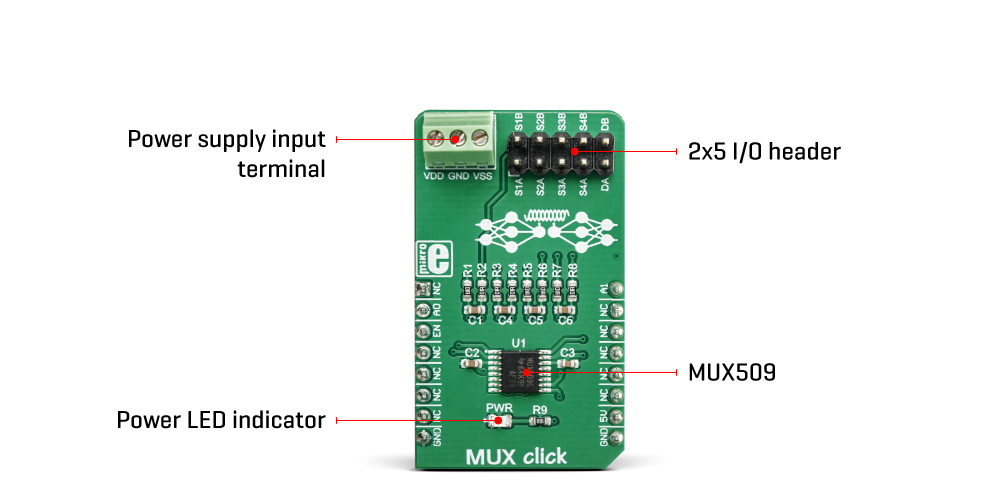
The MUX509 IC is targeted towards working with differential signals, rather than working with the single-ended inputs. Each input is composed of two pins: SNA, and SNB, where N represents the channel number in the range from 1 to 4. When a specific channel is selected (N), both the SNA and SNB pins of that channel will be routed to the DA and DB output pins, respectively. For the improved stability, each signal pair is equipped with the 100nF parallel capacitor and 100Ω series resistance. The input and the output signal pins are routed to the standard 2.54mm pitch 2x5 pins header on the Click board™.
The ultra-low leakage current ensures that there is no signal interference from the inputs that are not selected by the A0 and A1 pins. A low crosstalk also ensures that the signal on one channel remains clean of interferences caused by other channels. To prevent any two inputs to be switched at the output at the same time, a break-before-make switching action is utilized. This ensures a reliable operation of the IC and the Click board™ itself.
The MUX Click Board™ does not use the power from the mikroBUS™ power rails, except for the LED indicator. Instead, a three-pole screw terminal is used to connect an external power supply. Having in mind the minimum input voltage of 10V or ±5V, a power supply should be connected to this terminal before operating the Click board™. Depending on the type of the used power supply (single supply or symmetrical/dual supply), it should be connected to the power supply input terminal, accordingly: GND is the reference ground connection, VSS is the negative voltage connection terminal (GND if a single power supply is used), and VDD is the positive voltage connection terminal. The input and output signals can be connected via the 2x5 pins header. As mentioned before, the MUX509 IC supports rail-to-rail operation, supporting input and output signals that range from VSS (or GND) up to VDD. Independent power supply input allows the user to work with a wide range of signal amplitudes, depending on the application requirements, as long as the power supply stays within the limits.
More information about the MUX509 can be found in the attached datasheet. However, the Click board™ comes equipped with a library that contains easy to use functions and a usage example that may be used as a reference for the development.
SPECIFICATIONS
| Type |
DAC |
| Applications |
Automatization and process control, programmable logic controllers, digital multimeters, battery monitoring, and other applications that require differential signal switching |
| On-board modules |
MUX509, a precise analog multiplexing IC, produced by Texas Instruments |
| Key Features |
Features such as the break-before-make switching action, electrostatic discharge protection up to 2kV, low on-resistance and low input current leakage, make this circuit a perfect solution for various switching applications, especially those that utilize differential signals |
| Interface |
GPIO |
| Compatibility |
mikroBUS |
| Click board size |
M (42.9 x 25.4 mm) |
| Input Voltage |
5V |
PINOUT DIAGRAM
This table shows how the pinout of the MUX Click Board™ corresponds to the pinout on the mikroBUS™ socket (the latter shown in the two middle columns).
| Notes |
Pin |
 |
Pin |
Notes |
| NC |
1 |
AN |
PWM |
16 |
A1 |
Control pin 1 |
| Control pin 0 |
A0 |
2 |
RST |
INT |
15 |
NC |
| Chip Enable |
EN |
3 |
CS |
RX |
14 |
NC |
| NC |
4 |
SCK |
TX |
13 |
NC |
| NC |
5 |
MISO |
SCL |
12 |
NC |
| NC |
6 |
MOSI |
SDA |
11 |
NC |
| NC |
7 |
3.3V |
5V |
10 |
5V |
Power supply |
| Ground |
GND |
8 |
GND |
GND |
9 |
GND |
Ground |
ONBOARD SETTINGS AND INDICATORS
| Label |
Name |
Default |
Description |
| LD1 |
PWR |
- |
Power LED indicator |
MUX CLICK ELECTRICAL SPECIFICATIONS
| Description |
Min |
Typ |
Max |
Unit |
| VIN (voltage at the power supply input terminal, single supply) |
10 |
- |
36 |
V |
| VIN (voltage at the power supply input terminal, symmetrical supply) |
±5 |
- |
±18 |
V |
- description_tag: The MUX Click Board™ switches one of the four differential inputs to one differential output. It employs the MUX509, a modern CMOS analog multiplexing integrated circuit, produced by Texas Instruments. Available from Debug Store UK.
- title_tag: MikroE MUX Click Board™ (MIKROE-3247)
- manufacturer: Mikroelektronika d.o.o.
- warranty: 12 months
- amazon_enable: TRUE
- amazon_title: MUX Click Board
- amazon_product_type: computercomponent
- amazon_block: FALSE
- amazon_prime_enable: FALSE
- amazon_search: MikroElektronika Microelectronica MIKROE-1100
- amazon_uk_price: 14.96
- amazon_uk_currency: GBP
- amazon_de_currency: EUR
- amazon_de_price: 16.9048
- amazon_fr_currency: EUR
- amazon_fr_price: 16.9048
- amazon_es_currency: EUR
- amazon_es_price: 16.9048
- amazon_nl_currency: EUR
- amazon_nl_price: 16.9048
- amazon_it_currency: EUR
- amazon_it_price: 16.9048
- amazon_se_curency: SEK
- amazon_se_price: 170.544
- amazon_product_id: 8606018713929
- amazon_product_id_type: EAN
- amazon_update: Update
- amazon_short_description: MUX Click Board™ is a Click Board™ that switches one of the four differential inputs to one differential output. It employs the MUX509, a modern CMOS analog multiplexing integrated circuit, produced by Texas Instruments. This IC can be powered with both dual power supplies, ranging from ±5V to ±18V, and single power supplies, ranging from 10V to 36V. It offers rail-to-rail operation, allowing the input signal to swing up (and down) to the voltage of the power supply, with no distortion. Features such as the break-before-make switching action, electrostatic discharge protection up to 2kV, low on-resistance and low input current leakage, make this circuit a perfect solution for various switching applications, especially those that utilize differential signals.It comes in the package which also includes the mikroSDK software and a library with all the functions. The Click Board™ comes as a fully tested and approved prototype, making it a reliable device ready to use on the development board.
- amazon_long_description: MUX Click Board™ is a Click Board™ that switches one of the four differential inputs to one differential output. It employs the MUX509, a modern CMOS analog multiplexing integrated circuit, produced by Texas Instruments. This IC can be powered with both dual power supplies, ranging from ±5V to ±18V, and single power supplies, ranging from 10V to 36V. It offers rail-to-rail operation, allowing the input signal to swing up (and down) to the voltage of the power supply, with no distortion. Features such as the break-before-make switching action, electrostatic discharge protection up to 2kV, low on-resistance and low input current leakage, make this circuit a perfect solution for various switching applications, especially those that utilize differential signals.
It comes in the package which also includes the mikroSDK software and a library with all the functions. The Click Board™ comes as a fully tested and approved prototype, making it a reliable device ready to use on the development board.
- amazon_main_image: https://www.thedebugstore.com/images/product/lg-mux-front_1.jpg
- amazon_other_image_1: https://www.thedebugstore.com/images/product/lg-mux-back_1.jpg
- amazon_other_image_2: https://www.thedebugstore.com/images/product/lg-mux-click-in-use_1.jpg
- amazon_browse_node: 428655031
- mpn: MIKROE-3247
- backorder_label: If no stock shown above, check availability
- badge: No reviews
- widget:
- google_product_category: 222
- condition: new
- custom_product: false
- mpn: MIKROE-3247
- google_product_category: Electronics
- custom_label_0: Click Board
- examples:
We provide a library for the MUX Click Board™ on our LibStock page , as well as a demo application (example), developed using MikroElektronika compilers. The demo can run on all the main MikroElektronika development boards
Library Description
The library includes function for set current active mux channel and function for enable or disble mux device.
Key Functions
void mux_activeMuxChannel(uint8_t ch) - Functions for set active MUX channelvoid mux_deviceEnable() - Functions for enable MUX device
Example Description
The application is composed of the three sections :
- System Initialization - Sets RST pin, CS pin and PWM pin as OUTPUT
- Application Initialization - Initialization driver init end enable device
- Application Task - (code snippet) - Sets the current active channel. Changes the channel every 5 sec.
void applicationTask()
{
 mux_activeMuxChannel(_MUX_CHANNEL_1A_AND_1B);
 Delay_ms( 5000 );
 mux_activeMuxChannel(_MUX_CHANNEL_2A_AND_2B);
 Delay_ms( 5000 );
 mux_activeMuxChannel(_MUX_CHANNEL_3A_AND_3B);
 Delay_ms( 5000 );
 mux_activeMuxChannel(_MUX_CHANNEL_4A_AND_4B);
 Delay_ms( 5000 );
}
The full application code, and ready to use projects can be found on our LibStock page.
Other mikroE Libraries used in the example:
Additional Notes and Information
Depending on the development board you are using, you may needs a USB UART click, USB UART 2 click or RS232 click to connect to your PC, for development systems with no UART to USB interface available on the board. The terminal available in all MikroElektronika compilers, or any other terminal application of your choice, can be used to read the message.
MIKROSDK
The MUX Click Board™ is supported with mikroSDK - MikroElektronika Software Development Kit. To ensure proper operation of mikroSDK compliant click board demo applications, mikroSDK should be downloaded from the LibStock and installed for the compiler you are using.
- attachments: [{"download_file":[{"download_file":"MUX Click Board™ Schematic"}],"download_filetype":[{"download_filetype":"pdf"}]},{"download_file":[{"download_file":"Texas Instruments MUX509 Analogue Multiplexer"}],"download_filetype":[{"download_filetype":"pdf"}]}]
- device_vendor: Texas Instruments
- device_type: MUX509IPWR
- warranty: 12 months
- brand: MikroE
- key_feature_1: One of Four Differential Inputs to Differential Output
- manufacturer: Mikroelektronika d.o.o.
- brands: gid://shopify/Metaobject/56256004319
- breadcrumbs: ["gid://shopify/Collection/447955239135","gid://shopify/Collection/241680580797","gid://shopify/Collection/241545314493"]
- customhs_code: 847330
- detailed_description: {"type":"root","children":[{"type":"heading","level":3,"children":[{"type":"text","value":"How Does The MUX Click Board™ Work?"}]},{"type":"paragraph","children":[{"type":"text","value":"The "},{"type":"text","value":"MUX Click Board™","bold":true,"italic":true},{"type":"text","value":" is equipped with the MUX509, a precise analog multiplexing IC, produced by Texas Instruments. The MUX509 can be used with a wide range of power supplies. It can handle both dual and single power supplies, as well as the symmetrical and non-symmetrical ones. This allows it to be used in a very wide range of different applications. Another property of the MUX509 IC is that it has dual inputs and dual output. Three control pins are used to switch one of four input pairs to a single output pair. Control pins labelled as A0 and A1 are routed to the mikroBUS™ and can be operated by both 3.3V and 5V MCUs. The third control pin is labelled as EN pin, used to enable the output when is set to a HIGH logic level (it is active HIGH). A0 and A1 pins are routed to RST and PWM pins of the mikroBUS™ respectively, while the EN pin is routed to the CS pin on the mikroBUS™."},{"type":"text","value":""},{"type":"text","value":""},{"type":"text","value":""},{"type":"text","value":""},{"type":"text","value":"The MUX509 IC is targeted towards working with differential signals, rather than working with the single-ended inputs. Each input is composed of two pins: SNA, and SNB, where N represents the channel number in the range from 1 to 4. When a specific channel is selected (N), both the SNA and SNB pins of that channel will be routed to the DA and DB output pins, respectively. For the improved stability, each signal pair is equipped with the 100nF parallel capacitor and 100Ω series resistance. The input and the output signal pins are routed to the standard 2.54mm pitch 2x5 pins header on the Click board™."}]},{"type":"paragraph","children":[{"type":"text","value":"The ultra-low leakage current ensures that there is no signal interference from the inputs that are not selected by the A0 and A1 pins. A low crosstalk also ensures that the signal on one channel remains clean of interferences caused by other channels. To prevent any two inputs to be switched at the output at the same time, a break-before-make switching action is utilized. This ensures a reliable operation of the IC and the Click board™ itself."}]},{"type":"paragraph","children":[{"type":"text","value":"The "},{"type":"text","value":"MUX Click Board™","bold":true},{"type":"text","value":" does not use the power from the mikroBUS™ power rails, except for the LED indicator. Instead, a three-pole screw terminal is used to connect an external power supply. Having in mind the minimum input voltage of 10V or ±5V, a power supply should be connected to this terminal before operating the Click board™. Depending on the type of the used power supply (single supply or symmetrical/dual supply), it should be connected to the power supply input terminal, accordingly: GND is the reference ground connection, VSS is the negative voltage connection terminal (GND if a single power supply is used), and VDD is the positive voltage connection terminal. The input and output signals can be connected via the 2x5 pins header. As mentioned before, the MUX509 IC supports rail-to-rail operation, supporting input and output signals that range from VSS (or GND) up to VDD. Independent power supply input allows the user to work with a wide range of signal amplitudes, depending on the application requirements, as long as the power supply stays within the limits."}]},{"type":"paragraph","children":[{"type":"text","value":"More information about the MUX509 can be found in the attached datasheet. However, the Click board™ comes equipped with a library that contains easy to use functions and a usage example that may be used as a reference for the development."}]},{"type":"heading","level":3,"children":[{"type":"text","value":"SPECIFICATIONS"}]},{"type":"paragraph","children":[{"type":"text","value":"Type\nDAC\nApplications\nAutomatization and process control, programmable logic controllers, digital multimeters, battery monitoring, and other applications that require differential signal switching\nOn-board modules\nMUX509, a precise analog multiplexing IC, produced by Texas Instruments\nKey Features\nFeatures such as the break-before-make switching action, electrostatic discharge protection up to 2kV, low on-resistance and low input current leakage, make this circuit a perfect solution for various switching applications, especially those that utilize differential signals\nInterface\nGPIO\nCompatibility\nmikroBUS\nClick board size\nM (42.9 x 25.4 mm)\nInput Voltage\n5V"}]},{"type":"heading","level":3,"children":[{"type":"text","value":"PINOUT DIAGRAM"}]},{"type":"paragraph","children":[{"type":"text","value":"This table shows how the pinout of the "},{"type":"text","value":"MUX Click Board™","bold":true},{"type":"text","value":" corresponds to the pinout on the mikroBUS™ socket (the latter shown in the two middle columns)."}]},{"type":"paragraph","children":[{"type":"text","value":"Notes\nPin\nPin\nNotes\nNC\n1\nAN\nPWM\n16\nA1\nControl pin 1\nControl pin 0\nA0\n2\nRST\nINT\n15\nNC\nChip Enable\nEN\n3\nCS\nRX\n14\nNC\nNC\n4\nSCK\nTX\n13\nNC\nNC\n5\nMISO\nSCL\n12\nNC\nNC\n6\nMOSI\nSDA\n11\nNC\nNC\n7\n3.3V\n5V\n10\n5V\nPower supply\nGround\nGND\n8\nGND\nGND\n9\nGND\nGround"}]},{"type":"heading","level":3,"children":[{"type":"text","value":"ONBOARD SETTINGS AND INDICATORS"}]},{"type":"paragraph","children":[{"type":"text","value":"Label\nName\nDefault\nDescription\nLD1\nPWR\n-\nPower LED indicator"}]},{"type":"heading","level":3,"children":[{"type":"text","value":"MUX CLICK ELECTRICAL SPECIFICATIONS"}]},{"type":"paragraph","children":[{"type":"text","value":"Description\nMin\nTyp\nMax\nUnit\nVIN (voltage at the power supply input terminal, single supply)\n10\n-\n36\nV\nVIN (voltage at the power supply input terminal, symmetrical supply)\n±5\n-\n±18\nV"}]},{"type":"heading","level":3,"children":[{"type":"text","value":" "}]}]}
- summary: The MUX Click Board™ switches one of the four differential inputs to one differential output. It employs the MUX509, a modern CMOS analog multiplexing integrated circuit, produced by Texas Instruments. This IC can be powered with both dual power supplies, ranging from ±5V to ±18V, and single power supplies, ranging from 10V to 36V. It offers rail-to-rail operation, allowing the input signal to swing up (and down) to the voltage of the power supply, with no distortion. Features such as the break-before-make switching action, electrostatic discharge protection up to 2kV, low on-resistance and low input current leakage, make this circuit a perfect solution for various switching applications, especially those that utilize differential signals.
It comes in the package which also includes the mikroSDK software and a library with all the functions. The MUX Click Board™ comes as a fully tested and approved prototype, making it a reliable device ready to use on the development board.