# Title: NDIR CO2 Click Board™
## Description: Due to its large scale of integration, this sensor requires no external components involved in the measurement process, which improves the overall accuracy. Each of these sensors is factory tested and calibrated. The sensor also offers several I/O pins for simplified configuration and operation, saving the MCU from polling the registers. A specialized ALARM pin offers the possibility to trigger an MCU interrupt if the programmed CO2 concentration value is exceeded. These features make the NDIR CO2 Click Board™ a perfect solution for various CO2 measuring applications, such as air conditioning applications, indoor air quality control applications, automatic fresh air exchange and venting systems, and similar. How Does The NDIR CO2 Click Board™ Work? The main component on the NDIR CO2 Click Board™ is the CDM7160, a pre-calibrated single light source, dual wavelength, CO2 sensing system, by Figaro Engineering, INC. Its light source emits the light, which is detected by two IR sensors. One light sensor is placed behind the filter which allows only a part of the IR spectrum affected by the CO2 gas to pass through, while the second sensor is placed behind the filter which passes the IR spectrum of the light which is not affected by the CO2 gas. This forms a kind of a differential input for the sensor - an integrated MCU will process the received data by differentiating these readings. This allows the absolute value of the CO2 gas concentration to be obtained, but also removes any influences of particles and other disturbances, as they affect both sensors equally. This allows consistent readings over various temperatures, in various environments, including areas rich with corrosive gases (SO2, H2S…), and over a longer period of times (aging). The CDM7160 sensor has the ability to output data in two ways: depending on the status of the MSEL pin, it can use either a UART or I2C communication interface. If this pin is pulled to a LOW logic level, the I2C interface will be selected after the CDM7160 reset cycle. Otherwise, the UART interface will be selected. Since the communication pins are shared between the interfaces (SCL/RX and SDA/TX), they need to be switched to the corresponding pins of the mikroBUS™ whenever the different type of communication is used. Therefore, the Click board™ has a section with three small SMD slide switches labelled as COM SEL. Positioning all three switches to the LEFT position will select the I2C interface while the RIGHT position will select the UART interface. When the I2C interface is selected, an additional pin is available to set up the I2C address of the device. This pin determines the LSB of the I2C slave address and when it is pulled to a LOW logic level, this bit becomes 0. This allows up to 2 different devices to be connected to the same I2C bus. This pin is routed to another SMD slide switch, labelled as the ADD SEL. It is possible to perform two types of calibration for this sensor: zero calibration and the background calibration. The zero calibration is performed in the atmosphere with the CO2 concentration of 0 ppm, while the background calibration is performed in the atmosphere with a nominal CO2 value (400 ppm). Since the sensor is influenced by the sea level and the atmospheric pressure, these calibrations should be performed whenever these conditions are changed. This will allow an increased accuracy of the CO2 concentration readings. The CDM7160 sensor offers a pin labelled as CAL, for an easy calibration: if the CAL pin is pulled to a LOW logic level for about 2 to 11 seconds, a background calibration will be performed. If pulled to a LOW logic level for more than 12 seconds, the zero calibration will be performed. This pin should remain HIGH during normal operation. An internal pull-up resistor ensures that the pin is always HIGH if it remains floating. This pin is routed to the mikroBUS™ CS pin, labelled as CAL The ALERT pin of the CDM7160 sensor is used to trigger an interrupt on the host MCU. By default, it will trigger an interrupt if the CO2 concentration exceeds 1000ppm. The interrupt will be cleared if the concentration drops below 900ppm. These settings can be changed by writing values to the corresponding ALHI and ALLO registers (upper and lower threshold registers). The ALERT pin of the CDM7160 sensor is routed to the mikroBUS™ INT pin. BUSY pin of the sensor provides means to save the sensor from polling sensor registers in order to verify if the device is ready for the communication. By setting an interrupt for the BUSY pin, the MCU can be automatically triggered only when the sensor is ready to accept a new command. A logic LOW level signals the MCU that the sensor is unable to accept a new command. The sensor might be unavailable while processing the data internally, for about 0.3 seconds. This pin is routed to the mikroBUS™ RST pin, labelled as BSY on the Click board™. Besides UART and I2C communication, the sensor offers a 1KHz PWM signal of with the duty cycle which depends on the CO2 concentration (0 to 5000 ppm of CO2). The Click board™ is equipped with an operational amplifier, which averages the PWM signal, offering analog DC voltage (0 to 5V) on its output, directly proportional to the pulse width of the PWM signal. By switching the SMD jumper labelled as AN ENABLE to EN position, the voltage at the output of this operational amplifier becomes available at the AN pin of the mikroBUS™. By default, the jumper is soldered to DIS position. Note that the full-scale voltage on the operational amplifier output is 5V (5000 ppm of CO2 equals 5V) To allow communication with 3.3V MCUs, two additional ICs are used: one is the PCA9306, which translates voltage levels of the I2C signals, while the second IC is the TXB0106, used to translate voltage levels of the remaining IC pins, including the UART. Both of these ICs are used on many other designs, and are proven to be very reliable solution. SPECIFICATIONS Type Gas Applications The NDIR CO2 Click Board™ is a perfect solution for various CO2 measuring applications, such as air conditioning applications, indoor air quality control applications, automatic fresh air exchange and venting system applications, and similar. On-board modules CDM7160, a CO2 sensing system, by Figaro Engineering, INC; PCA9306, a dual bidirectional I2C bus voltage translator; TXB0106, a 6bit bidirectional level shifter, both from Texas Instruments; MCP606, a rail-to-rail op-amp by Microchip Key Features NDIR sensor which uses dual IR sensors which allow differential reading of CO2 concentration, provides absolute CO2 gas concentration levels, long term stability, accuracy and immunity to interferences and pollution, offers several I/O interface types. Interface Analog,I2C,UART Compatibility mikroBUS Click board size L (57.15 x 25.4 mm) Input Voltage 3.3V,5V PINOUT DIAGRAM This table shows how the pinout of the NDIR CO2 Click Board™ corresponds to the pinout on the mikroBUS™ socket (the latter shown in the two middle columns). Notes Pin Pin Notes Analog OUT AN 1 AN PWM 16 NC Busy status BSY 2 RST INT 15 INT Alarm OUT Calibration CAL 3 CS RX 14 TX UART TX NC 4 SCK TX 13 RX UART RX NC 5 MISO SCL 12 SCL I2C Clock NC 6 MOSI SDA 11 SDA I2C Data Power supply 3.3V 7 3.3V 5V 10 5V Power supply Ground GND 8 GND GND 9 GND Ground ONBOARD JUMPERS AND SETTINGS Label Name Default Description PWR PWR - Power LED indicator SW1 - SW3 ADD SEL Left Communication protocol selection: left position I2C, right position UART SW4 ADD SEL Left I2C address LSB selection: left position 0, right position 1 JP1 AN ENABLE Left AN pin output selection: left position AN disabled, right position AN enabled H-BRIDGE CLICK ELECTRICAL SPECIFICATIONS Description Min Type Max Unit Voltage at the AN pin (if enabled) 0 - 5 V Measurement range 300 - 5000 ppm Averaging interval - 2 - s
## Product type: Click Board
## Vendor: Mikroelektronika d.o.o.
## Tags: Click Board, Figaro, Gas, MikroE, Sensor
## Price range: 104.3 - 104.3 GBP
## Link: https://thedebugstore.com/products/mikroe-3134-ndir-co2-click-board-uk
## Compare-at price range: 149.0 - 149.0 GBP
## Options
- Title: Default Title
## Collections
- [New Products](https://thedebugstore.com/a/llms/collections/new-products-debug-store)
- [Mikroelektronika d.o.o. (MikroE)](https://thedebugstore.com/a/llms/collections/mikroelektronika-catalogue-uk)
- [Figaro Engineering Gas Sensor Support: Debug Store's Development Boards and Tools](https://thedebugstore.com/a/llms/collections/figaro-engineering-inc-device-support)
- [Sensor Click Boards™](https://thedebugstore.com/a/llms/collections/sensor-click-boards-catalogue)
- [MikroE Click Boards™](https://thedebugstore.com/a/llms/collections/mikroe-click-boards-catalogue-uk)
- [Gas Sensor Click Boards™](https://thedebugstore.com/a/llms/collections/gas-sensor-click-boards-catalogue)
- [Click Boards™ Summer Sale](https://thedebugstore.com/a/llms/collections/inventory-sale)
- [MikroE Sale](https://thedebugstore.com/a/llms/collections/mikroe-sale)
- [MIKROE Stock](https://thedebugstore.com/a/llms/collections/mikroe-products-in-stock-sale)
## Variants
- Default Title, SKU: MIKROE-3134, Available: yes, Inventory: 1
## Metafields
- full_description: Due to its large scale of integration, this sensor requires no external components involved in the measurement process, which improves the overall accuracy. Each of these sensors is factory tested and calibrated. The sensor also offers several I/O pins for simplified configuration and operation, saving the MCU from polling the registers. A specialized ALARM pin offers the possibility to trigger an MCU interrupt if the programmed CO2 concentration value is exceeded. These features make the NDIR CO2 Click Board™ a perfect solution for various CO2 measuring applications, such as air conditioning applications, indoor air quality control applications, automatic fresh air exchange and venting systems, and similar.
How Does The NDIR CO2 Click Board™ Work?
The main component on the NDIR CO2 Click Board™ is the CDM7160, a pre-calibrated single light source, dual wavelength, CO2 sensing system, by Figaro Engineering, INC. Its light source emits the light, which is detected by two IR sensors. One light sensor is placed behind the filter which allows only a part of the IR spectrum affected by the CO2 gas to pass through, while the second sensor is placed behind the filter which passes the IR spectrum of the light which is not affected by the CO2 gas. This forms a kind of a differential input for the sensor - an integrated MCU will process the received data by differentiating these readings. This allows the absolute value of the CO2 gas concentration to be obtained, but also removes any influences of particles and other disturbances, as they affect both sensors equally. This allows consistent readings over various temperatures, in various environments, including areas rich with corrosive gases (SO2, H2S…), and over a longer period of times (aging).
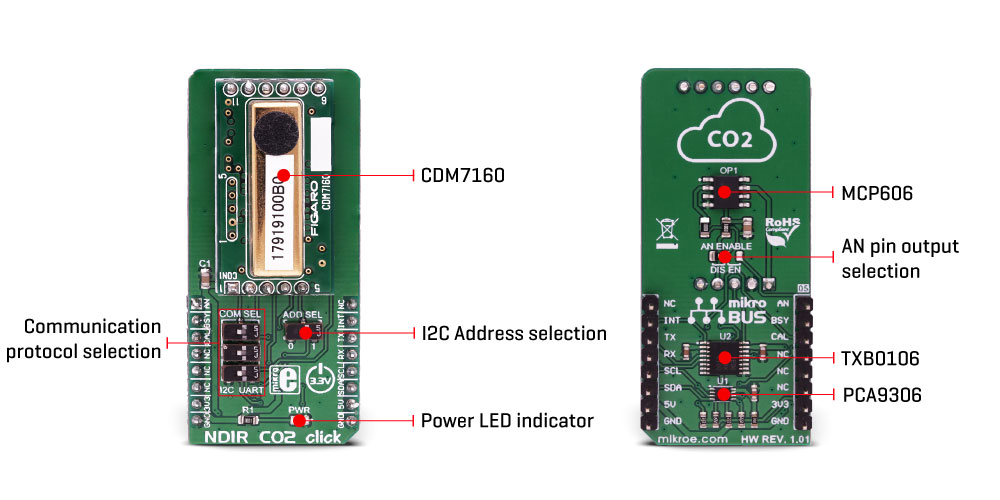
The CDM7160 sensor has the ability to output data in two ways: depending on the status of the MSEL pin, it can use either a UART or I2C communication interface. If this pin is pulled to a LOW logic level, the I2C interface will be selected after the CDM7160 reset cycle. Otherwise, the UART interface will be selected. Since the communication pins are shared between the interfaces (SCL/RX and SDA/TX), they need to be switched to the corresponding pins of the mikroBUS™ whenever the different type of communication is used. Therefore, the Click board™ has a section with three small SMD slide switches labelled as COM SEL. Positioning all three switches to the LEFT position will select the I2C interface while the RIGHT position will select the UART interface. When the I2C interface is selected, an additional pin is available to set up the I2C address of the device. This pin determines the LSB of the I2C slave address and when it is pulled to a LOW logic level, this bit becomes 0. This allows up to 2 different devices to be connected to the same I2C bus. This pin is routed to another SMD slide switch, labelled as the ADD SEL.
It is possible to perform two types of calibration for this sensor: zero calibration and the background calibration. The zero calibration is performed in the atmosphere with the CO2 concentration of 0 ppm, while the background calibration is performed in the atmosphere with a nominal CO2 value (400 ppm). Since the sensor is influenced by the sea level and the atmospheric pressure, these calibrations should be performed whenever these conditions are changed. This will allow an increased accuracy of the CO2 concentration readings. The CDM7160 sensor offers a pin labelled as CAL, for an easy calibration: if the CAL pin is pulled to a LOW logic level for about 2 to 11 seconds, a background calibration will be performed. If pulled to a LOW logic level for more than 12 seconds, the zero calibration will be performed. This pin should remain HIGH during normal operation. An internal pull-up resistor ensures that the pin is always HIGH if it remains floating. This pin is routed to the mikroBUS™ CS pin, labelled as CAL
The ALERT pin of the CDM7160 sensor is used to trigger an interrupt on the host MCU. By default, it will trigger an interrupt if the CO2 concentration exceeds 1000ppm. The interrupt will be cleared if the concentration drops below 900ppm. These settings can be changed by writing values to the corresponding ALHI and ALLO registers (upper and lower threshold registers). The ALERT pin of the CDM7160 sensor is routed to the mikroBUS™ INT pin.
BUSY pin of the sensor provides means to save the sensor from polling sensor registers in order to verify if the device is ready for the communication. By setting an interrupt for the BUSY pin, the MCU can be automatically triggered only when the sensor is ready to accept a new command. A logic LOW level signals the MCU that the sensor is unable to accept a new command. The sensor might be unavailable while processing the data internally, for about 0.3 seconds. This pin is routed to the mikroBUS™ RST pin, labelled as BSY on the Click board™.
Besides UART and I2C communication, the sensor offers a 1KHz PWM signal of with the duty cycle which depends on the CO2 concentration (0 to 5000 ppm of CO2). The Click board™ is equipped with an operational amplifier, which averages the PWM signal, offering analog DC voltage (0 to 5V) on its output, directly proportional to the pulse width of the PWM signal. By switching the SMD jumper labelled as AN ENABLE to EN position, the voltage at the output of this operational amplifier becomes available at the AN pin of the mikroBUS™. By default, the jumper is soldered to DIS position. Note that the full-scale voltage on the operational amplifier output is 5V (5000 ppm of CO2 equals 5V)
To allow communication with 3.3V MCUs, two additional ICs are used: one is the PCA9306, which translates voltage levels of the I2C signals, while the second IC is the TXB0106, used to translate voltage levels of the remaining IC pins, including the UART. Both of these ICs are used on many other designs, and are proven to be very reliable solution.
SPECIFICATIONS
| Type |
Gas |
| Applications |
The NDIR CO2 Click Board™ is a perfect solution for various CO2 measuring applications, such as air conditioning applications, indoor air quality control applications, automatic fresh air exchange and venting system applications, and similar. |
| On-board modules |
CDM7160, a CO2 sensing system, by Figaro Engineering, INC; PCA9306, a dual bidirectional I2C bus voltage translator; TXB0106, a 6bit bidirectional level shifter, both from Texas Instruments; MCP606, a rail-to-rail op-amp by Microchip |
| Key Features |
NDIR sensor which uses dual IR sensors which allow differential reading of CO2 concentration, provides absolute CO2 gas concentration levels, long term stability, accuracy and immunity to interferences and pollution, offers several I/O interface types. |
| Interface |
Analog,I2C,UART |
| Compatibility |
mikroBUS |
| Click board size |
L (57.15 x 25.4 mm) |
| Input Voltage |
3.3V,5V |
PINOUT DIAGRAM
This table shows how the pinout of the NDIR CO2 Click Board™ corresponds to the pinout on the mikroBUS™ socket (the latter shown in the two middle columns).
| Notes |
Pin |
 |
Pin |
Notes |
| Analog OUT |
AN |
1 |
AN |
PWM |
16 |
NC |
| Busy status |
BSY |
2 |
RST |
INT |
15 |
INT |
Alarm OUT |
| Calibration |
CAL |
3 |
CS |
RX |
14 |
TX |
UART TX |
| NC |
4 |
SCK |
TX |
13 |
RX |
UART RX |
| NC |
5 |
MISO |
SCL |
12 |
SCL |
I2C Clock |
| NC |
6 |
MOSI |
SDA |
11 |
SDA |
I2C Data |
| Power supply |
3.3V |
7 |
3.3V |
5V |
10 |
5V |
Power supply |
| Ground |
GND |
8 |
GND |
GND |
9 |
GND |
Ground |
ONBOARD JUMPERS AND SETTINGS
| Label |
Name |
Default |
Description |
| PWR |
PWR |
- |
Power LED indicator |
| SW1 - SW3 |
ADD SEL |
Left |
Communication protocol selection: left position I2C, right position UART |
| SW4 |
ADD SEL |
Left |
I2C address LSB selection: left position 0, right position 1 |
| JP1 |
AN ENABLE |
Left |
AN pin output selection: left position AN disabled, right position AN enabled |
H-BRIDGE CLICK ELECTRICAL SPECIFICATIONS
| Description |
Min |
Type |
Max |
Unit |
| Voltage at the AN pin (if enabled) |
0 |
- |
5 |
V |
| Measurement range |
300 |
- |
5000 |
ppm |
| Averaging interval |
- |
2 |
- |
s |
- description_tag: The NDIR CO2 Click Board™ is an advanced integrated carbon dioxide gas sensor system, which is able to measure an absolute CO2 concentration, by utilizing the CDM7160 integrated sensor. Available from Debug Store UK.
- title_tag: MikroE NDIR CO2 Click Board™ (MIKROE-3134)
- manufacturer: Mikroelektronika d.o.o.
- warranty: 12 months
- amazon_enable: TRUE
- amazon_title: NDIR CO2 Click Board
- amazon_product_type: computercomponent
- amazon_block: FALSE
- amazon_prime_enable: TRUE
- amazon_search: MikroElektronika Microelectronica MIKROE-1100
- amazon_uk_price: 131.12
- amazon_uk_currency: GBP
- amazon_de_currency: EUR
- amazon_de_price: 148.1656
- amazon_fr_currency: EUR
- amazon_fr_price: 148.1656
- amazon_es_currency: EUR
- amazon_es_price: 148.1656
- amazon_nl_currency: EUR
- amazon_nl_price: 148.1656
- amazon_it_currency: EUR
- amazon_it_price: 148.1656
- amazon_se_curency: SEK
- amazon_se_price: 1494.768
- amazon_product_id: 8606018713455
- amazon_product_id_type: EAN
- amazon_update: Update
- amazon_short_description: The NDIR CO2 Click Board™ is an advanced integrated carbon dioxide gas sensor system, which is able to measure an absolute CO2 concentration, by utilizing the CDM7160 integrated sensor. This sensor is based on non-dispersive infrared sensing principle (NDIR), with two detection elements: one is used for detecting the wavelength of the IR light spectrum, affected by the CO2 gas, while the other detects the wavelength of the IR light spectrum not affected by the CO2 gas. The integrated MCU processes the readings and outputs the absolute CO2 gas concentration value through UART or I2C interface. Dual wavelength sensing method allows not only accurate absolute readings, but also provides immunity against dust pollution, providing consistent readings in corrosive atmosphere, variable ambient temperature, and over longer periods of time.
- amazon_long_description: NDIR CO2 Click Board™ is an advanced integrated CO2 gas sensor system, which is able to measure an absolute CO2 concentration, by utilizing the CDM7160 integrated sensor. This sensor is based on non-dispersive infrared sensing principle (NDIR), with two detection elements: one is used for detecting the wavelength of the IR light spectrum, affected by the CO2 gas, while the other detects the wavelength of the IR light spectrum not affected by the CO2 gas. The integrated MCU processes the readings and outputs the absolute CO2 gas concentration value through UART or I2C interface. Dual wavelength sensing method allows not only accurate absolute readings, but also provides immunity against dust pollution, providing consistent readings in corrosive atmosphere, variable ambient temperature, and over longer periods of time.
- amazon_main_image: https://www.thedebugstore.com/images/product/lg-ndir-co2-front_1.jpg
- amazon_other_image_1: https://www.thedebugstore.com/images/product/lg-ndir-co2-back_1.jpg
- amazon_other_image_2: https://www.thedebugstore.com/images/product/lg-ndir-co2-click-in-use_1.jpg
- amazon_browse_node: 428655031
- mpn: MIKROE-3134
- backorder_label: If no stock shown above, check availability
- condition: new
- custom_product: false
- mpn: MIKROE-3134
- google_product_category: Electronics
- custom_label_0: Click Board
- examples:
We provide a demo application for the NDIR CO2 Click Board™ on our Libstock page, as well as a demo application (example), developed using MikroElektronika compilers. The demo can run on all the main MikroElektronika development boards.
Library Description
Library initializes and defines I2C driver and performs writing to registers and reading from registers. Also has the ability to measure CO2 concentration in ppm unit. For more details check the documentation.
Key Functions
uint8_t ndirco2_writeReg( uint8_t register_address, uint8_t transfer_data ) - The function writes one byte of data to register.uint8_t ndirco2_readReg( uint8_t register_address, uint16_t *dataOut ) - The function reads data from a register.void ndirco2_readCO2( uint8_t setCheckMode, uint16_t *outputData ) - The function reads 15-bit CO2 concentration data from data registers, only when data is ready for reading after each measurement, or after the number of consecutive measurements determined by the AVE register + 1 is exceeded.
Example Description
The application is composed of three sections:
- System Initialization - Initializes peripherals and pins.
- Application Initialization - Initializes I2C driver and performs driver reset and determines
a number of averaging measurements.
- Application Task - (code snippet) - Reads CO2 concentration data in ppm unit after each completed measurement. One measurement is finished after 300 ms, and the period between the two measurements is 2 seconds. Results of measurements logs on USBUART.void applicationTask()
void applicationTask()
{
 ndirco2_readCO2( _NDIRCO2_CHECK_EACH_MEASURE, &co2Data );
 WordToStr( co2Data, text );
 mikrobus_logWrite( "CO2 concentration is: ", _LOG_TEXT );
 mikrobus_logWrite( text, _LOG_TEXT );
 mikrobus_logWrite( "ppm", _LOG_LINE );
}
The full application code, and ready to use projects can be found on our Libstock page.
Other MikroElektronika libraries used in the example:
ADDITIONAL NOTES AND INFORMATION
Depending on the development board you are using, you may need a USB UART click, USB UART 2 click or RS232 click to connect to your PC, for development systems with no UART to USB interface available on the board. The terminal available in all MikroElektronika compilers, or any other terminal application of your choice, can be used to read the message.
MIKROSDK
The NDIR CO2 Click Board™ is supported with mikroSDK - MikroElektronika Software Development Kit. To ensure proper operation of mikroSDK compliant click board demo applications, mikroSDK should be downloaded from the LibStock and installed for the compiler you are using.
- attachments: [{"download_file":[{"download_file":"NDIR CO2 Click Board™ Schematic"}],"download_filetype":[{"download_filetype":"pdf"}]},{"download_file":[{"download_file":"Figaro CDM7160 CO2 Sensor Datasheet"}],"download_filetype":[{"download_filetype":"pdf"}]}]
- device_vendor: Figaro, Texas Instruments
- device_type: CDM7160, PCA9306DCUR, TXB0106PWR
- warranty: 12 months
- brand: MikroE
- key_feature_1: Measures Absolute CO2 Concentration
- manufacturer: Mikroelektronika d.o.o.
- badge: No reviews
- widget:
- brands: gid://shopify/Metaobject/56256004319
- breadcrumbs: ["gid://shopify/Collection/447955239135","gid://shopify/Collection/241680580797","gid://shopify/Collection/241545969853"]
- customhs_code: 847330
- detailed_description: {"type":"root","children":[{"type":"paragraph","children":[{"type":"text","value":"Due to its large scale of integration, this sensor requires no external components involved in the measurement process, which improves the overall accuracy. Each of these sensors is factory tested and calibrated. The sensor also offers several I/O pins for simplified configuration and operation, saving the MCU from polling the registers. A specialized ALARM pin offers the possibility to trigger an MCU interrupt if the programmed CO2 concentration value is exceeded. These features make the "},{"type":"text","value":"NDIR CO2 Click Board™","bold":true,"italic":true},{"type":"text","value":" a perfect solution for various CO2 measuring applications, such as air conditioning applications, indoor air quality control applications, automatic fresh air exchange and venting systems, and similar."}]},{"type":"heading","level":2,"children":[{"type":"text","value":"How Does The NDIR CO2 Click Board™ Work?"}]},{"type":"paragraph","children":[{"type":"text","value":"The main component on the "},{"type":"text","value":"NDIR CO2 Click Board™","bold":true},{"type":"text","value":" is the CDM7160, a pre-calibrated single light source, dual wavelength, CO2 sensing system, by Figaro Engineering, INC. Its light source emits the light, which is detected by two IR sensors. One light sensor is placed behind the filter which allows only a part of the IR spectrum affected by the CO2 gas to pass through, while the second sensor is placed behind the filter which passes the IR spectrum of the light which is not affected by the CO2 gas. This forms a kind of a differential input for the sensor - an integrated MCU will process the received data by differentiating these readings. This allows the absolute value of the CO2 gas concentration to be obtained, but also removes any influences of particles and other disturbances, as they affect both sensors equally. This allows consistent readings over various temperatures, in various environments, including areas rich with corrosive gases (SO2, H2S…), and over a longer period of times (aging)."},{"type":"text","value":""},{"type":"text","value":""},{"type":"text","value":""},{"type":"text","value":""},{"type":"text","value":""}]},{"type":"paragraph","children":[{"type":"text","value":"The CDM7160 sensor has the ability to output data in two ways: depending on the status of the MSEL pin, it can use either a UART or I2C communication interface. If this pin is pulled to a LOW logic level, the I2C interface will be selected after the CDM7160 reset cycle. Otherwise, the UART interface will be selected. Since the communication pins are shared between the interfaces (SCL/RX and SDA/TX), they need to be switched to the corresponding pins of the mikroBUS™ whenever the different type of communication is used. Therefore, the Click board™ has a section with three small SMD slide switches labelled as COM SEL. Positioning all three switches to the LEFT position will select the I2C interface while the RIGHT position will select the UART interface. When the I2C interface is selected, an additional pin is available to set up the I2C address of the device. This pin determines the LSB of the I2C slave address and when it is pulled to a LOW logic level, this bit becomes 0. This allows up to 2 different devices to be connected to the same I2C bus. This pin is routed to another SMD slide switch, labelled as the ADD SEL."}]},{"type":"paragraph","children":[{"type":"text","value":"It is possible to perform two types of calibration for this sensor: zero calibration and the background calibration. The zero calibration is performed in the atmosphere with the CO2 concentration of 0 ppm, while the background calibration is performed in the atmosphere with a nominal CO2 value (400 ppm). Since the sensor is influenced by the sea level and the atmospheric pressure, these calibrations should be performed whenever these conditions are changed. This will allow an increased accuracy of the CO2 concentration readings. The CDM7160 sensor offers a pin labelled as CAL, for an easy calibration: if the CAL pin is pulled to a LOW logic level for about 2 to 11 seconds, a background calibration will be performed. If pulled to a LOW logic level for more than 12 seconds, the zero calibration will be performed. This pin should remain HIGH during normal operation. An internal pull-up resistor ensures that the pin is always HIGH if it remains floating. This pin is routed to the mikroBUS™ CS pin, labelled as CAL"}]},{"type":"paragraph","children":[{"type":"text","value":"The ALERT pin of the CDM7160 sensor is used to trigger an interrupt on the host MCU. By default, it will trigger an interrupt if the CO2 concentration exceeds 1000ppm. The interrupt will be cleared if the concentration drops below 900ppm. These settings can be changed by writing values to the corresponding ALHI and ALLO registers (upper and lower threshold registers). The ALERT pin of the CDM7160 sensor is routed to the mikroBUS™ INT pin."}]},{"type":"paragraph","children":[{"type":"text","value":"BUSY pin of the sensor provides means to save the sensor from polling sensor registers in order to verify if the device is ready for the communication. By setting an interrupt for the BUSY pin, the MCU can be automatically triggered only when the sensor is ready to accept a new command. A logic LOW level signals the MCU that the sensor is unable to accept a new command. The sensor might be unavailable while processing the data internally, for about 0.3 seconds. This pin is routed to the mikroBUS™ RST pin, labelled as BSY on the Click board™."}]},{"type":"paragraph","children":[{"type":"text","value":"Besides UART and I2C communication, the sensor offers a 1KHz PWM signal of with the duty cycle which depends on the CO2 concentration (0 to 5000 ppm of CO2). The Click board™ is equipped with an operational amplifier, which averages the PWM signal, offering analog DC voltage (0 to 5V) on its output, directly proportional to the pulse width of the PWM signal. By switching the SMD jumper labelled as AN ENABLE to EN position, the voltage at the output of this operational amplifier becomes available at the AN pin of the mikroBUS™. By default, the jumper is soldered to DIS position. Note that the full-scale voltage on the operational amplifier output is 5V (5000 ppm of CO2 equals 5V)"}]},{"type":"paragraph","children":[{"type":"text","value":"To allow communication with 3.3V MCUs, two additional ICs are used: one is the PCA9306, which translates voltage levels of the I2C signals, while the second IC is the TXB0106, used to translate voltage levels of the remaining IC pins, including the UART. Both of these ICs are used on many other designs, and are proven to be very reliable solution."}]},{"type":"heading","level":3,"children":[{"type":"text","value":"SPECIFICATIONS"}]},{"type":"paragraph","children":[{"type":"text","value":"Type\nGas\nApplications\nThe NDIR CO2 Click Board™ is a perfect solution for various CO2 measuring applications, such as air conditioning applications, indoor air quality control applications, automatic fresh air exchange and venting system applications, and similar.\nOn-board modules\nCDM7160, a CO2 sensing system, by Figaro Engineering, INC; PCA9306, a dual bidirectional I2C bus voltage translator; TXB0106, a 6bit bidirectional level shifter, both from Texas Instruments; MCP606, a rail-to-rail op-amp by Microchip\nKey Features\nNDIR sensor which uses dual IR sensors which allow differential reading of CO2 concentration, provides absolute CO2 gas concentration levels, long term stability, accuracy and immunity to interferences and pollution, offers several I/O interface types.\nInterface\nAnalog,I2C,UART\nCompatibility\nmikroBUS\nClick board size\nL (57.15 x 25.4 mm)\nInput Voltage\n3.3V,5V"}]},{"type":"heading","level":3,"children":[{"type":"text","value":"PINOUT DIAGRAM"}]},{"type":"paragraph","children":[{"type":"text","value":"This table shows how the pinout of the "},{"type":"text","value":"NDIR CO2 Click Board™","bold":true},{"type":"text","value":" corresponds to the pinout on the mikroBUS™ socket (the latter shown in the two middle columns)."}]},{"type":"paragraph","children":[{"type":"text","value":"Notes\nPin\nPin\nNotes\nAnalog OUT\nAN\n1\nAN\nPWM\n16\nNC\nBusy status\nBSY\n2\nRST\nINT\n15\nINT\nAlarm OUT\nCalibration\nCAL\n3\nCS\nRX\n14\nTX\nUART TX\nNC\n4\nSCK\nTX\n13\nRX\nUART RX\nNC\n5\nMISO\nSCL\n12\nSCL\nI2C Clock\nNC\n6\nMOSI\nSDA\n11\nSDA\nI2C Data\nPower supply\n3.3V\n7\n3.3V\n5V\n10\n5V\nPower supply\nGround\nGND\n8\nGND\nGND\n9\nGND\nGround"}]},{"type":"heading","level":3,"children":[{"type":"text","value":""},{"type":"text","value":"ONBOARD JUMPERS AND SETTINGS"}]},{"type":"paragraph","children":[{"type":"text","value":"Label\nName\nDefault\nDescription\nPWR\nPWR\n-\nPower LED indicator\nSW1 - SW3\nADD SEL\nLeft\nCommunication protocol selection: left position I2C, right position UART\nSW4\nADD SEL\nLeft\nI2C address LSB selection: left position 0, right position 1\nJP1\nAN ENABLE\nLeft\nAN pin output selection: left position AN disabled, right position AN enabled"}]},{"type":"heading","level":3,"children":[{"type":"text","value":"H-BRIDGE CLICK ELECTRICAL SPECIFICATIONS"}]},{"type":"paragraph","children":[{"type":"text","value":"Description\nMin\nType\nMax\nUnit\nVoltage at the AN pin (if enabled)\n0\n-\n5\nV\nMeasurement range\n300\n-\n5000\nppm\nAveraging interval\n-\n2\n-\ns"}]},{"type":"heading","level":3,"children":[{"type":"text","value":" "}]}]}
- summary: The NDIR CO2 Click Board™ is an advanced integrated carbon dioxide gas sensor system, which is able to measure an absolute CO2 concentration, by utilizing the CDM7160 integrated sensor. This sensor is based on the non-dispersive infrared sensing principle (NDIR), with two detection elements: one is used for detecting the wavelength of the IR light spectrum, affected by the CO2 gas, while the other detects the wavelength of the IR light spectrum not affected by the CO2 gas.
The integrated MCU processes the readings and outputs the absolute CO2 gas concentration value through UART or I2C interface. The dual-wavelength sensing method allows not only accurate absolute readings, but also provides immunity against dust pollution, providing consistent readings in corrosive atmosphere, variable ambient temperature, and over longer periods of time.