# Title: Clock Gen 2 Click Board™
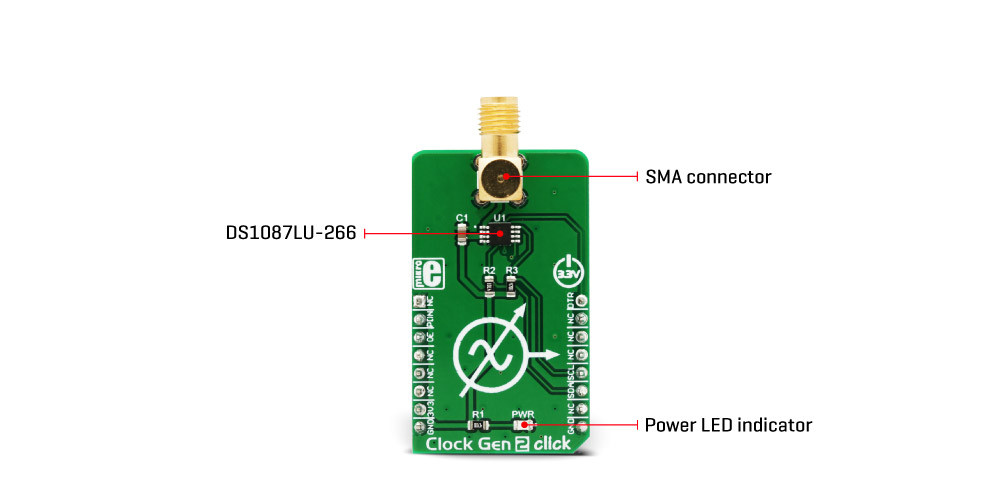
## Description: Equipped with the NV memory, synchronous Output Enable and Power Down function, clock prescaler, spread-spectrum options for reducing EMI radiation, the high-quality SMA connector, and an industry-standard I2C communication interface, the Clock Gen 2 Click Board™ can be used for development and evaluation of various applications that require a reliable and EMI-free clock signal. It can be especially useful when building applications that allow switching of the main MCU, eliminating the need to equip every MCU with its own clock signal generator. Spread-Spectrum Dithering Since all the digital signals within a device are synchronous, the high-frequency harmonics generated on the edges of these digital impulses are adding up, resulting with a very large narrow-band peak signal, that can easily exceed the acceptable level. To avoid this, a technique called spread-spectrum dither is employed, which slightly changes the clock rate over time, broadening the harmonics frequency band, preventing all the digital signals and their harmonics within the circuit to resonate (add-up) and cause considerably large EMI. There are several types of spread-spectrum dithering, depending on the frequency modulation waveform, as well as the modulation range and offset. How Does The Clock Gen 2 Click Board™ Work? The main component used in the Clock Gen 2 Click Board™, is the DS1087LU-266, a 3.3V spread-spectrum EconOscillator, from Analog Devices (Dallas Semiconductors). This IC is factory-produced with a range of different master clock frequencies, ranging from 33.3 MHz, up to 66.6 MHz, with variable spread spectrum percentages. The IC used on the Clock Gen 2 click has the master clock fixed to 66.6 MHz, allowing the frequency range from 260 kHz to 66.6 MHz to be achieved. This IC uses the clock prescaler in the range from 2 0 to 2 8 in order to achieve frequencies different from the master frequency. By selecting the spread-spectrum percentage, it is possible to avoid generation of too much EMI, that otherwise might violate the FCC/IEC regulations. As already mentioned, the internal clock frequency which is generated by the DS1087LU-266 is 66.6MHz. The master clock is frequency-modulated by the internal triangle wave generator. The main oscillator frequency can be dithered below the maximum frequency by a selectable ratio. A bit in the prescaler register determines the spread-spectrum dither range, which can be selected between 2% and 4% under the main clock frequency. The IC pin labelled as SPRD is routed to the mikroBUS™ PWM pin. A logic HIGH level on this pin enables the spread-spectrum function. The DS1087LU is equipped with the non-volatile memory locations (EEPROM), used to store the content of all the configuration registers. Writing data to the configuration registers can be automatically mirrored to the EEPROM. This is controlled by the Write Control bit (WC). It allows to either automatically store data to EEPROM after each register change (WC = 0, default), or to store the config data manually, by issuing the WRITE EE command (WC = 1). This feature allows the configuration to be remembered between the POR (Power ON Reset) cycles. Output Enable (OE) pin allows the output clock to be disabled at the output pin. A logic HIGH level on this pin disables the clock output. However, this will not disable the internal master clock generator, so the IC will still drain the power, necessary to work. To completely put the device in a power down mode, another pin is used: a logic LOW level on the PDN pin shuts down the master oscillator, draining less current from the power source. The OE pin is routed to the mikroBUS™ CS pin and it is labelled as OE, while the PDN pin is routed to the RST pin of the mikroBUS™ and is labelled as PDN. Both of these signals are synchronized with the internal master clock, preventing glitches at the output. The clock output signal is present at the SMA connector on the Click board™. This connector provides protection of the high-frequency clock signal and further reduces EMI. It also provides a reliable contact with the least possible losses. The clock output signal amplitude is 2.4V, which makes this Click board™ usable with most 3.3V operated MCUs and other devices. The standardized I2C interface allows the Clock Gen 2 Click Board™ to be interfaced with a wide range of devices. I2C clock and data pins of the IC (SCL and SDA) are routed to the appropriate mikroBUS™ pins, allows simple and reliable interfacing. SPECIFICATIONS Type Clock generator Applications For development and evaluation of various applications that require a reliable and EMI-free clock signal. Useful when building applications that allow switching of the main MCU, eliminating the need to equip every MCU with own clock signal generator On-board modules DS1087LU-266, a 3.3V spread-spectrum EconOscillator, from Maxim Integrated (Dallas Semiconductors) Key Features Equipped with the NV memory, synchronous Output Enable and Power Down function, clock prescaler, spread-spectrum options for reducing EMI radiation, the high-quality SMA connector Interface GPIO,I2C Compatibility mikroBUS Click board size M (42.9 x 25.4 mm) Input Voltage 3.3V PINOUT DIAGRAM This table shows how the pinout of the Clock Gen 2 Click Board™ corresponds to the pinout on the mikroBUS™ socket (the latter shown in the two middle columns). Notes Pin Pin Notes NC 1 AN PWM 16 DTR Dither Enable Power Down PDN 2 RST INT 15 NC Output Enable OE 3 CS RX 14 NC NC 4 SCK TX 13 NC NC 5 MISO SCL 12 SCL I2C Clock NC 6 MOSI SDA 11 SDA I2C Data Power supply 3.3V 7 3.3V 5V 10 NC Ground GND 8 GND GND 9 GND Ground CLOCK GEN 2 CLICK ELECTRICAL SPECIFICATIONS Description Min Typ Max Unit Master Oscillator Frequency Tolerance -0.5 - 0.5 % I2C clock frequency - - 400 kHz ONBOARD SETTINGS AND INDICATORS Label Name Default Description LD1 PWR - Power LED indicator CN1 CN1 - Clock output SMA connector
## Product type: Click Board
## Vendor: Mikroelektronika d.o.o.
## Tags: Analog Devices, Click Board, Clock Generator, Clock Timing, MikroE
## Price range: 14.0 - 14.0 GBP
## Link: https://thedebugstore.com/products/mikroe-3076-clock-gen-2-click-board-uk
## Compare-at price range: 20.0 - 20.0 GBP
## Options
- Title: Default Title
## Collections
- [New Products](https://thedebugstore.com/a/llms/collections/new-products-debug-store)
- [Mikroelektronika d.o.o. (MikroE)](https://thedebugstore.com/a/llms/collections/mikroelektronika-catalogue-uk)
- [Analog Devices Development Boards and Support Tools | Debug Store](https://thedebugstore.com/a/llms/collections/analog-devices-device-support-uk)
- [Clock & Timing Click Boards™](https://thedebugstore.com/a/llms/collections/clock-timing-click-boards-catalogue)
- [MikroE Click Boards™](https://thedebugstore.com/a/llms/collections/mikroe-click-boards-catalogue-uk)
- [Clock Generators Click Boards™](https://thedebugstore.com/a/llms/collections/clock-generator-click-boards-catalogue)
- [Click Boards™ Summer Sale](https://thedebugstore.com/a/llms/collections/inventory-sale)
- [MikroE Sale](https://thedebugstore.com/a/llms/collections/mikroe-sale)
- [MIKROE Stock](https://thedebugstore.com/a/llms/collections/mikroe-products-in-stock-sale)
## Variants
- Default Title, SKU: MIKROE-3076, Available: yes, Inventory: 1
## Metafields
- full_description:
Equipped with the NV memory, synchronous Output Enable and Power Down function, clock prescaler, spread-spectrum options for reducing EMI radiation, the high-quality SMA connector, and an industry-standard I2C communication interface, the Clock Gen 2 Click Board™ can be used for development and evaluation of various applications that require a reliable and EMI-free clock signal. It can be especially useful when building applications that allow switching of the main MCU, eliminating the need to equip every MCU with its own clock signal generator.
Spread-Spectrum Dithering
Since all the digital signals within a device are synchronous, the high-frequency harmonics generated on the edges of these digital impulses are adding up, resulting with a very large narrow-band peak signal, that can easily exceed the acceptable level. To avoid this, a technique called spread-spectrum dither is employed, which slightly changes the clock rate over time, broadening the harmonics frequency band, preventing all the digital signals and their harmonics within the circuit to resonate (add-up) and cause considerably large EMI. There are several types of spread-spectrum dithering, depending on the frequency modulation waveform, as well as the modulation range and offset.
How Does The Clock Gen 2 Click Board™ Work?
The main component used in the Clock Gen 2 Click Board™, is the DS1087LU-266, a 3.3V spread-spectrum EconOscillator, from Analog Devices (Dallas Semiconductors). This IC is factory-produced with a range of different master clock frequencies, ranging from 33.3 MHz, up to 66.6 MHz, with variable spread spectrum percentages. The IC used on the Clock Gen 2 click has the master clock fixed to 66.6 MHz, allowing the frequency range from 260 kHz to 66.6 MHz to be achieved. This IC uses the clock prescaler in the range from 2 0 to 2 8 in order to achieve frequencies different from the master frequency. By selecting the spread-spectrum percentage, it is possible to avoid generation of too much EMI, that otherwise might violate the FCC/IEC regulations.
As already mentioned, the internal clock frequency which is generated by the DS1087LU-266 is 66.6MHz. The master clock is frequency-modulated by the internal triangle wave generator. The main oscillator frequency can be dithered below the maximum frequency by a selectable ratio. A bit in the prescaler register determines the spread-spectrum dither range, which can be selected between 2% and 4% under the main clock frequency. The IC pin labelled as SPRD is routed to the mikroBUS™ PWM pin. A logic HIGH level on this pin enables the spread-spectrum function.
The DS1087LU is equipped with the non-volatile memory locations (EEPROM), used to store the content of all the configuration registers. Writing data to the configuration registers can be automatically mirrored to the EEPROM. This is controlled by the Write Control bit (WC). It allows to either automatically store data to EEPROM after each register change (WC = 0, default), or to store the config data manually, by issuing the WRITE EE command (WC = 1). This feature allows the configuration to be remembered between the POR (Power ON Reset) cycles.
Output Enable (OE) pin allows the output clock to be disabled at the output pin. A logic HIGH level on this pin disables the clock output. However, this will not disable the internal master clock generator, so the IC will still drain the power, necessary to work. To completely put the device in a power down mode, another pin is used: a logic LOW level on the PDN pin shuts down the master oscillator, draining less current from the power source. The OE pin is routed to the mikroBUS™ CS pin and it is labelled as OE, while the PDN pin is routed to the RST pin of the mikroBUS™ and is labelled as PDN. Both of these signals are synchronized with the internal master clock, preventing glitches at the output.
The clock output signal is present at the SMA connector on the Click board™. This connector provides protection of the high-frequency clock signal and further reduces EMI. It also provides a reliable contact with the least possible losses. The clock output signal amplitude is 2.4V, which makes this Click board™ usable with most 3.3V operated MCUs and other devices.
The standardized I2C interface allows the Clock Gen 2 Click Board™ to be interfaced with a wide range of devices. I2C clock and data pins of the IC (SCL and SDA) are routed to the appropriate mikroBUS™ pins, allows simple and reliable interfacing.
SPECIFICATIONS
Type
Clock generator
Applications
For development and evaluation of various applications that require a reliable and EMI-free clock signal. Useful when building applications that allow switching of the main MCU, eliminating the need to equip every MCU with own clock signal generator
On-board modules
DS1087LU-266, a 3.3V spread-spectrum EconOscillator, from Maxim Integrated (Dallas Semiconductors)
Key Features
Equipped with the NV memory, synchronous Output Enable and Power Down function, clock prescaler, spread-spectrum options for reducing EMI radiation, the high-quality SMA connector
Interface
GPIO,I2C
Compatibility
mikroBUS
Click board size
M (42.9 x 25.4 mm)
Input Voltage
3.3V
PINOUT DIAGRAM
This table shows how the pinout of the Clock Gen 2 Click Board™ corresponds to the pinout on the mikroBUS™ socket (the latter shown in the two middle columns).
Notes
Pin
Pin
Notes
NC
1
AN
PWM
16
DTR
Dither Enable
Power Down
PDN
2
RST
INT
15
NC
Output Enable
OE
3
CS
RX
14
NC
NC
4
SCK
TX
13
NC
NC
5
MISO
SCL
12
SCL
I2C Clock
NC
6
MOSI
SDA
11
SDA
I2C Data
Power supply
3.3V
7
3.3V
5V
10
NC
Ground
GND
8
GND
GND
9
GND
Ground
CLOCK GEN 2 CLICK ELECTRICAL SPECIFICATIONS
Description
Min
Typ
Max
Unit
Master Oscillator Frequency Tolerance
-0.5
-
0.5
%
I2C clock frequency
-
-
400
kHz
ONBOARD SETTINGS AND INDICATORS
Label
Name
Default
Description
LD1
PWR
-
Power LED indicator
CN1
CN1
-
Clock output SMA connector
- description_tag: The Clock Gen 2 Click Board™ is an accurate square wave generator that can generate a clock signal in the range from 260kHz to 66.6MHz. Available from Debug Store UK.
- title_tag: MikroE Clock Gen 2 Click Board™ (MIKROE-3076)
- manufacturer: Mikroelektronika d.o.o.
- warranty: 12 months
- amazon_enable: TRUE
- amazon_title: Clock Gen 2 Click Board
- amazon_product_type: computercomponent
- amazon_block: FALSE
- amazon_prime_enable: FALSE
- amazon_search: MikroElektronika Microelectronica MIKROE-1100
- amazon_uk_price: 14.96
- amazon_uk_currency: GBP
- amazon_de_currency: EUR
- amazon_de_price: 16.9048
- amazon_fr_currency: EUR
- amazon_fr_price: 16.9048
- amazon_es_currency: EUR
- amazon_es_price: 16.9048
- amazon_nl_currency: EUR
- amazon_nl_price: 16.9048
- amazon_it_currency: EUR
- amazon_it_price: 16.9048
- amazon_se_curency: SEK
- amazon_se_price: 170.544
- amazon_product_id: 8606018713202
- amazon_product_id_type: EAN
- amazon_update: Update
- amazon_short_description: The Clock Gen 2 Click Board™ is an accurate square wave generator that can generate a clock signal in the range from 260kHz to 66.6MHz. It generates a square wave in the frequency of 66.6MHz, which is then processed by the prescaler, which can be set in the range from 20 up to 28. This allows the full frequency range to be achieved on the output. The DS1087L, a 3.3V spread-spectrum Econ Oscillator, used on the Clock Gen 2 Click Board™, offers the spread-spectrum function, which can be controlled via the IC pin and register setting. This allows reduced EMI, especially on the high frequencies. Finally, the DS1087L offers a NV memory (EEPROM), which is used for storing the values of the configuration registers.
- amazon_long_description:
The Clock Gen 2 Click Board™ is an accurate square wave generator that can generate a clock signal in the range from 260kHz to 66.6MHz. It generates a square wave in the frequency of 66.6MHz, which is then processed by the prescaler, which can be set in the range from 20 up to 28. This allows the full frequency range to be achieved on the output. The DS1087L, a 3.3V spread-spectrum Econ Oscillator, used on the Clock Gen 2 Click Board™, offers the spread-spectrum function, which can be controlled via the IC pin and register setting. This allows reduced EMI, especially on the high frequencies. Finally, the DS1087L offers a NV memory (EEPROM), which is used for storing the values of the configuration registers.
We provide a library for the Clock Gen 2 Click Board™ on our LibStock page, as well as a demo application (example, developed using MikroElektronika compilers. The demo can run on all the main MikroElektronika development boards.
Library Description
Library provides basic functions for setting different clock output frequencies.
Key functions :
void clockgen2_setPrescaler(uint8_t VAL); - Function for setting the clock prescaler.
void clockgen2_changeAddress(uint8_t _newAddr); - Function for changing the default address.
void clockgen2_outputEnable(uint8_t state); - Function for enabling the clock output.
Examples Description
The application is composed of three sections :
System Initialization - Initialize GPIO and I2C structures.
The full application code, and ready to use projects can be found on our
LibStock page.
Other mikroE Libraries used in the example:
I2C Library
Additional Notes and Information
Depending on the development board you are using, you may need a USB UART click, USB UART 2 click or RS232 click to connect to your PC, for development systems with no UART to USB interface available on the board. The terminal available in all MikroElektronika compilers, or any other terminal application of your choice, can be used to read the message.
MIKROSDK
The Clock Gen 2 Click Board™ is supported with mikroSDK - MikroElektronika Software Development Kit. To ensure proper operation of mikroSDK compliant click board demo applications, mikroSDK should be downloaded from the LibStock and installed for the compiler you are using.
- attachments: [{"download_file":[{"download_file":"Clock Gen 2 Click Board™ Schematic"}],"download_filetype":[{"download_filetype":"pdf"}]},{"download_file":[{"download_file":"Maxim DS1087L Spread-Spectrum Oscillator Datasheet"}],"download_filetype":[{"download_filetype":"pdf"}]}]
- device_vendor: Maxim Integrated
- device_type: DS1087LU-266+
- warranty: 12 months
- brand: MikroE
- manufacturer: Mikroelektronika d.o.o.
- brands: gid://shopify/Metaobject/56256004319
- breadcrumbs: ["gid://shopify/Collection/241680580797","gid://shopify/Collection/241553998013","gid://shopify/Collection/279407231165"]
- customhs_code: 847330
- detailed_description: {"type":"root","children":[{"type":"paragraph","children":[{"type":"text","value":""}]},{"type":"paragraph","children":[{"type":"text","value":"Equipped with the NV memory, synchronous Output Enable and Power Down function, clock prescaler, spread-spectrum options for reducing EMI radiation, the high-quality SMA connector, and an industry-standard I2C communication interface, the "},{"type":"text","value":"Clock Gen 2 Click Board™","bold":true,"italic":true},{"type":"text","value":" can be used for development and evaluation of various applications that require a reliable and EMI-free clock signal. It can be especially useful when building applications that allow switching of the main MCU, eliminating the need to equip every MCU with its own clock signal generator."}]},{"type":"heading","level":2,"children":[{"type":"text","value":"Spread-Spectrum Dithering"}]},{"type":"paragraph","children":[{"type":"text","value":"Since all the digital signals within a device are synchronous, the high-frequency harmonics generated on the edges of these digital impulses are adding up, resulting with a very large narrow-band peak signal, that can easily exceed the acceptable level. To avoid this, a technique called spread-spectrum dither is employed, which slightly changes the clock rate over time, broadening the harmonics frequency band, preventing all the digital signals and their harmonics within the circuit to resonate (add-up) and cause considerably large EMI. There are several types of spread-spectrum dithering, depending on the frequency modulation waveform, as well as the modulation range and offset."}]},{"type":"heading","level":2,"children":[{"type":"text","value":"How Does The Clock Gen 2 Click Board™ Work?"}]},{"type":"paragraph","children":[{"type":"text","value":"The main component used in the "},{"type":"text","value":"Clock Gen 2 Click Board™","bold":true},{"type":"text","value":", is the DS1087LU-266, a 3.3V spread-spectrum EconOscillator, from Analog Devices (Dallas Semiconductors). This IC is factory-produced with a range of different master clock frequencies, ranging from 33.3 MHz, up to 66.6 MHz, with variable spread spectrum percentages. The IC used on the Clock Gen 2 click has the master clock fixed to 66.6 MHz, allowing the frequency range from 260 kHz to 66.6 MHz to be achieved. This IC uses the clock prescaler in the range from 2 "},{"type":"text","value":"0"},{"type":"text","value":" to 2 "},{"type":"text","value":"8"},{"type":"text","value":" in order to achieve frequencies different from the master frequency. By selecting the spread-spectrum percentage, it is possible to avoid generation of too much EMI, that otherwise might violate the FCC/IEC regulations."},{"type":"text","value":""},{"type":"text","value":""},{"type":"text","value":""},{"type":"text","value":""},{"type":"text","value":""},{"type":"text","value":"As already mentioned, the internal clock frequency which is generated by the DS1087LU-266 is 66.6MHz. The master clock is frequency-modulated by the internal triangle wave generator. The main oscillator frequency can be dithered below the maximum frequency by a selectable ratio. A bit in the prescaler register determines the spread-spectrum dither range, which can be selected between 2% and 4% under the main clock frequency. The IC pin labelled as SPRD is routed to the mikroBUS™ PWM pin. A logic HIGH level on this pin enables the spread-spectrum function."}]},{"type":"paragraph","children":[{"type":"text","value":"The DS1087LU is equipped with the non-volatile memory locations (EEPROM), used to store the content of all the configuration registers. Writing data to the configuration registers can be automatically mirrored to the EEPROM. This is controlled by the Write Control bit (WC). It allows to either automatically store data to EEPROM after each register change (WC = 0, default), or to store the config data manually, by issuing the WRITE EE command (WC = 1). This feature allows the configuration to be remembered between the POR (Power ON Reset) cycles."}]},{"type":"paragraph","children":[{"type":"text","value":"Output Enable (OE) pin allows the output clock to be disabled at the output pin. A logic HIGH level on this pin disables the clock output. However, this will not disable the internal master clock generator, so the IC will still drain the power, necessary to work. To completely put the device in a power down mode, another pin is used: a logic LOW level on the PDN pin shuts down the master oscillator, draining less current from the power source. The OE pin is routed to the mikroBUS™ CS pin and it is labelled as OE, while the PDN pin is routed to the RST pin of the mikroBUS™ and is labelled as PDN. Both of these signals are synchronized with the internal master clock, preventing glitches at the output."}]},{"type":"paragraph","children":[{"type":"text","value":"The clock output signal is present at the SMA connector on the Click board™. This connector provides protection of the high-frequency clock signal and further reduces EMI. It also provides a reliable contact with the least possible losses. The clock output signal amplitude is 2.4V, which makes this Click board™ usable with most 3.3V operated MCUs and other devices."}]},{"type":"paragraph","children":[{"type":"text","value":"The standardized I2C interface allows the "},{"type":"text","value":"Clock Gen 2 Click Board™","bold":true},{"type":"text","value":" to be interfaced with a wide range of devices. I2C clock and data pins of the IC (SCL and SDA) are routed to the appropriate mikroBUS™ pins, allows simple and reliable interfacing."}]},{"type":"heading","level":3,"children":[{"type":"text","value":"SPECIFICATIONS"}]},{"type":"paragraph","children":[{"type":"text","value":"Type\nClock generator\nApplications\nFor development and evaluation of various applications that require a reliable and EMI-free clock signal. Useful when building applications that allow switching of the main MCU, eliminating the need to equip every MCU with own clock signal generator\nOn-board modules\nDS1087LU-266, a 3.3V spread-spectrum EconOscillator, from Maxim Integrated (Dallas Semiconductors)\nKey Features\nEquipped with the NV memory, synchronous Output Enable and Power Down function, clock prescaler, spread-spectrum options for reducing EMI radiation, the high-quality SMA connector\nInterface\nGPIO,I2C\nCompatibility\nmikroBUS\nClick board size\nM (42.9 x 25.4 mm)\nInput Voltage\n3.3V"}]},{"type":"heading","level":3,"children":[{"type":"text","value":"PINOUT DIAGRAM"}]},{"type":"paragraph","children":[{"type":"text","value":"This table shows how the pinout of the "},{"type":"text","value":"Clock Gen 2 Click Board™","bold":true},{"type":"text","value":" corresponds to the pinout on the mikroBUS™ socket (the latter shown in the two middle columns)."}]},{"type":"paragraph","children":[{"type":"text","value":"Notes\nPin\nPin\nNotes\nNC\n1\nAN\nPWM\n16\nDTR\nDither Enable\nPower Down\nPDN\n2\nRST\nINT\n15\nNC\nOutput Enable\nOE\n3\nCS\nRX\n14\nNC\nNC\n4\nSCK\nTX\n13\nNC\nNC\n5\nMISO\nSCL\n12\nSCL\nI2C Clock\nNC\n6\nMOSI\nSDA\n11\nSDA\nI2C Data\nPower supply\n3.3V\n7\n3.3V\n5V\n10\nNC\nGround\nGND\n8\nGND\nGND\n9\nGND\nGround"}]},{"type":"heading","level":3,"children":[{"type":"text","value":"CLOCK GEN 2 CLICK ELECTRICAL SPECIFICATIONS"}]},{"type":"paragraph","children":[{"type":"text","value":"Description\nMin\nTyp\nMax\nUnit\nMaster Oscillator Frequency Tolerance\n-0.5\n-\n0.5\n%\nI2C clock frequency\n-\n-\n400\nkHz"}]},{"type":"heading","level":3,"children":[{"type":"text","value":"ONBOARD SETTINGS AND INDICATORS"}]},{"type":"paragraph","children":[{"type":"text","value":"Label\nName\nDefault\nDescription\nLD1\nPWR\n-\nPower LED indicator\nCN1\nCN1\n-\nClock output SMA connector"}]},{"type":"paragraph","children":[{"type":"text","value":""},{"type":"text","value":" "}]}]}
- summary:
The Clock Gen 2 Click Board™ is an accurate square wave generator that can generate a clock signal in the range from 260kHz to 66.6MHz. It generates a square wave in the frequency of 66.6MHz, which is then processed by the prescaler, which can be set in the range from 20 up to 28. This allows the full frequency range to be achieved on the output.
The DS1087L, a 3.3V spread-spectrum Econ Oscillator, used on the Clock Gen 2 Click Board™, offers the spread-spectrum function, which can be controlled via the IC pin and register setting. This allows reduced EMI, especially on the high frequencies. Finally, the DS1087L offers a NV memory (EEPROM), which is used for storing the values of the configuration registers.
 As already mentioned, the internal clock frequency which is generated by the DS1087LU-266 is 66.6MHz. The master clock is frequency-modulated by the internal triangle wave generator. The main oscillator frequency can be dithered below the maximum frequency by a selectable ratio. A bit in the prescaler register determines the spread-spectrum dither range, which can be selected between 2% and 4% under the main clock frequency. The IC pin labelled as SPRD is routed to the mikroBUS™ PWM pin. A logic HIGH level on this pin enables the spread-spectrum function.