# Title: Water Detect Click Board™
## Description: The Water Detect Click Board™ is used for detecting water and other electroconductive liquids. If the detection area is wet the output of Microchip's MCP606 CMOS op-amp will go positive, signaling the presence of liquid. The Water Detect Click Board™ can be used as a household flood alarm sensor, rain detector for smart buildings or for water tanks that act as a limit switch for a pump. You could use it on one of our clicker 2 development boards, with GSM 4 click, or any other from the wireless range, and create a home flood alarm. Any time the Water Detect Click Board™ detects water it will send you an SMS. How Does The Water Detect Click Board™ Work? The Water Detect Click Board™ works by comparing the voltage of two resistor dividers using the MCP606 comparator. The resistor divider (made of R2 and R3) is used as a voltage reference. The MCP606 functions as a comparator on this click board™. The second divider is made of resistor R1 and the sensory area. When the sensory area is dry, it's resistance is near infinite, and the voltage applied to the inverting terminal of the comparator equals VCC. Since the voltage of the reference divider connected to the non-inverting input is VCC/2, the output of the comparator is at zero voltage. Once the liquid is present at the sensory area, it's resistance drops and pulls the voltage on the inverting input of the comparator toward zero volts. Once this voltage falls below VCC/2, the comparator output swings toward VCC signaling the presence of liquid. The comparator output is tied to the INT pin on the mikroBUS™ header. The water detection area is actually made of exposed conducting wires - simple but effective technology. SPECIFICATIONS Type Miscellaneous Applications Household flood alarm sensor, rain detector for smart buildings or water tank fill sensor, automated watering systems, etc. On-board modules Water detection area, MCP606 comparator Key Features The water detection area is actually made of exposed conducting wires - simple but effective technology Interface GPIO Compatibility mikroBUS Click board size L (57.15 x 25.4 mm) Input Voltage 3.3V or 5V PINOUT DIAGRAM This table shows how the pinout of the Water Detect Click Board™ corresponds to the pinout on the mikroBUS™ socket (the latter shown in the two middle columns). Notes Pin Pin Notes NC 1 AN PWM 16 NC NC 2 RST INT 15 INT MCP606 output (water detect) NC 3 CS TX 14 NC NC 4 SCK RX 13 NC NC 5 MISO SCL 12 NC NC 6 MOSI SDA 11 NC Power supply +3.3V 7 3.3V 5V 10 +5V Power supply Ground GND 8 GND GND 9 GND Ground JUMPERS AND SETTINGS Designator Name Default Position Default Option Description VCC SEL VCC SEL Left 3.3V Power Supply Voltage Selection between 3.3V/5V, left position 3.3V, right position 5V
## Product type: Click Board
## Vendor: Mikroelektronika d.o.o.
## Tags: Click Board, MikroE, Misc, Sensor, Water
## Price range: 7.7 - 7.7 GBP
## Link: https://thedebugstore.com/products/mikroe-2786-water-detect-click-board-uk
## Compare-at price range: 11.0 - 11.0 GBP
## Options
- Title: Default Title
## Collections
- [New Products](https://thedebugstore.com/a/llms/collections/new-products-debug-store)
- [Mikroelektronika d.o.o. (MikroE)](https://thedebugstore.com/a/llms/collections/mikroelektronika-catalogue-uk)
- [Sensor Click Boards™](https://thedebugstore.com/a/llms/collections/sensor-click-boards-catalogue)
- [Miscellaneous Click Boards™](https://thedebugstore.com/a/llms/collections/miscellaneous-click-boards-catalogue)
- [MikroE Click Boards™](https://thedebugstore.com/a/llms/collections/mikroe-click-boards-catalogue-uk)
- [Google Shopping - invalid product](https://thedebugstore.com/a/llms/collections/google-shopping-valid-products)
- [Miscellaneous Sensor Click Boards™](https://thedebugstore.com/a/llms/collections/miscellaneous-sensor-click-boards-catalogue)
- [Water Sensor Click Boards™](https://thedebugstore.com/a/llms/collections/water-sensor-click-boards-catalogue)
- [Click Boards™ Summer Sale](https://thedebugstore.com/a/llms/collections/inventory-sale)
- [MikroE Sale](https://thedebugstore.com/a/llms/collections/mikroe-sale)
- [MIKROE Stock](https://thedebugstore.com/a/llms/collections/mikroe-products-in-stock-sale)
## Variants
- Default Title, SKU: MIKROE-2786, Available: yes, Inventory: 1
## Metafields
- full_description: The Water Detect Click Board™ is used for detecting water and other electroconductive liquids. If the detection area is wet the output of Microchip's MCP606 CMOS op-amp will go positive, signaling the presence of liquid.
The Water Detect Click Board™ can be used as a household flood alarm sensor, rain detector for smart buildings or for water tanks that act as a limit switch for a pump.
You could use it on one of our clicker 2 development boards, with GSM 4 click, or any other from the wireless range, and create a home flood alarm. Any time the Water Detect Click Board™ detects water it will send you an SMS.
How Does The Water Detect Click Board™ Work?
The Water Detect Click Board™ works by comparing the voltage of two resistor dividers using the MCP606 comparator. The resistor divider (made of R2 and R3) is used as a voltage reference.
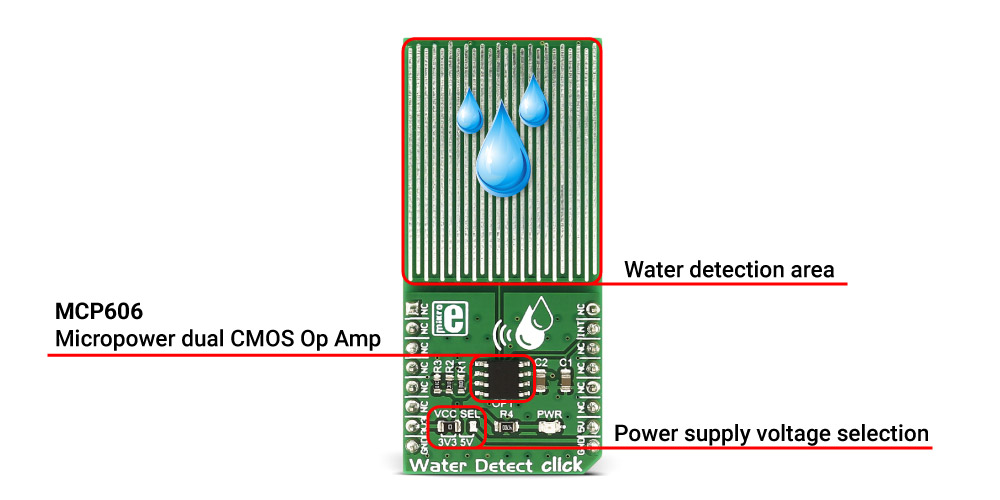
The MCP606 functions as a comparator on this click board™.
The second divider is made of resistor R1 and the sensory area. When the sensory area is dry, it's resistance is near infinite, and the voltage applied to the inverting terminal of the comparator equals VCC.
Since the voltage of the reference divider connected to the non-inverting input is VCC/2, the output of the comparator is at zero voltage. Once the liquid is present at the sensory area, it's resistance drops and pulls the voltage on the inverting input of the comparator toward zero volts. Once this voltage falls below VCC/2, the comparator output swings toward VCC signaling the presence of liquid. The comparator output is tied to the INT pin on the mikroBUS™ header.
The water detection area is actually made of exposed conducting wires - simple but effective technology.
SPECIFICATIONS
| Type |
Miscellaneous |
| Applications |
Household flood alarm sensor, rain detector for smart buildings or water tank fill sensor, automated watering systems, etc. |
| On-board modules |
Water detection area, MCP606 comparator |
| Key Features |
The water detection area is actually made of exposed conducting wires - simple but effective technology |
| Interface |
GPIO |
| Compatibility |
mikroBUS |
| Click board size |
L (57.15 x 25.4 mm) |
| Input Voltage |
3.3V or 5V |
PINOUT DIAGRAM
This table shows how the pinout of the Water Detect Click Board™ corresponds to the pinout on the mikroBUS™ socket (the latter shown in the two middle columns).
| Notes |
Pin |
 |
Pin |
Notes |
| NC |
1 |
AN |
PWM |
16 |
NC |
| NC |
2 |
RST |
INT |
15 |
INT |
MCP606 output (water detect) |
| NC |
3 |
CS |
TX |
14 |
NC |
| NC |
4 |
SCK |
RX |
13 |
NC |
| NC |
5 |
MISO |
SCL |
12 |
NC |
| NC |
6 |
MOSI |
SDA |
11 |
NC |
| Power supply |
+3.3V |
7 |
3.3V |
5V |
10 |
+5V |
Power supply |
| Ground |
GND |
8 |
GND |
GND |
9 |
GND |
Ground |
JUMPERS AND SETTINGS
| Designator |
Name |
Default Position |
Default Option |
Description |
| VCC SEL |
VCC SEL |
Left |
3.3V |
Power Supply Voltage Selection between 3.3V/5V, left position 3.3V, right position 5V |
- description_tag: The Water Detect Click Board™ is used for detecting water and other electro-conductive liquids. If the detection area is wet the output of Microchip's MCP606 CMOS op-amp will go positive, signalling the presence of liquid. Available from Debug Store UK.
- title_tag: MikroE Water Detect Click Board™ (MIKROE-2786)
- manufacturer: Mikroelektronika d.o.o.
- warranty: 12 months
- amazon_enable: TRUE
- amazon_title: Water Detect Click Board
- amazon_product_type: computercomponent
- amazon_block: FALSE
- amazon_prime_enable: FALSE
- amazon_search: MikroElektronika Microelectronica MIKROE-1100
- amazon_uk_price: 7.92
- amazon_uk_currency: GBP
- amazon_de_currency: EUR
- amazon_de_price: 8.9496
- amazon_fr_currency: EUR
- amazon_fr_price: 8.9496
- amazon_es_currency: EUR
- amazon_es_price: 8.9496
- amazon_nl_currency: EUR
- amazon_nl_price: 8.9496
- amazon_it_currency: EUR
- amazon_it_price: 8.9496
- amazon_se_curency: SEK
- amazon_se_price: 90.288
- amazon_product_id: 8606018711642
- amazon_product_id_type: EAN
- amazon_update: Update
- amazon_short_description: Avoid plumbing and water leakage disasters!.The Water Detect Click Board™ is used for detecting water and other electro-conductive liquids. If the detection area is wet the output of Microchip's MCP606 CMOS op-amp will go positive, signalling the presence of liquid.Water Detect Click Board™ can be used as a household flood alarm sensor, rain detector for smart buildings or for water tanks that act as a limit switch for a pump.
- amazon_long_description: The Water Detect Click Board™ is used for detecting water and other electroconductive liquids. If the detection area is wet the output of Microchip's MCP606 CMOS op-amp will go positive, signaling the presence of liquid.
Water Detect Click can be used as a household flood alarm sensor, rain detector for smart buildings or for water tanks that act as a limit switch for a pump.
You could use it on one of the MikroE Clicker 2 development boards, with GSM 4 Click, or any other from the wireless range, and create a home flood alarm. Any time Water Detect Click detects water it will send you an SMS.
How the Water Detect Click Works
Water Detect Click works by comparing the voltage of two resistor dividers using the MCP606 comparator. The resistor divider (made of R2 and R3) is used as a voltage reference.
 .
.
The MCP606 functions as a comparator on this Click Board™'.
The second divider is made of resistor R1 and the sensory area. When the sensory area is dry, it's resistance is near infinite, and the voltage applied to the inverting terminal of the comparator equals VCC.
Since the voltage of the reference divider connected to the non-inverting input is VCC/2, the output of the comparator is at zero voltage. Once the liquid is present at the sensory area, it's resistance drops and pulls the voltage on the inverting input of the comparator toward zero volts. Once this voltage falls below VCC/2, the comparator output swings toward VCC signaling the presence of liquid. The comparator output is tied to the INT pin on the mikroBUS header.
The water detection area is actually made of exposed conducting wires - simple but effective technology.
- amazon_main_image: https://www.thedebugstore.com/images/product/lg-water-detect-click-board.jpg
- amazon_browse_node: 428655031
- mpn: MIKROE-2786
- backorder_label: If no stock shown above, check availability
- badge: No reviews
- widget:
- condition: new
- custom_product: false
- mpn: MIKROE-2786
- google_product_category: Electronics
- custom_label_0: Click Board
- examples:
We provide a library that reads the status of the click output (INT pin) when water is detected, as well as an example application that, when this happens, sends the message “Water detected!” on the microcontroller UART. The library and the example run on all the MikroElektronika compilers and main development boards; you can download both on LibStock.
Note: depending on the development board you are using, you may need the RS232 click or USB-UART click, to connect to your PC. The terminal available in all MikroElektronika compilers, or any other of your choice, can be used to read the message.
Library Description
The library implements GPIO HAL and one function which checks the state of the INT pin.
Key Functions
uint8_t WDETECT_getStatus() - Returns water detection status
Demo application description
The demo application is composed of three sections :
- System Initialization - Initializes GPIO and UART used for logging
- Application Initialization - Initializes Library GPIO HAL
- Application Task - (code snippet) Constantly polling INT pin using
WDETECT_getStatus() if water is detected it sends a message to UART. It uses the getINT() function which returns the state of INT pin.
void applicationTask()
{
 if (WDETECT_getStatus())
 {
 UART1_Write_text("Water Detected!");
 UART1_Write(13);
 UART1_Write(10);
 }
}
Other MikroElektronika Libraries used in this demo application:
- attachments: [{"download_file":[{"download_file":"Water Detect Click Board™ Schematic"}],"download_filetype":[{"download_filetype":"pdf"}]},{"download_file":[{"download_file":"Microchip MCP606 CMOS OpAmp Datasheet"}],"download_filetype":[{"download_filetype":"pdf"}]}]
- device_vendor: Microchip Technology
- device_type: MCP606-I/SN
- warranty: 12 months
- brand: MikroE
- manufacturer: Mikroelektronika d.o.o.
- brands: gid://shopify/Metaobject/56256004319
- breadcrumbs: ["gid://shopify/Collection/447955239135","gid://shopify/Collection/241680580797","gid://shopify/Collection/241545969853"]
- customhs_code: 847330
- detailed_description: {"type":"root","children":[{"type":"paragraph","children":[{"type":"text","value":"The "},{"type":"text","value":"Water Detect Click Board™","bold":true,"italic":true},{"type":"text","value":" is used for detecting water and other electroconductive liquids. If the detection area is wet the output of Microchip's MCP606 CMOS op-amp will go positive, signaling the presence of liquid."}]},{"type":"paragraph","children":[{"type":"text","value":"The "},{"type":"text","value":"Water Detect Click Board™","bold":true},{"type":"text","value":" can be used as a household flood alarm sensor, rain detector for smart buildings or for water tanks that act as a limit switch for a pump."},{"type":"text","value":""},{"type":"text","value":""},{"type":"text","value":""},{"type":"text","value":"You could use it on one of our clicker 2 development boards, with GSM 4 click, or any other from the wireless range, and create a home flood alarm. Any time the "},{"type":"text","value":"Water Detect Click Board™","bold":true},{"type":"text","value":" detects water it will send you an SMS."}]},{"type":"heading","level":3,"children":[{"type":"text","value":"How Does The Water Detect Click Board™ Work?"}]},{"type":"paragraph","children":[{"type":"text","value":"The "},{"type":"text","value":"Water Detect Click Board™","bold":true},{"type":"text","value":" works by comparing the voltage of two resistor dividers using the MCP606 comparator. The resistor divider (made of R2 and R3) is used as a voltage reference."},{"type":"text","value":""},{"type":"text","value":""},{"type":"text","value":""}]},{"type":"paragraph","children":[{"type":"text","value":"The MCP606 functions as a comparator on this click board™."},{"type":"text","value":""},{"type":"text","value":""},{"type":"text","value":""},{"type":"text","value":"The second divider is made of resistor R1 and the sensory area. When the sensory area is dry, it's resistance is near infinite, and the voltage applied to the inverting terminal of the comparator equals VCC."}]},{"type":"paragraph","children":[{"type":"text","value":"Since the voltage of the reference divider connected to the non-inverting input is VCC/2, the output of the comparator is at zero voltage. Once the liquid is present at the sensory area, it's resistance drops and pulls the voltage on the inverting input of the comparator toward zero volts. Once this voltage falls below VCC/2, the comparator output swings toward VCC signaling the presence of liquid. The comparator output is tied to the INT pin on the mikroBUS™ header."},{"type":"text","value":""},{"type":"text","value":""},{"type":"text","value":""},{"type":"text","value":"The water detection area is actually made of exposed conducting wires - simple but effective technology."}]},{"type":"heading","level":3,"children":[{"type":"text","value":"SPECIFICATIONS"}]},{"type":"paragraph","children":[{"type":"text","value":"Type\nMiscellaneous\nApplications\nHousehold flood alarm sensor, rain detector for smart buildings or water tank fill sensor, automated watering systems, etc.\nOn-board modules\nWater detection area, MCP606 comparator\nKey Features\nThe water detection area is actually made of exposed conducting wires - simple but effective technology\nInterface\nGPIO\nCompatibility\nmikroBUS\nClick board size\nL (57.15 x 25.4 mm)\nInput Voltage\n3.3V or 5V"}]},{"type":"heading","level":3,"children":[{"type":"text","value":"PINOUT DIAGRAM"}]},{"type":"paragraph","children":[{"type":"text","value":"This table shows how the pinout of the "},{"type":"text","value":"Water Detect Click Board™","bold":true},{"type":"text","value":" corresponds to the pinout on the mikroBUS™ socket (the latter shown in the two middle columns)."}]},{"type":"paragraph","children":[{"type":"text","value":"Notes\nPin\nPin\nNotes\nNC\n1\nAN\nPWM\n16\nNC\nNC\n2\nRST\nINT\n15\nINT\nMCP606 output (water detect)\nNC\n3\nCS\nTX\n14\nNC\nNC\n4\nSCK\nRX\n13\nNC\nNC\n5\nMISO\nSCL\n12\nNC\nNC\n6\nMOSI\nSDA\n11\nNC\nPower supply\n+3.3V\n7\n3.3V\n5V\n10\n+5V\nPower supply\nGround\nGND\n8\nGND\nGND\n9\nGND\nGround"}]},{"type":"heading","level":3,"children":[{"type":"text","value":"JUMPERS AND SETTINGS"}]},{"type":"paragraph","children":[{"type":"text","value":"Designator\nName\nDefault Position\nDefault Option\nDescription\nVCC SEL\nVCC SEL\nLeft\n3.3V\nPower Supply Voltage Selection between 3.3V/5V, left position 3.3V, right position 5V"}]},{"type":"heading","level":3,"children":[{"type":"text","value":" "}]},{"type":"list","listType":"unordered","children":[]}]}
- summary: Avoid plumbing and water leakage disasters!.
The Water Detect Click Board™ is used for detecting water and other electro-conductive liquids. If the detection area is wet the output of Microchip's MCP606 CMOS op-amp will go positive, signaling the presence of liquid.
The Water Detect Click Board™ can be used as a household flood alarm sensor, rain detector for smart buildings or for water tanks that act as a limit switch for a pump.
 .
.