# Title: IqRF 2 Click Board™
## Description: The IQRF 2 Click Board™ carries the DCTR-72DAT RF transceiver, operating in the 868/916 MHz frequency. The click is designed to run on a 3.3V power supply. It communicates with the target microcontroller over SPI or UART interface, with additional functionality provided by the following pins on the mikroBUS™ line: AN, PWM. Module Features DCTR-72DAT is an RF transceiver operating in the 868/916 MHz license-free ISM (Industry, Scientific, and Medical) frequency band. Its highly integrated ready-to-use design containing MCU, RF circuitry, serial EEPROM and optional onboard antenna requires no external components. How Does The IQRF 2 Click Board™ Work? The DCTR-72DAT module's highly integrated ready-to-use design containing MCU, RF circuitry, integrated LDO regulator, serial EEPROM, optional temperature sensor and optional onboard antenna requires no external components. It has extended RF power results in higher RF range. The ultra-low power consumption fits for battery powered applications. The module with a built-in operating system significantly reduces application development time. Optional DPA framework supports applications even without programming. To upload application codes in DCTRs and configure DCTR parameters, CK-USB-04A kit is intended. When the application is uploaded to the IQRF it can be put in microBUS™ socket and communicate with it with MCU. To upload the firmware put the jumpers in the SPI position. To use our LibStock library examples the jumpers need to be in UART position. SPECIFICATIONS Type Sub-1 GHz Transceievers Applications Point-to-point or network wireless connectivity, Telemetry, AMR (automatic meter reading), WSN (wireless sensor network), Building automation, Street lighting control, etc. On-board modules DCTR-72DAT RF transceiver Key Features Selectable RF band 868 / 916 MHz, multiple channels Interface Analog,GPIO,SPI,UART Compatibility mikroBUS Click board size M (42.9 x 25.4 mm) Input Voltage 3.3V PINOUT DIAGRAM This table shows how the pinout of the IQRF 2 Click Board™ corresponds to the pinout on the mikroBUS™ socket (the latter shown in the two middle columns). Notes Pin Pin Notes Analog pin ADC 1 AN PWM 16 DIN General I/O pin NC 2 RST INT 15 NC SPI enable SPI_CS 3 CS TX 14 TXD UART transmit SPI Clock SPI_SCK 4 SCK RX 13 RXD UART receive SPI Master Input Slave Output SPI_MISO 5 MISO SCL 12 NC SPI Master Output Slave Input SPI_MOSI 6 MOSI SDA 11 NC Power supply +3.3V 7 3.3V 5V 10 NC Ground GND 8 GND GND 9 GND Ground
## Product type: Click Board
## Vendor: Mikroelektronika d.o.o.
## Tags: Click Board, IQRF, Microrisc, MikroE, Sub-1GHz, Wireless
## Price range: 41.3 - 41.3 GBP
## Link: https://thedebugstore.com/products/mikroe-2587-iqrf-2-click-board-uk
## Compare-at price range: 59.0 - 59.0 GBP
## Options
- Title: Default Title
## Collections
- [New Products](https://thedebugstore.com/a/llms/collections/new-products-debug-store)
- [Mikroelektronika d.o.o. (MikroE)](https://thedebugstore.com/a/llms/collections/mikroelektronika-catalogue-uk)
- [iQRF Device Support: Development Boards & Tools | Debug Store UK](https://thedebugstore.com/a/llms/collections/iqrf-device-support-uk)
- [Wireless Interface Click Boards™](https://thedebugstore.com/a/llms/collections/wireless-interface-click-boards-catalogue)
- [MikroE Click Boards™](https://thedebugstore.com/a/llms/collections/mikroe-click-boards-catalogue-uk)
- [Sub-1GHz Transceiver Click Boards™](https://thedebugstore.com/a/llms/collections/sub-1ghz-transceiver-click-boards-catalogue)
- [Click Boards™ Summer Sale](https://thedebugstore.com/a/llms/collections/inventory-sale)
- [Microrisc s.r.o. Device Support: IQRF Wireless Technology Solutions](https://thedebugstore.com/a/llms/collections/microrisc-s-r-o-device-support)
- [MikroE Sale](https://thedebugstore.com/a/llms/collections/mikroe-sale)
- [MIKROE Stock](https://thedebugstore.com/a/llms/collections/mikroe-products-in-stock-sale)
## Variants
- Default Title, SKU: MIKROE-2587, Available: yes, Inventory: 1
## Metafields
- full_description: The IQRF 2 Click Board™ carries the DCTR-72DAT RF transceiver, operating in the 868/916 MHz frequency. The click is designed to run on a 3.3V power supply. It communicates with the target microcontroller over SPI or UART interface, with additional functionality provided by the following pins on the mikroBUS™ line: AN, PWM.
Module Features
DCTR-72DAT is an RF transceiver operating in the 868/916 MHz license-free ISM (Industry, Scientific, and Medical) frequency band. Its highly integrated ready-to-use design containing MCU, RF circuitry, serial EEPROM and optional onboard antenna requires no external components.
How Does The IQRF 2 Click Board™ Work?
The DCTR-72DAT module's highly integrated ready-to-use design containing MCU, RF circuitry, integrated LDO regulator, serial EEPROM, optional temperature sensor and optional onboard antenna requires no external components.
It has extended RF power results in higher RF range. The ultra-low power consumption fits for battery powered applications.
The module with a built-in operating system significantly reduces application development time. Optional DPA framework supports applications even without programming.
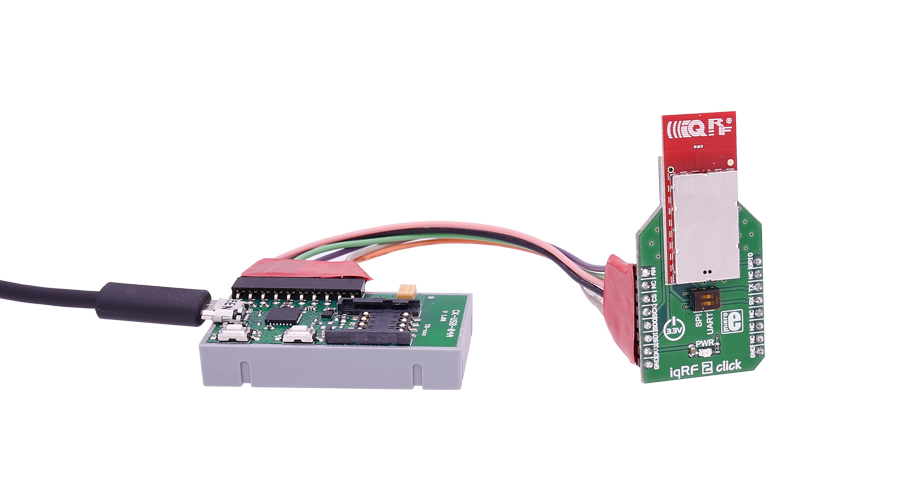
To upload application codes in DCTRs and configure DCTR parameters, CK-USB-04A kit is intended. When the application is uploaded to the IQRF it can be put in microBUS™ socket and communicate with it with MCU.
To upload the firmware put the jumpers in the SPI position.
To use our LibStock library examples the jumpers need to be in UART position.
SPECIFICATIONS
| Type |
Sub-1 GHz Transceievers |
| Applications |
Point-to-point or network wireless connectivity, Telemetry, AMR (automatic meter reading), WSN (wireless sensor network), Building automation, Street lighting control, etc. |
| On-board modules |
DCTR-72DAT RF transceiver |
| Key Features |
Selectable RF band 868 / 916 MHz, multiple channels |
| Interface |
Analog,GPIO,SPI,UART |
| Compatibility |
mikroBUS |
| Click board size |
M (42.9 x 25.4 mm) |
| Input Voltage |
3.3V |
PINOUT DIAGRAM
This table shows how the pinout of the IQRF 2 Click Board™ corresponds to the pinout on the mikroBUS™ socket (the latter shown in the two middle columns).
| Notes |
Pin |
 |
Pin |
Notes |
| Analog pin |
ADC |
1 |
AN |
PWM |
16 |
DIN |
General I/O pin |
| NC |
2 |
RST |
INT |
15 |
NC |
| SPI enable |
SPI_CS |
3 |
CS |
TX |
14 |
TXD |
UART transmit |
| SPI Clock |
SPI_SCK |
4 |
SCK |
RX |
13 |
RXD |
UART receive |
| SPI Master Input Slave Output |
SPI_MISO |
5 |
MISO |
SCL |
12 |
NC |
| SPI Master Output Slave Input |
SPI_MOSI |
6 |
MOSI |
SDA |
11 |
NC |
| Power supply |
+3.3V |
7 |
3.3V |
5V |
10 |
NC |
| Ground |
GND |
8 |
GND |
GND |
9 |
GND |
Ground |
- description_tag: The IQRF 2 Click Board™ carries the DCTR-72DAT RF transceiver, operating in the 868/916 MHz frequency. The Click Board™ is designed to run on a 3.3V power supply. Available from Debug Store UK.
- title_tag: MikroE IqRF 2 Click Board™ (MIKROE-2587)
- manufacturer: Mikroelektronika d.o.o.
- warranty: 12 months
- amazon_enable: TRUE
- amazon_title: IqRF 2 Click Board
- amazon_product_type: computercomponent
- amazon_block: FALSE
- amazon_prime_enable: FALSE
- amazon_search: MikroElektronika Microelectronica MIKROE-1100
- amazon_uk_price: 43.12
- amazon_uk_currency: GBP
- amazon_de_currency: EUR
- amazon_de_price: 48.7256
- amazon_fr_currency: EUR
- amazon_fr_price: 48.7256
- amazon_es_currency: EUR
- amazon_es_price: 48.7256
- amazon_nl_currency: EUR
- amazon_nl_price: 48.7256
- amazon_it_currency: EUR
- amazon_it_price: 48.7256
- amazon_se_curency: SEK
- amazon_se_price: 491.568
- amazon_product_id: 8606018710362
- amazon_product_id_type: EAN
- amazon_update: Update
- amazon_short_description: The IQRF 2 Click Board™ carries the DCTR-72DAT RF transceiver, operating in the 868/916 MHz frequency. The Click Board™ is designed to run on a 3.3V power supply.It communicates with the target microcontroller over SPI or UART interface, with additional functionality provided by the following pins on the MikroBUSline: AN, PWM.
- amazon_long_description: The IQRF 2 Click Board™ carries the DCTR-72DAT RF transceiver, operating in the 868/916 MHz frequency. The Click Board™ is designed to run on a 3.3V power supply.
It communicates with the target microcontroller over SPI or UART interface, with additional functionality provided by the following pins on the MikroBUSline: AN, PWM.
- amazon_main_image: https://www.thedebugstore.com/images/product/lg-iqrf-2-back_1.jpg
- amazon_other_image_1: https://www.thedebugstore.com/images/product/lg-iqrf-2-click_1.jpg
- amazon_other_image_2: https://www.thedebugstore.com/images/product/lg-iqrf-2-click-in-use_1.jpg
- amazon_other_image_3: https://www.thedebugstore.com/images/product/lg-iqrf-2-front_1.jpg
- amazon_browse_node: 428655031
- mpn: MIKROE-2587
- backorder_label: If no stock shown above, check availability
- google_product_category: 2082
- condition: new
- custom_product: false
- mpn: MIKROE-2587
- google_product_category: Electronics
- custom_label_0: Click Board
- examples:
Code examples for the IQRF 2 Click Board™, written for MikroElektronika hardware and compilers are available on Libstock.
CODE SNIPPET
This code snippet contains receiver and transmitter code for the IQRF 2 Click Board™ working with Thermo K click. When in transmit mode, MCU reads temperature from Thermo K and if certain threshold has been reached, byte data is sent to IQRF board via UART communication. Then, iqRF is broadcasting that byte to every other iqRF within range. Every Other IQRF click board is receiving that byte via RF communication and sending data to his local MCU via UART. Every event is displayed on easyTFT.
01 while(1)
02   {
03     #ifdef __TX__
04     ////////////////////////////////////////
05     status = &Read_MCP9600_Status;
06     Temp_Data_Ready = (status & 0x40);
07
08     temp =  Read_Temperature();
09
10     if (Temp_Data_Ready)
11     {                                        // Check is Temperature Data ready
12       sprintf(txt, "%2.1f  C", temp);        // Format Temperature Data and store it to txt
13       res = strcmp(txt,old_txt);             // Compare old_txt and txt
14
15       if(res != 0)                           // If old_txt and txt are not equal
16       {
17         updateLabel(txt, 135, 90, lab1);     // Write temperature value on display
18         strcpy(old_txt,txt);                 // Copy txt to old_txt string array
19       }
20     }
21
22     if (temp <= LOW_TEMP_POINT)              // If low temperature point has been reached
23     {
24      if (!low_point_reached)
25      {
26       UART3_Write_Text("L");                 // Send byte via UART
27      }
28      low_point_reached = true;
29
30     }
31     else if (temp >= HIGH_TEMP_POINT)        // If high temperature point has been reached
32     {
33      if(!high_point_reached)
34      {
35       UART3_Write_Text("H");                 // Send byte via UART
36      }
37      high_point_reached = true;
38
39     }
40     else
41     {
42      low_point_reached = false;
43      high_point_reached = false;
44     }
45     Delay_ms(500);
46   #endif
47   ////////////////////////////////////////
48   #ifdef __RX__
49
50     TFT_Set_Font(&HandelGothic_BT21x22_Regular, CL_BLACK, FO_HORIZONTAL);
51
52     // Writing warnings on display
53     if(high_point_reached)
54     {
55      TFT_Set_Font(&HandelGothic_BT21x22_Regular, CL_RED, FO_HORIZONTAL);
56      high_point_reached = false;
57      TFT_Write_Text("HIGH ", 130, 100);
58      Delay_ms(2000);
59      TFT_Set_Font(&HandelGothic_BT21x22_Regular, CL_WHITE, FO_HORIZONTAL);
60      TFT_Write_Text("HIGH ", 130, 100);
61     }
62     if(low_point_reached)
63     {
64      TFT_Set_Font(&HandelGothic_BT21x22_Regular, CL_BLUE, FO_HORIZONTAL);
65      low_point_reached = false;
66      TFT_Write_Text("LOW", 130, 100);
67      Delay_ms(2000);
68      TFT_Set_Font(&HandelGothic_BT21x22_Regular, CL_WHITE, FO_HORIZONTAL);
69      TFT_Write_Text("LOW ", 130, 100);
70     }
71   #endif
72   }
73
74 }
- attachments: [{"download_file":[{"download_file":"IqRF 2 Click Board™ Schematic"}],"download_filetype":[{"download_filetype":"pdf"}]},{"download_file":[{"download_file":"IQRF DCTR-32DAT RF Transceiver Datasheet"}],"download_filetype":[{"download_filetype":"pdf"}]}]
- device_vendor: MICRORISC s.r.o
- device_type: DCTR-72DAT
- warranty: 12 months
- brand: MikroE
- manufacturer: Mikroelektronika d.o.o.
- badge: No reviews
- widget:
- brands: gid://shopify/Metaobject/56256004319
- breadcrumbs: ["gid://shopify/Collection/447955239135","gid://shopify/Collection/241680580797","gid://shopify/Collection/241546166461"]
- customhs_code: 847330
- detailed_description: {"type":"root","children":[{"type":"paragraph","children":[{"type":"text","value":"The"},{"type":"text","value":" IQRF 2 Click Board™","bold":true,"italic":true},{"type":"text","value":" carries the DCTR-72DAT RF transceiver, operating in the 868/916 MHz frequency. The click is designed to run on a 3.3V power supply. It communicates with the target microcontroller over SPI or UART interface, with additional functionality provided by the following pins on the mikroBUS™ line: AN, PWM."}]},{"type":"heading","level":3,"children":[{"type":"text","value":"Module Features"}]},{"type":"paragraph","children":[{"type":"text","value":"DCTR-72DAT is an RF transceiver operating in the 868/916 MHz license-free ISM (Industry, Scientific, and Medical) frequency band. Its highly integrated ready-to-use design containing MCU, RF circuitry, serial EEPROM and optional onboard antenna requires no external components."}]},{"type":"heading","level":3,"children":[{"type":"text","value":"How Does The IQRF 2 Click Board™ Work?"}]},{"type":"paragraph","children":[{"type":"text","value":"The DCTR-72DAT module's highly integrated ready-to-use design containing MCU, RF circuitry, integrated LDO regulator, serial EEPROM, optional temperature sensor and optional onboard antenna requires no external components."},{"type":"text","value":""},{"type":"text","value":""},{"type":"text","value":""},{"type":"text","value":"It has extended RF power results in higher RF range. The ultra-low power consumption fits for battery powered applications."},{"type":"text","value":""},{"type":"text","value":""},{"type":"text","value":""},{"type":"text","value":"The module with a built-in operating system significantly reduces application development time. Optional DPA framework supports applications even without programming."},{"type":"text","value":""},{"type":"text","value":""},{"type":"text","value":""},{"type":"text","value":""},{"type":"text","value":""},{"type":"text","value":""},{"type":"text","value":""},{"type":"text","value":""},{"type":"text","value":"To upload application codes in DCTRs and configure DCTR parameters, CK-USB-04A kit is intended. When the application is uploaded to the IQRF it can be put in microBUS™ socket and communicate with it with MCU."},{"type":"text","value":""},{"type":"text","value":""},{"type":"text","value":""},{"type":"text","value":"To upload the firmware put the jumpers in the SPI position."},{"type":"text","value":""},{"type":"text","value":""},{"type":"text","value":""},{"type":"text","value":"To use our LibStock library examples the jumpers need to be in UART position."}]},{"type":"heading","level":3,"children":[{"type":"text","value":"SPECIFICATIONS"}]},{"type":"paragraph","children":[{"type":"text","value":"Type\nSub-1 GHz Transceievers\nApplications\nPoint-to-point or network wireless connectivity, Telemetry, AMR (automatic meter reading), WSN (wireless sensor network), Building automation, Street lighting control, etc.\nOn-board modules\nDCTR-72DAT RF transceiver\nKey Features\nSelectable RF band 868 / 916 MHz, multiple channels\nInterface\nAnalog,GPIO,SPI,UART\nCompatibility\nmikroBUS\nClick board size\nM (42.9 x 25.4 mm)\nInput Voltage\n3.3V"}]},{"type":"heading","level":3,"children":[{"type":"text","value":"PINOUT DIAGRAM"}]},{"type":"paragraph","children":[{"type":"text","value":"This table shows how the pinout of the "},{"type":"text","value":"IQRF 2 Click Board™","bold":true},{"type":"text","value":" corresponds to the pinout on the mikroBUS™ socket (the latter shown in the two middle columns)."}]},{"type":"paragraph","children":[{"type":"text","value":"Notes\nPin\nPin\nNotes\nAnalog pin\nADC\n1\nAN\nPWM\n16\nDIN\nGeneral I/O pin\nNC\n2\nRST\nINT\n15\nNC\nSPI enable\nSPI_CS\n3\nCS\nTX\n14\nTXD\nUART transmit\nSPI Clock\nSPI_SCK\n4\nSCK\nRX\n13\nRXD\nUART receive\nSPI Master Input Slave Output\nSPI_MISO\n5\nMISO\nSCL\n12\nNC\nSPI Master Output Slave Input\nSPI_MOSI\n6\nMOSI\nSDA\n11\nNC\nPower supply\n+3.3V\n7\n3.3V\n5V\n10\nNC\nGround\nGND\n8\nGND\nGND\n9\nGND\nGround"}]},{"type":"heading","level":3,"children":[{"type":"text","value":" "}]},{"type":"paragraph","children":[{"type":"text","value":" "}]}]}
- summary: The IQRF 2 Click Board™ carries the DCTR-72DAT RF transceiver, operating in the 868/916 MHz frequency. The Click Board™ is designed to run on a 3.3V power supply.
It communicates with the target microcontroller over SPI or UART interface, with additional functionality provided by the following pins on the MikroBUSline: AN, PWM.