# Title: Tamper Click Board™
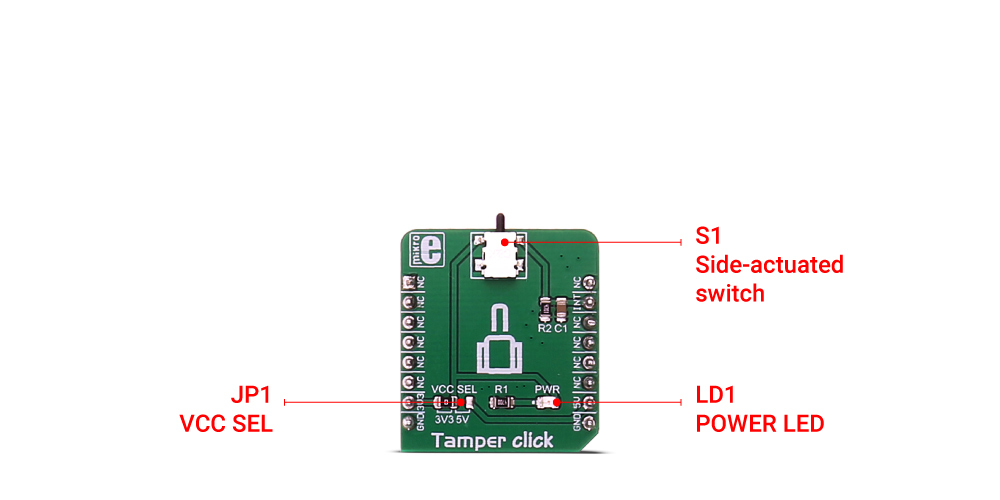
## Description: The Tamper Click Board™ is equipped with SDS001, a low profile side-actuated detect switch, made by C&K company. This is a high-quality, low-current detection switch, which is designed in a form of a push button. The switch itself is very small - only 2mm of switch overtravel length, which coupled with its low actuation force, makes it ideal for using it as a contact detector in various applications - consumer electronics devices, medical devices, smart card detection and similar applications. The Tamper Click Board™ is also additionally equipped with the RC filter that minimizes the bouncing effect, making this click a reliable solution for any contact detection application. How Does The Tamper Click Board™ Work? The Tamper Click Board™ is equipped with SDS001, low profile side-actuated detect switch. The switch itself acts as a push button and has 2 NO (Normally Open) terminals, which get shorted when the force is applied to the small piston-shaped button of the switch. These kinds of switches are usually mounted on the edge of the PCB so they can be easily reached by the elements that would apply a pressure to the switch. The applied pressure closes the circuit, connecting the VCC routed to the first pin of the switch, with the INT pin on the mikroBUS™ The microcontroller is then able to detect a high logical level on the INT pin and the desired task can then be executed. The applied RC filter serves both as a debouncing circuitry and a pull-down for the terminal of the switch, preventing the floating state that way. The used switch itself is intended to operate with digital signal levels, thus its electrical characteristics are tailored for this purpose: low contact resistance of 100mΩ, relatively low contact ratings of 100mA at 12V and 50 000 switching cycles before the failure. These attributes make it ideal for digital signal applications, specifically. Onboard SMD jumper allows using either 5V or 3.3V at the VCC level. This should be selected accordingly to the microcontroller pin voltage capability. SPECIFICATIONS Type Pushbutton/Switches Applications Contact detector in various applications - consumer electronics devices, medical devices, smart card detection and similar applications On-board modules Side-actuated detect switch, made by C&K company Key Features Light pressure force needed to activate the switch, high number of switching cycles, optimized to be used in digital circuit Interface GPIO Compatibility mikroBUS Click board size S (28.6 x 25.4 mm) Input Voltage 3.3V or 5V PINOUT DIAGRAM This table shows how the pinout of the Tamper Click Board™ corresponds to the pinout on the mikroBUS™ socket (the latter shown in the two middle columns). Notes Pin Pin Notes NC 1 AN PWM 16 NC NC 2 RST INT 15 INT Switch signal NC 3 CS RX 14 NC NC 4 SCK TX 13 NC NC 5 MISO SCL 12 NC NC 6 MOSI SDA 11 NC Power supply 3V3 7 3.3V 5V 10 5V Power supply Ground GND 8 GND GND 9 GND Ground TAMPER CLICK ELECTRICAL SPECIFICATIONS Description Min Typ Max Unit Actuation force - - 75 gr Contact resistance - - 100 mΩ Mechanical and electrical life - - 50000 cycles ONBOARD SETTINGS AND INDICATORS Label Name Default Description JP1 VCC SEL Left Power supply voltage selection 3V3/5V, left position 3V3, right position 5V S1 SWITCH - The switch at the top of the click board™ LD1 Power LED - Power LED indicates that the click is powered on
## Product type: Click Board
## Vendor: Mikroelektronika d.o.o.
## Tags: CandK, Click Board, HMI, MikroE, Switch
## Price range: 7.7 - 7.7 GBP
## Link: https://thedebugstore.com/products/mikroe-2552-tamper-click-board-uk
## Compare-at price range: 11.0 - 11.0 GBP
## Options
- Title: Default Title
## Collections
- [New Products](https://thedebugstore.com/a/llms/collections/new-products-debug-store)
- [Mikroelektronika d.o.o. (MikroE)](https://thedebugstore.com/a/llms/collections/mikroelektronika-catalogue-uk)
- [HMI Interface Click Boards™](https://thedebugstore.com/a/llms/collections/hmi-interface-click-boards-catalogue-uk)
- [MikroE Click Boards™](https://thedebugstore.com/a/llms/collections/mikroe-click-boards-catalogue-uk)
- [Google Shopping - invalid product](https://thedebugstore.com/a/llms/collections/google-shopping-valid-products)
- [Pushbutton/Switch Click Boards™](https://thedebugstore.com/a/llms/collections/pushbutton-switch-click-boards-catalogue)
- [Click Boards™ Summer Sale](https://thedebugstore.com/a/llms/collections/inventory-sale)
- [C&K Switches and Connectors: Development Boards and Tools | Debug Store](https://thedebugstore.com/a/llms/collections/c-k-switches-device-support)
- [MikroE Sale](https://thedebugstore.com/a/llms/collections/mikroe-sale)
- [MIKROE Stock](https://thedebugstore.com/a/llms/collections/mikroe-products-in-stock-sale)
## Variants
- Default Title, SKU: MIKROE-2551, Available: yes, Inventory: 1
## Metafields
- full_description:
The Tamper Click Board™ is equipped with SDS001, a low profile side-actuated detect switch, made by C&K company. This is a high-quality, low-current detection switch, which is designed in a form of a push button. The switch itself is very small - only 2mm of switch overtravel length, which coupled with its low actuation force, makes it ideal for using it as a contact detector in various applications - consumer electronics devices, medical devices, smart card detection and similar applications.
The Tamper Click Board™ is also additionally equipped with the RC filter that minimizes the bouncing effect, making this click a reliable solution for any contact detection application.
How Does The Tamper Click Board™ Work?
The Tamper Click Board™ is equipped with SDS001, low profile side-actuated detect switch. The switch itself acts as a push button and has 2 NO (Normally Open) terminals, which get shorted when the force is applied to the small piston-shaped button of the switch. These kinds of switches are usually mounted on the edge of the PCB so they can be easily reached by the elements that would apply a pressure to the switch. The applied pressure closes the circuit, connecting the VCC routed to the first pin of the switch, with the INT pin on the mikroBUS™ The microcontroller is then able to detect a high logical level on the INT pin and the desired task can then be executed. The applied RC filter serves both as a debouncing circuitry and a pull-down for the terminal of the switch, preventing the floating state that way.
The used switch itself is intended to operate with digital signal levels, thus its electrical characteristics are tailored for this purpose: low contact resistance of 100mΩ, relatively low contact ratings of 100mA at 12V and 50 000 switching cycles before the failure. These attributes make it ideal for digital signal applications, specifically.
Onboard SMD jumper allows using either 5V or 3.3V at the VCC level. This should be selected accordingly to the microcontroller pin voltage capability.
SPECIFICATIONS
Type
Pushbutton/Switches
Applications
Contact detector in various applications - consumer electronics devices, medical devices, smart card detection and similar applications
On-board modules
Side-actuated detect switch, made by C&K company
Key Features
Light pressure force needed to activate the switch, high number of switching cycles, optimized to be used in digital circuit
Interface
GPIO
Compatibility
mikroBUS
Click board size
S (28.6 x 25.4 mm)
Input Voltage
3.3V or 5V
PINOUT DIAGRAM
This table shows how the pinout of the Tamper Click Board™ corresponds to the pinout on the mikroBUS™ socket (the latter shown in the two middle columns).
Notes
Pin
Pin
Notes
NC
1
AN
PWM
16
NC
NC
2
RST
INT
15
INT
Switch signal
NC
3
CS
RX
14
NC
NC
4
SCK
TX
13
NC
NC
5
MISO
SCL
12
NC
NC
6
MOSI
SDA
11
NC
Power supply
3V3
7
3.3V
5V
10
5V
Power supply
Ground
GND
8
GND
GND
9
GND
Ground
TAMPER CLICK ELECTRICAL SPECIFICATIONS
Description
Min
Typ
Max
Unit
Actuation force
-
-
75
gr
Contact resistance
-
-
100
mΩ
Mechanical and electrical life
-
-
50000
cycles
ONBOARD SETTINGS AND INDICATORS
Label
Name
Default
Description
JP1
VCC SEL
Left
Power supply voltage selection 3V3/5V, left position 3V3, right position 5V
S1
SWITCH
-
The switch at the top of the click board™
LD1
Power LED
-
Power LED indicates that the click is powered on
- description_tag: The Tamper Click Board™ is equipped with SDS001, a low profile side-actuated detect switch, made by C&K company. This is a high-quality, low-current detection switch, which is designed in a form of a push button. Available from Debug Store UK.
- title_tag: MikroE Tamper Click Board™ (MIKROE-2551)
- manufacturer: Mikroelektronika d.o.o.
- warranty: 12 months
- amazon_enable: TRUE
- amazon_title: Tamper Click Board
- amazon_product_type: computercomponent
- amazon_block: FALSE
- amazon_prime_enable: FALSE
- amazon_search: MikroElektronika Microelectronica MIKROE-1100
- amazon_uk_price: 7.92
- amazon_uk_currency: GBP
- amazon_de_currency: EUR
- amazon_de_price: 8.9496
- amazon_fr_currency: EUR
- amazon_fr_price: 8.9496
- amazon_es_currency: EUR
- amazon_es_price: 8.9496
- amazon_nl_currency: EUR
- amazon_nl_price: 8.9496
- amazon_it_currency: EUR
- amazon_it_price: 8.9496
- amazon_se_curency: SEK
- amazon_se_price: 90.288
- amazon_product_id: 8606018711772
- amazon_product_id_type: EAN
- amazon_update: Update
- amazon_short_description: The Tamper Click Board™ is equipped with SDS001, a low profile side-actuated detect switch, made by C&K company. This is a high-quality, low-current detection switch, which is designed in a form of a push button. The switch itself is very small - only 2mm of switch overtravel length, which coupled with its low actuation force, makes it ideal for using it as a contact detector in various applications - consumer electronics devices, medical devices, smart card detection and similar applications.Tamper Click Board™ is also additionally equipped with the RC filter that minimizes the bouncing effect, making this Click Board™ a reliable solution for any contact detection application.
- amazon_long_description:
The Tamper Click Board is equipped with SDS001, a low profile side-actuated detect switch, made by C&K company. This is a high-quality, low-current detection switch, which is designed in a form of a push button. The switch itself is very small - only 2mm of switch overtravel length, which coupled with its low actuation force, makes it ideal for using it as a contact detector in various applications - consumer electronics devices, medical devices, smart card detection and similar applications.
Tamper click board™ is also additionally equipped with the RC filter that minimizes the bouncing effect, making this click a reliable solution for any contact detection application.
How Does The Tamper Click Board Work?
The Tamper click is equipped with SDS001, low profile side-actuated detect switch. The switch itself acts as a push button and has 2 NO (Normally Open) terminals, which get shorted when the force is applied to the small piston-shaped button of the switch. These kinds of switches are usually mounted on the edge of the PCB so they can be easily reached by the elements that would apply a pressure to the switch. The applied pressure closes the circuit, connecting the VCC routed to the first pin of the switch, with the INT pin on the mikroBUS™ The microcontroller is then able to detect a high logical level on the INT pin and the desired task can then be executed. The applied RC filter serves both as a debouncing circuitry and a pull-down for the terminal of the switch, preventing the floating state that way.
The used switch itself is intended to operate with digital signal levels, thus its electrical characteristics are tailored for this purpose: low contact resistance of 100mΩ, relatively low contact ratings of 100mA at 12V and 50 000 switching cycles before the failure. These attributes make it ideal for digital signal applications, specifically.
Onboard SMD jumper allows using either 5V or 3.3V at the VCC level. This should be selected accordingly to the microcontroller pin voltage capability.
We provide an example for the Tamper Click Board™ on our LibStock page, as well as a demo application (example), developed using MikroElektronika compilers. The demo can run on all the main MikroElektronika development boards.
Example Description
The application is composed of three sections:
System initialization - Initializes the UART module used for data logging
Application Initialization - Initializes the Tamper click GPIO pin as input
Application task - Polls the GPIO pin and logs information to UART whenever a press is detected
Tamper_Task()
{
    if (Tamper_STATE == 1)
    {
        UART0_Write_text("Tamper click is in ON statern");
        Delay_ms(500);
    }
}
- attachments: [{"download_file":[{"download_file":"Tamper Click Board™ Schematic"}],"download_filetype":[{"download_filetype":"pdf"}]},{"download_file":[{"download_file":"C&K Company SDS001 Low-Profile Switch Datasheet"}],"download_filetype":[{"download_filetype":"pdf"}]}]
- device_vendor: C&K
- device_type: SDS001R
- warranty: 12 months
- brand: MikroE
- manufacturer: Mikroelektronika d.o.o.
- brands: gid://shopify/Metaobject/56256004319
- breadcrumbs: ["gid://shopify/Collection/447955239135","gid://shopify/Collection/241680580797","gid://shopify/Collection/241545019581"]
- customhs_code: 847330
- detailed_description: {"type":"root","children":[{"type":"paragraph","children":[{"type":"text","value":""}]},{"type":"paragraph","children":[{"type":"text","value":"The "},{"type":"text","value":"Tamper Click Board™","bold":true,"italic":true},{"type":"text","value":" is equipped with SDS001, a low profile side-actuated detect switch, made by C&K company. This is a high-quality, low-current detection switch, which is designed in a form of a push button. The switch itself is very small - only 2mm of switch overtravel length, which coupled with its low actuation force, makes it ideal for using it as a contact detector in various applications - consumer electronics devices, medical devices, smart card detection and similar applications."}]},{"type":"paragraph","children":[{"type":"text","value":"The "},{"type":"text","value":"Tamper Click Board™","bold":true},{"type":"text","value":" is also additionally equipped with the RC filter that minimizes the bouncing effect, making this click a reliable solution for any contact detection application."}]},{"type":"heading","level":3,"children":[{"type":"text","value":"How Does The Tamper Click Board™ Work?"}]},{"type":"paragraph","children":[{"type":"text","value":"The "},{"type":"text","value":"Tamper Click Board™","bold":true},{"type":"text","value":" is equipped with SDS001, low profile side-actuated detect switch. The switch itself acts as a push button and has 2 NO (Normally Open) terminals, which get shorted when the force is applied to the small piston-shaped button of the switch. These kinds of switches are usually mounted on the edge of the PCB so they can be easily reached by the elements that would apply a pressure to the switch. The applied pressure closes the circuit, connecting the VCC routed to the first pin of the switch, with the INT pin on the mikroBUS™ The microcontroller is then able to detect a high logical level on the INT pin and the desired task can then be executed. The applied RC filter serves both as a debouncing circuitry and a pull-down for the terminal of the switch, preventing the floating state that way."}]},{"type":"paragraph","children":[{"type":"text","value":""}]},{"type":"paragraph","children":[{"type":"text","value":"The used switch itself is intended to operate with digital signal levels, thus its electrical characteristics are tailored for this purpose: low contact resistance of 100mΩ, relatively low contact ratings of 100mA at 12V and 50 000 switching cycles before the failure. These attributes make it ideal for digital signal applications, specifically."}]},{"type":"paragraph","children":[{"type":"text","value":"Onboard SMD jumper allows using either 5V or 3.3V at the VCC level. This should be selected accordingly to the microcontroller pin voltage capability."}]},{"type":"heading","level":3,"children":[{"type":"text","value":"SPECIFICATIONS"}]},{"type":"paragraph","children":[{"type":"text","value":"Type\nPushbutton/Switches\nApplications\nContact detector in various applications - consumer electronics devices, medical devices, smart card detection and similar applications\nOn-board modules\nSide-actuated detect switch, made by C&K company\nKey Features\nLight pressure force needed to activate the switch, high number of switching cycles, optimized to be used in digital circuit\nInterface\nGPIO\nCompatibility\nmikroBUS\nClick board size\nS (28.6 x 25.4 mm)\nInput Voltage\n3.3V or 5V"}]},{"type":"heading","level":3,"children":[{"type":"text","value":"PINOUT DIAGRAM"}]},{"type":"paragraph","children":[{"type":"text","value":"This table shows how the pinout of the "},{"type":"text","value":"Tamper Click Board™","bold":true},{"type":"text","value":" corresponds to the pinout on the mikroBUS™ socket (the latter shown in the two middle columns)."}]},{"type":"paragraph","children":[{"type":"text","value":"Notes\nPin\nPin\nNotes\nNC\n1\nAN\nPWM\n16\nNC\nNC\n2\nRST\nINT\n15\nINT\nSwitch signal\nNC\n3\nCS\nRX\n14\nNC\nNC\n4\nSCK\nTX\n13\nNC\nNC\n5\nMISO\nSCL\n12\nNC\nNC\n6\nMOSI\nSDA\n11\nNC\nPower supply\n3V3\n7\n3.3V\n5V\n10\n5V\nPower supply\nGround\nGND\n8\nGND\nGND\n9\nGND\nGround"}]},{"type":"heading","level":3,"children":[{"type":"text","value":"TAMPER CLICK ELECTRICAL SPECIFICATIONS"}]},{"type":"paragraph","children":[{"type":"text","value":"Description\nMin\nTyp\nMax\nUnit\nActuation force\n-\n-\n75\ngr\nContact resistance\n-\n-\n100\nmΩ\nMechanical and electrical life\n-\n-\n50000\ncycles"}]},{"type":"heading","level":3,"children":[{"type":"text","value":"ONBOARD SETTINGS AND INDICATORS"}]},{"type":"paragraph","children":[{"type":"text","value":"Label\nName\nDefault\nDescription\nJP1\nVCC SEL\nLeft\nPower supply voltage selection 3V3/5V, left position 3V3, right position 5V\nS1\nSWITCH\n-\nThe switch at the top of the click board™\nLD1\nPower LED\n-\nPower LED indicates that the click is powered on"}]},{"type":"heading","level":3,"children":[{"type":"text","value":" "}]},{"type":"list","listType":"unordered","children":[{"type":"list-item","children":[{"type":"text","value":" "}]}]}]}
- summary:
The Tamper Click Board™ is equipped with SDS001, a low profile side-actuated detect switch, made by C&K company. This is a high-quality, low-current detection switch, which is designed in a form of a push button. The switch itself is very small - only 2mm of switch overtravel length, which coupled with its low actuation force, makes it ideal for using it as a contact detector in various applications - consumer electronics devices, medical devices, smart card detection and similar applications.
The Tamper Click Board™ is also additionally equipped with the RC filter that minimizes the bouncing effect, making this Click Board™ a reliable solution for any contact detection application.