# Title: NFC Click Board™
## Description: The NFC Click Board™ has full compliancy with NFC Forum specifications which means that you will be able to use the full potential of NFC and its three distinct operating modes: 1. Card emulation 2. Read/Write 3. P2P In other words, NFC click can be set to behave either as an NFC reader, or a tag, or to establish a two-way connection with another NFC device. FULLY COMPLIANT AND EASY TO INTEGRATE The NXP's PN7120 IC integrates an ARM™ Cortex-M0 MCU, which enables easier integration into designs, because it requires fewer resources from the host MCU. The integrated firmware provides all NFC protocols for performing the contactless communication in charge of the modulation, data processing and error detection. The board communicates with the target board MCU through the mikroBUS™ I2C interface, in compliance with NCI 1.0 host protocols (NCI stands for NFC controller interface). RST and INT pins provide additional functionality. The board uses a 3.3V power supply. OPERATING MODES NFC is designed to be intuitive for users. Communication between two devices is established in the simplest way possible — by bringing them close to each other. The standards are dictated by the NFC Forum. NFC frontends, like the one on this click, can operate in three distinct modes: 1. Card emulation mode — where NFC click behaves like a smartcard or a tag In this mode, the NFC Click Board™ emulates an NFC tag. It doesn't initiate the communication, it only responds to an NFC reader. A typical application of the card emulation mode is how people use NFC in their smartphones to replace several cards, badges and tags at once (using the same phone for tollgate checkins, contactless payments and so on). Card emulation mode, however, is not useful just for smartphones, but for any type of portable device. 2. Read/Write — where NFC click behaves as an NFC Reader Here, the NFC Click Board™ communicates with a passive tag, smartcard, or an NFC device operating in card emulation mode. It can both read or write to a tag (although reading is a more common use-case because tags will often be write protected). In this mode, it is NFC click that generates the RF field, while a tag or card only modulates it. 3. Peer-to-peer — for more complex interactions Peer-to-peer mode establishes a two-way communication channel between a pair of NFC-enabled devices. More complex interactions are possible in this mode, such as simplifying bluetooth pairing. When a user brings two devices close to each other, the two NFC chips establish a P2P connection and exchange data that facilitates the Bluetooth pairing, seamlessly — the user doesn't have to type passwords or set configurations. Note that NFC is a subset of RFID working on 13.54 MHz. Therefore, an NFC IC can read/write ISO14443 RFID tags, and vice verca — compatible RFID readers (such as RFID click) can read NFC tags or NFC devices functioning in card emulation mode. PN7120 FEATURES PN7120 embeds a new generation RF contactless front-end supporting various transmission modes according to NFCIP-1 and NFCIP-2, ISO/IEC14443, ISO/IEC 15693, ISO/IEC 18000-3, MIFARE and FeliCa specifications. It embeds an ARM Cortex-M0 microcontroller core loaded with the integrated firmware supporting the NCI 1.0 host communication. The module also has a highly integrated demodulator and decoder, as well as buffered output drivers to connect an antenna with minimum number of external components. APPLICATIONS The tap-and-go nature of NFC makes many areas of life more convenient. From mobile payments to advertising, from home automation to building security. NFC is already pervasive and widespread. As it is a standard feature of newer smartphones, many people carry an NFC chip with them at all times. There are many innovative uses and applications that are yet to be discovered, many markets that are yet to be tapped. You can use it in all devices requiring NFC functionality especially those running in an Andrond or Linux environment. Use it in TVs, set-top boxes, Blu-ray decoders, audio devices or home automation, gateways, and wireless routers. Printers, IP phones, gaming consoles, the list goes on and on. SPECIFICATIONS Type RFID/NFC Applications The tap-and-go nature of NFC makes many areas of life more convenient. From mobile payments to advertising, from home automation to building security On-board modules PN7120 IC Key Features FeliCa PCD mode, NFC Forum tag 1 to 4 (MIFARE Ultralight, Jewel, Open FeliCa tag, DESFire) Interface GPIO,I2C Compatibility mikroBUS Click board size L (57.15 x 25.4 mm) Input Voltage 3.3V FEATURES AND USAGE NOTES The following diagram shows the protocols that correspond to each operating mode: RF protocols supported: NFCIP-1, NFCIP-2 protocol ISO/IEC 14443A, ISO/IEC 14443B PICC mode via host interface ISO/IEC 14443A, ISO/IEC 14443B PCD designed according to NFC Forum digital protocol T4T platform and ISO-DEP FeliCa PCD mode MIFARE PCD encryption mechanism (MIFARE 1K/4K) NFC Forum tag 1 to 4 (MIFARE Ultralight, Jewel, Open FeliCa tag, DESFire) ISO/IEC 15693/ICODE VCD mode Supported host interfaces: NCI protocol interface according to NFC Forum standardization I2C-bus High-speed mode ADDITIONAL NOTES Note that NFC is a subset of RFID working on 13.54 MHz. Therefore, an NFC IC can read/write ISO14443 RFID tags, and vice versa — compatible RFID readers (such as RFID click can read NFC tags or NFC devices functioning in card emulation mode. The board has one SMD Jumper (ADDR SEL.) which is used to determine the I2C address. By default is on 0. PINOUT DIAGRAM This table shows how the pinout of the NFC Click Board™ corresponds to the pinout on the mikroBUS™ socket. Notes Pin Pin Notes NC 1 AN PWM 16 NC Reset of the PN7120 RST 2 RST INT 15 INT Interrupt request output NC 3 CS RX 14 NC NC 4 SCK TX 13 NC NC 5 MISO SCL 12 SCL I2C-bus serial clock input NC 6 MOSI SDA 11 SDA I2C-bus serial data +3.3V power input +3.3V 7 +3.3V +5V 10 NC Ground GND 8 GND GND 9 GND Ground
## Product type: Click Board
## Vendor: Mikroelektronika d.o.o.
## Tags: Click Board, ID, MikroE, Misc, NFC, NXP, RFid+NFC, Wireless
## Price range: 28.7 - 28.7 GBP
## Link: https://thedebugstore.com/products/mikroe-2395-nfc-click-board-uk
## Compare-at price range: 41.0 - 41.0 GBP
## Options
- Title: Default Title
## Collections
- [New Products](https://thedebugstore.com/a/llms/collections/new-products-debug-store)
- [Mikroelektronika d.o.o. (MikroE)](https://thedebugstore.com/a/llms/collections/mikroelektronika-catalogue-uk)
- [NXP Device Support from Debug Store: Explore Our Innovative Embedded Solutions](https://thedebugstore.com/a/llms/collections/nxp-device-support-uk)
- [Wireless Interface Click Boards™](https://thedebugstore.com/a/llms/collections/wireless-interface-click-boards-catalogue)
- [Miscellaneous Click Boards™](https://thedebugstore.com/a/llms/collections/miscellaneous-click-boards-catalogue)
- [MikroE Click Boards™](https://thedebugstore.com/a/llms/collections/mikroe-click-boards-catalogue-uk)
- [RFid/NFC Click Boards™](https://thedebugstore.com/a/llms/collections/rfid-nfc-click-boards-catalogue)
- [ID Click Boards™](https://thedebugstore.com/a/llms/collections/id-click-boards-catalogue)
- [Click Boards™ Summer Sale](https://thedebugstore.com/a/llms/collections/inventory-sale)
- [MikroE Sale](https://thedebugstore.com/a/llms/collections/mikroe-sale)
- [MIKROE Stock](https://thedebugstore.com/a/llms/collections/mikroe-products-in-stock-sale)
## Variants
- Default Title, SKU: MIKROE-2395, Available: yes, Inventory: 1
## Metafields
- full_description:
The NFC Click Board™ has full compliancy with NFC Forum specifications which means that you will be able to use the full potential of NFC and its three distinct operating modes:
- 1. Card emulation
- 2. Read/Write
- 3. P2P
In other words, NFC click can be set to behave either as an NFC reader, or a tag, or to establish a two-way connection with another NFC device.
FULLY COMPLIANT AND EASY TO INTEGRATE
The NXP's PN7120 IC integrates an ARM™ Cortex-M0 MCU, which enables easier integration into designs, because it requires fewer resources from the host MCU. The integrated firmware provides all NFC protocols for performing the contactless communication in charge of the modulation, data processing and error detection.
The board communicates with the target board MCU through the mikroBUS™ I2C interface, in compliance with NCI 1.0 host protocols (NCI stands for NFC controller interface). RST and INT pins provide additional functionality. The board uses a 3.3V power supply.
OPERATING MODES
NFC is designed to be intuitive for users. Communication between two devices is established in the simplest way possible — by bringing them close to each other. The standards are dictated by the NFC Forum. NFC frontends, like the one on this click, can operate in three distinct modes:
1. Card emulation mode — where NFC click behaves like a smartcard or a tag

In this mode, the NFC Click Board™ emulates an NFC tag. It doesn't initiate the communication, it only responds to an NFC reader. A typical application of the card emulation mode is how people use NFC in their smartphones to replace several cards, badges and tags at once (using the same phone for tollgate checkins, contactless payments and so on). Card emulation mode, however, is not useful just for smartphones, but for any type of portable device.
2. Read/Write — where NFC click behaves as an NFC Reader

Here, the NFC Click Board™ communicates with a passive tag, smartcard, or an NFC device operating in card emulation mode. It can both read or write to a tag (although reading is a more common use-case because tags will often be write protected). In this mode, it is NFC click that generates the RF field, while a tag or card only modulates it.
3. Peer-to-peer — for more complex interactions
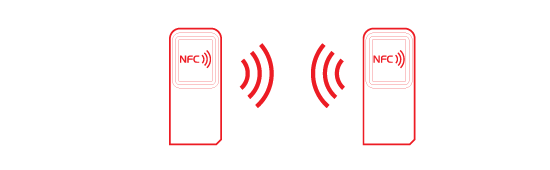
Peer-to-peer mode establishes a two-way communication channel between a pair of NFC-enabled devices. More complex interactions are possible in this mode, such as simplifying bluetooth pairing. When a user brings two devices close to each other, the two NFC chips establish a P2P connection and exchange data that facilitates the Bluetooth pairing, seamlessly — the user doesn't have to type passwords or set configurations.
Note that NFC is a subset of RFID working on 13.54 MHz. Therefore, an NFC IC can read/write ISO14443 RFID tags, and vice verca — compatible RFID readers (such as RFID click) can read NFC tags or NFC devices functioning in card emulation mode.
PN7120 FEATURES
PN7120 embeds a new generation RF contactless front-end supporting various transmission modes according to NFCIP-1 and NFCIP-2, ISO/IEC14443, ISO/IEC 15693, ISO/IEC 18000-3, MIFARE and FeliCa specifications. It embeds an ARM Cortex-M0 microcontroller core loaded with the integrated firmware supporting the NCI 1.0 host communication.
The module also has a highly integrated demodulator and decoder, as well as buffered output drivers to connect an antenna with minimum number of external components.
APPLICATIONS
The tap-and-go nature of NFC makes many areas of life more convenient. From mobile payments to advertising, from home automation to building security.
NFC is already pervasive and widespread. As it is a standard feature of newer smartphones, many people carry an NFC chip with them at all times. There are many innovative uses and applications that are yet to be discovered, many markets that are yet to be tapped.
You can use it in all devices requiring NFC functionality especially those running in an Andrond or Linux environment. Use it in TVs, set-top boxes, Blu-ray decoders, audio devices or home automation, gateways, and wireless routers. Printers, IP phones, gaming consoles, the list goes on and on.
SPECIFICATIONS
| Type |
RFID/NFC |
| Applications |
The tap-and-go nature of NFC makes many areas of life more convenient. From mobile payments to advertising, from home automation to building security |
| On-board modules |
PN7120 IC |
| Key Features |
FeliCa PCD mode, NFC Forum tag 1 to 4 (MIFARE Ultralight, Jewel, Open FeliCa tag, DESFire) |
| Interface |
GPIO,I2C |
| Compatibility |
mikroBUS |
| Click board size |
L (57.15 x 25.4 mm) |
| Input Voltage |
3.3V |
FEATURES AND USAGE NOTES
The following diagram shows the protocols that correspond to each operating mode:
RF protocols supported:
- NFCIP-1, NFCIP-2 protocol
- ISO/IEC 14443A, ISO/IEC 14443B PICC mode via host interface
- ISO/IEC 14443A, ISO/IEC 14443B PCD designed according to NFC Forum digital protocol T4T platform and ISO-DEP
- FeliCa PCD mode
- MIFARE PCD encryption mechanism (MIFARE 1K/4K)
- NFC Forum tag 1 to 4 (MIFARE Ultralight, Jewel, Open FeliCa tag, DESFire)
- ISO/IEC 15693/ICODE VCD mode
Supported host interfaces:
- NCI protocol interface according to NFC Forum standardization
- I2C-bus High-speed mode
ADDITIONAL NOTES
Note that NFC is a subset of RFID working on 13.54 MHz. Therefore, an NFC IC can read/write ISO14443 RFID tags, and vice versa — compatible RFID readers (such as RFID click can read NFC tags or NFC devices functioning in card emulation mode.
The board has one SMD Jumper (ADDR SEL.) which is used to determine the I2C address. By default is on 0.
PINOUT DIAGRAM
This table shows how the pinout of the NFC Click Board™ corresponds to the pinout on the mikroBUS™ socket.
| Notes |
Pin |
 |
Pin |
Notes |
| NC |
1 |
AN |
PWM |
16 |
NC |
| Reset of the PN7120 |
RST |
2 |
RST |
INT |
15 |
INT |
Interrupt request output |
| NC |
3 |
CS |
RX |
14 |
NC |
| NC |
4 |
SCK |
TX |
13 |
NC |
| NC |
5 |
MISO |
SCL |
12 |
SCL |
I2C-bus serial clock input |
| NC |
6 |
MOSI |
SDA |
11 |
SDA |
I2C-bus serial data |
| +3.3V power input |
+3.3V |
7 |
+3.3V |
+5V |
10 |
NC |
| Ground |
GND |
8 |
GND |
GND |
9 |
GND |
Ground |
- description_tag: The NFC Click Board™ is a mikroBUS add-on board with a versatile near field communications controller from NXP the PN7120 IC. Available from Debug Store UK.
- title_tag: MikroE NFC Click Board™ (MIKROE-2395)
- manufacturer: Mikroelektronika d.o.o.
- warranty: 12 months
- amazon_enable: TRUE
- amazon_title: NFC Click Board
- amazon_product_type: computercomponent
- amazon_block: FALSE
- amazon_prime_enable: FALSE
- amazon_search: MikroElektronika Microelectronica MIKROE-1100
- amazon_uk_price: 29.92
- amazon_uk_currency: GBP
- amazon_de_currency: EUR
- amazon_de_price: 33.8096
- amazon_fr_currency: EUR
- amazon_fr_price: 33.8096
- amazon_es_currency: EUR
- amazon_es_price: 33.8096
- amazon_nl_currency: EUR
- amazon_nl_price: 33.8096
- amazon_it_currency: EUR
- amazon_it_price: 33.8096
- amazon_se_curency: SEK
- amazon_se_price: 341.088
- amazon_product_id: 8606015079165
- amazon_product_id_type: EAN
- amazon_update: Update
- amazon_short_description: NFC Click Board™ is a mikroBUS add-on board with a versatile near field communications controller from NXP the PN7120 IC.NFC devices are used in contactless payment systems, electronic ticketing, smartcards, but also in retail and advertising inexpensive NFC tags can be embedded into packaging labels, flyers or posters.
- amazon_long_description: NFC Click is a mikroBUS add-on board with a versatile near field communications controller from NXP, the PN7120 IC. NFC devices are used in contactless payment systems, electronic ticketing, smartcards, but also in retail and advertising inexpensive NFC tags can be embedded into packaging labels, flyers or posters.
This board has full compliancy with NFC Forum specifications which means that you will be able to use the full potential of NFC and its three distinct operating modes:
1. Card emulation
2. Read/Write
3. P2P
In other words, NFC Click can be set to behave either as an NFC reader, or a tag, or to establish a two-way connection with another NFC device.
Fully Compliant and Easy to Integrate
The NXP's PN7120 IC integrates an ARM Cortex-M0 MCU, which enables easier integration into designs, because it requires fewer resources from the host MCU. The integrated firmware provides all NFC protocols for performing the contactless communication in charge of the modulation, data processing and error detection.
The board communicates with the target board MCU through the mikroBUS I2C interface, in compliance with NCI 1.0 host protocols (NCI stands for NFC controller interface). RST and INT pins provide additional functionality. The board uses a 3.3V power supply.
PB7120 Features
PN7120 embeds a new generation RF contactless front-end supporting various transmission modes according to NFCIP-1 and NFCIP-2, ISO/IEC14443, ISO/IEC 15693, ISO/IEC 18000-3, MIFARE and FeliCa specifications. It embeds an ARM Cortex-M0 microcontroller core loaded with the integrated firmware supporting the NCI 1.0 host communication.The module also has a highly integrated demodulator and decoder, as well as buffered output drivers to connect an antenna with minimum number of external components
Applications
The tap-and-go nature of NFC makes many areas of life more convenient. From mobile payments to advertising, from home automation to building security.
NFC is already pervasive and widespread. As it is a standard feature of newer smartphones, many people carry an NFC chip with them at all times. There are many innovative uses and applications that are yet to be discovered, many markets that are yet to be tapped.You can use it in all devices requiring NFC functionality especially those running in an Andrond or Linux environment. Use it in TVs, set-top boxes, Blu-ray decoders, audio devices or home automation, gateways, and wireless routers. Printers, IP phones, gaming consoles, the list goes on and on.
- amazon_main_image: https://www.thedebugstore.com/images/product/lg-nfc-back_1.jpg
- amazon_other_image_1: https://www.thedebugstore.com/images/product/lg-nfc-click-in-use_1.jpg
- amazon_other_image_2: https://www.thedebugstore.com/images/product/lg-nfc-click-in-use_1.jpg
- amazon_browse_node: 428655031
- related_products: MIKROE-4309
- mpn: MIKROE-2395
- backorder_label: If no stock shown above, check availability
- google_product_category: 2082
- condition: new
- custom_product: false
- mpn: MIKROE-2395
- google_product_category: Electronics
- custom_label_0: Click Board
- examples: The Libstock example shows the Read/Write and Card Emulation modes of NFC click. A tag or phone is detected when it approaches the field of the NFC Click Board™ (2-3cm). The example is available for both clicker 2 and Hexiwear.
Code examples for NFC click, written for MikroElektronika hardware and compilers are available on Libstock.
 1 const char NDEF_RECORD[] = { 0xD1, // MB / ME / CF / 1 / IL / TNF
 2 0x01, // TYPE LENGTH
 3 51, // PAYLOAD LENTGH
 4 'T', // TYPE
 5 0x02, // Status
 6 'e', 'n', // Language
 7 13, 10, 13, 10, 32, 32, 32, 32, 32,
 8 'M', 'i', 'k', 'r', 'o', 'E', 'l', 'e', 'k', 't', 'r', 'o', 'n', 'i', 'k', 'a',
 9 13, 10, 13, 10, 32, 32, 32, 32, 32, 32, 32, 32, 32, 32,
10 'N', 'F', 'C', ' ', 'c', 'l', 'i', 'c', 'k'
11 };
- attachments: [{"download_file":[{"download_file":"NFC Click Board™ Schematic"}]},{"download_file":[{"download_file":"NXP PN7120 NFC Controller Datasheet"}]}]
- device_vendor: NXP Semiconductors
- device_type: PN7120A0EV/C10801Y
- warranty: 12 months
- brand: MikroE
- manufacturer: Mikroelektronika d.o.o.
- badge: No reviews
- widget:
- brands: gid://shopify/Metaobject/56256004319
- breadcrumbs: ["gid://shopify/Collection/447955239135","gid://shopify/Collection/241680580797","gid://shopify/Collection/241546166461"]
- customhs_code: 847330
- detailed_description: {"type":"root","children":[{"type":"paragraph","children":[{"type":"text","value":" "}]},{"type":"paragraph","children":[{"type":"text","value":""}]},{"type":"paragraph","children":[{"type":"text","value":"The "},{"type":"text","value":"NFC Click Board™","bold":true},{"type":"text","value":" has full compliancy with NFC Forum specifications which means that you will be able to use the full potential of NFC and its three distinct operating modes:"}]},{"type":"list","listType":"ordered","children":[{"type":"list-item","children":[{"type":"text","value":"1. Card emulation"}]},{"type":"list-item","children":[{"type":"text","value":"2. Read/Write"}]},{"type":"list-item","children":[{"type":"text","value":"3. P2P"}]}]},{"type":"paragraph","children":[{"type":"text","value":"In other words, NFC click can be set to behave either as an NFC reader, or a tag, or to establish a two-way connection with another NFC device."}]},{"type":"heading","level":3,"children":[{"type":"text","value":"FULLY COMPLIANT AND EASY TO INTEGRATE"}]},{"type":"paragraph","children":[{"type":"text","value":"The NXP's PN7120 IC integrates an ARM™ Cortex-M0 MCU, which enables easier integration into designs, because it requires fewer resources from the host MCU. The integrated firmware provides all NFC protocols for performing the contactless communication in charge of the modulation, data processing and error detection."}]},{"type":"paragraph","children":[{"type":"text","value":"The board communicates with the target board MCU through the mikroBUS™ I2C interface, in compliance with NCI 1.0 host protocols (NCI stands for NFC controller interface). RST and INT pins provide additional functionality. The board uses a 3.3V power supply."}]},{"type":"heading","level":3,"children":[{"type":"text","value":"OPERATING MODES"}]},{"type":"paragraph","children":[{"type":"text","value":"NFC is designed to be intuitive for users. Communication between two devices is established in the simplest way possible — by bringing them close to each other. The standards are dictated by the NFC Forum. NFC frontends, like the one on this click, can operate in three distinct modes:"}]},{"type":"paragraph","children":[{"type":"text","value":"1. "},{"type":"text","value":"Card emulation mode","bold":true},{"type":"text","value":" — where NFC click behaves like a smartcard or a tag"}]},{"type":"paragraph","children":[{"type":"text","value":""}]},{"type":"paragraph","children":[{"type":"text","value":"In this mode, the "},{"type":"text","value":"NFC Click Board™","bold":true},{"type":"text","value":" emulates an NFC tag. It doesn't initiate the communication, it only responds to an NFC reader. A typical application of the card emulation mode is how people use NFC in their smartphones to replace several cards, badges and tags at once (using the same phone for tollgate checkins, contactless payments and so on). Card emulation mode, however, is not useful just for smartphones, but for any type of portable device."}]},{"type":"paragraph","children":[{"type":"text","value":"2. "},{"type":"text","value":"Read/Write","bold":true},{"type":"text","value":" — where NFC click behaves as an NFC Reader"}]},{"type":"paragraph","children":[{"type":"text","value":""}]},{"type":"paragraph","children":[{"type":"text","value":"Here, the "},{"type":"text","value":"NFC Click Board™","bold":true},{"type":"text","value":" communicates with a passive tag, smartcard, or an NFC device operating in card emulation mode. It can both read or write to a tag (although reading is a more common use-case because tags will often be write protected). In this mode, it is NFC click that generates the RF field, while a tag or card only modulates it."}]},{"type":"paragraph","children":[{"type":"text","value":"3. "},{"type":"text","value":"Peer-to-peer","bold":true},{"type":"text","value":" — for more complex interactions"}]},{"type":"paragraph","children":[{"type":"text","value":""}]},{"type":"paragraph","children":[{"type":"text","value":"Peer-to-peer mode establishes a two-way communication channel between a pair of NFC-enabled devices. More complex interactions are possible in this mode, such as simplifying bluetooth pairing. When a user brings two devices close to each other, the two NFC chips establish a P2P connection and exchange data that facilitates the Bluetooth pairing, seamlessly — the user doesn't have to type passwords or set configurations."}]},{"type":"paragraph","children":[{"type":"text","value":"Note that NFC is a subset of RFID working on 13.54 MHz. Therefore, an NFC IC can read/write ISO14443 RFID tags, and vice verca — compatible RFID readers (such as RFID click) can read NFC tags or NFC devices functioning in card emulation mode."}]},{"type":"heading","level":3,"children":[{"type":"text","value":"PN7120 FEATURES"}]},{"type":"paragraph","children":[{"type":"text","value":"PN7120 embeds a new generation RF contactless front-end supporting various transmission modes according to NFCIP-1 and NFCIP-2, ISO/IEC14443, ISO/IEC 15693, ISO/IEC 18000-3, MIFARE and FeliCa specifications. It embeds an ARM Cortex-M0 microcontroller core loaded with the integrated firmware supporting the NCI 1.0 host communication."},{"type":"text","value":""},{"type":"text","value":""},{"type":"text","value":""},{"type":"text","value":"The module also has a highly integrated demodulator and decoder, as well as buffered output drivers to connect an antenna with minimum number of external components."}]},{"type":"heading","level":3,"children":[{"type":"text","value":"APPLICATIONS"}]},{"type":"paragraph","children":[{"type":"text","value":"The tap-and-go nature of NFC makes many areas of life more convenient. From mobile payments to advertising, from home automation to building security."}]},{"type":"paragraph","children":[{"type":"text","value":"NFC is already pervasive and widespread. As it is a standard feature of newer smartphones, many people carry an NFC chip with them at all times. There are many innovative uses and applications that are yet to be discovered, many markets that are yet to be tapped."},{"type":"text","value":""},{"type":"text","value":""},{"type":"text","value":""},{"type":"text","value":"You can use it in all devices requiring NFC functionality especially those running in an Andrond or Linux environment. Use it in TVs, set-top boxes, Blu-ray decoders, audio devices or home automation, gateways, and wireless routers. Printers, IP phones, gaming consoles, the list goes on and on."}]},{"type":"heading","level":3,"children":[{"type":"text","value":"SPECIFICATIONS"}]},{"type":"paragraph","children":[{"type":"text","value":"Type\nRFID/NFC\nApplications\nThe tap-and-go nature of NFC makes many areas of life more convenient. From mobile payments to advertising, from home automation to building security\nOn-board modules\nPN7120 IC\nKey Features\nFeliCa PCD mode, NFC Forum tag 1 to 4 (MIFARE Ultralight, Jewel, Open FeliCa tag, DESFire)\nInterface\nGPIO,I2C\nCompatibility\nmikroBUS\nClick board size\nL (57.15 x 25.4 mm)\nInput Voltage\n3.3V"}]},{"type":"heading","level":3,"children":[{"type":"text","value":"FEATURES AND USAGE NOTES"}]},{"type":"paragraph","children":[{"type":"text","value":"The following diagram shows the protocols that correspond to each operating mode:"}]},{"type":"paragraph","children":[{"type":"text","value":"RF protocols supported:"}]},{"type":"list","listType":"unordered","children":[{"type":"list-item","children":[{"type":"text","value":"NFCIP-1, NFCIP-2 protocol"}]},{"type":"list-item","children":[{"type":"text","value":"ISO/IEC 14443A, ISO/IEC 14443B PICC mode via host interface"}]},{"type":"list-item","children":[{"type":"text","value":"ISO/IEC 14443A, ISO/IEC 14443B PCD designed according to NFC Forum digital protocol T4T platform and ISO-DEP"}]},{"type":"list-item","children":[{"type":"text","value":"FeliCa PCD mode"}]},{"type":"list-item","children":[{"type":"text","value":"MIFARE PCD encryption mechanism (MIFARE 1K/4K)"}]},{"type":"list-item","children":[{"type":"text","value":"NFC Forum tag 1 to 4 (MIFARE Ultralight, Jewel, Open FeliCa tag, DESFire)"}]},{"type":"list-item","children":[{"type":"text","value":"ISO/IEC 15693/ICODE VCD mode"}]}]},{"type":"paragraph","children":[{"type":"text","value":"Supported host interfaces:","bold":true}]},{"type":"list","listType":"unordered","children":[{"type":"list-item","children":[{"type":"text","value":"NCI protocol interface according to NFC Forum standardization"}]},{"type":"list-item","children":[{"type":"text","value":"I2C-bus High-speed mode"}]}]},{"type":"heading","level":3,"children":[{"type":"text","value":"ADDITIONAL NOTES"}]},{"type":"paragraph","children":[{"type":"text","value":"Note that NFC is a subset of RFID working on 13.54 MHz. Therefore, an NFC IC can read/write ISO14443 RFID tags, and vice versa — compatible RFID readers (such as RFID click can read NFC tags or NFC devices functioning in card emulation mode."}]},{"type":"paragraph","children":[{"type":"text","value":"The board has one SMD Jumper (ADDR SEL.) which is used to determine the I2C address. By default is on 0."}]},{"type":"heading","level":3,"children":[{"type":"text","value":"PINOUT DIAGRAM"}]},{"type":"paragraph","children":[{"type":"text","value":"This table shows how the pinout of the "},{"type":"text","value":"NFC Click Board™","bold":true},{"type":"text","value":" corresponds to the pinout on the mikroBUS™ socket."}]},{"type":"paragraph","children":[{"type":"text","value":"Notes\nPin\nPin\nNotes\nNC\n1\nAN\nPWM\n16\nNC\nReset of the PN7120\nRST\n2\nRST\nINT\n15\nINT\nInterrupt request output\nNC\n3\nCS\nRX\n14\nNC\nNC\n4\nSCK\nTX\n13\nNC\nNC\n5\nMISO\nSCL\n12\nSCL\nI2C-bus serial clock input\nNC\n6\nMOSI\nSDA\n11\nSDA\nI2C-bus serial data\n+3.3V power input\n+3.3V\n7\n+3.3V\n+5V\n10\nNC\nGround\nGND\n8\nGND\nGND\n9\nGND\nGround"}]},{"type":"heading","level":3,"children":[{"type":"text","value":" "}]}]}
- summary: The NFC Click Board™ is a mikroBUS add-on board with a versatile near field communications controller from NXP the PN7120 IC.
NFC devices are used in contactless payment systems, electronic ticketing, smartcards, but also in retail and advertising inexpensive NFC tags can be embedded into packaging labels, flyers or posters.