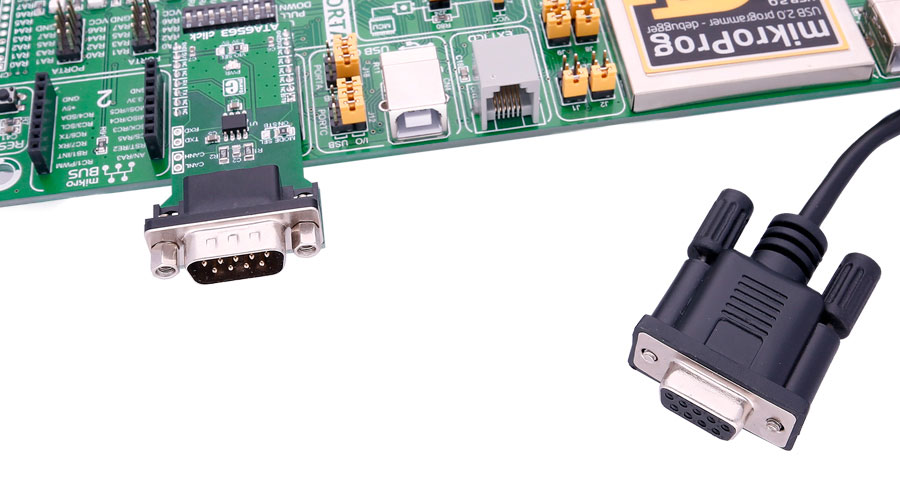
The ATA6563 Click Board™ carries the ATA6563 high-speed CAN transceiver. The click is designed to run on a 5V power supply. Use the VIO SEL jumper for selecting the 3.3V or 5V logic level. It communicates with the target microcontroller over UART interface, with additional functionality provided by the AN pin on the mikroBUS™ line.
The ATA6563 is a high-speed CAN transceiver that provides an interface between a controller area network (CAN) protocol controller and the physical two-wire CAN bus.
The transceiver is designed for high-speed ( up to 5 Mbps ) CAN applications in the automotive industry, providing differential transmit and receive capability to (a microcontroller with) a CAN protocol controller. It offers improved electromagnetic compatibility (EMC) and electrostatic discharge (ESD) performance.
The transceiver is CAN FD (Flexible data-rate) ready, meaning it has increased data rates in comparison with classic CAN.
The ATA6563 Click Board™ is connected to a CAN bus via the DB9 cable, which then communicates with the network.
| Type | CAN,CAN FD |
| Applications | Classical CAN and CAN FD networks in Automotive, Industrial, Aerospace, Medical and Consumer applications. |
| On-board modules | ATA6563 high-speed CAN transceiver from Microchip |
| Key Features | Optimized for CAN FD at 2 and 5 Mbps operation, maximum propagation delay: 210ns; the chip supports CAN 2.0 and CAN with flexible data rates. |
| Interface | UART |
| Compatibility | mikroBUS |
| Click board size | L (57.15 x 25.4 mm) |
| Input Voltage | 3.3V or 5V |
This table shows how the pinout on ATA6563 click corresponds to the pinout on the mikroBUS™ socket (the latter shown in the two middle columns).
| Notes | Pin |  |
Pin | Notes | |||
|---|---|---|---|---|---|---|---|
| Standby select | STBY | 1 | AN | PWM | 16 | NC | |
| NC | 2 | RST | INT | 15 | NC | ||
| NC | 3 | CS | RX | 14 | TX | UART data receive | |
| NC | 4 | SCK | TX | 13 | RX | UART data transmit | |
| NC | 5 | MISO | SCL | 12 | NC | ||
| NC | 6 | MOSI | SDA | 11 | NC | ||
| Power supply | +3.3V | 7 | 3.3V | 5V | 10 | +5V | Power supply |
| Ground | GND | 8 | GND | GND | 9 | GND | Ground |
| Designator | Name | Default Position | Default Option | Description |
|---|---|---|---|---|
| JP1 | VIO SEL | Left | 3V3 | VIO Supply Voltage Selection 3V3/5V, left position 3V3, right position 5V |
| JP2 | MODE SEL | Left | ON | Selection of the standby feature; default is always on, right option switches to the STB pin on the mikroBUS™ |
| Name | I/O | Description |
|---|---|---|
| CANL | I/O | CAN lines, same as on DB9 connector |
| CANH | I/O | CAN lines, same as on DB9 connector |
| TXD | I | UART lines, same as on the mikroBUS™ |
| RXD | O | UART lines, same as on the mikroBUS™ |
The ATA6563 Click carries the ATA6563 high-speed CAN transceiver. The Click is designed to run on a 5V power supply. Use the VIO SEL jumper for selecting the 3.3V or 5V logic level. It communicates with the target microcontroller over UART interface, with additional functionality provided by the AN pin on the mikroBUS line.
The ATA6563 is a high-speed CAN transceiver that provides an interface between a controller area network (CAN) protocol controller and the physical two-wire CAN bus.
The transceiver is designed for high-speed (up to 5 Mbps) CAN applications in the automotive industry, providing differential transmit and receive capability to (a microcontroller with) a CAN protocol controller. It offers improved electromagnetic compatibility (EMC) and electrostatic discharge (ESD) performance.The transceiver is CAN FD (Flexible data-rate) ready, meaning it has increased data rates in comparison with classic CAN.
 .
.
ATA6563 Click is connected to a CAN bus via the DB9 cable, which then communicates with the network.
- amazon_main_image: https://www.thedebugstore.com/images/product/lg-ata6563-click-board.jpg - amazon_browse_node: 428655031 - related_products: MIKROE-2228,TP360510,TP360110,TP360410,TP360310 - mpn: MIKROE-2334 - backorder_label: If no stock shown above, check availability - badge: - widget:Code examples for the ATA6563 Click Board™, written for MikroElektronika hardware and compilers are available on Libstock.
A simple example of the ATA6563 library usage. The example waits until 8 bytes are received on the RX and then prints the received data using the other UART module.
01 void main()
02 {
03     int i = 0;
04     system_init();
05     while( 1 ) {
06         if( Button( &GPIOA_IDR , 5, 100, 1 ) ){
07             ata6563_send( TX_DATA, sizeof( TX_DATA ) );
08             TFT_Write_Text( "Data Sent", 50, 100 );
09         }
10         if( ( chk = ata6563_rdy() ) == 8 ){
11             ata6563_read( buf, chk );
12             for( i = 0; i < chk; i++ )
13                  UART1_Write( buf[ i ] );
14         }
15     }
16 }
- attachments: [{"download_file":[{"download_file":"ATA6563 Click Board™ Schematic"}],"download_filetype":[{"download_filetype":"pdf"}]},{"download_file":[{"download_file":"Microchip ATA6563 CAN Transceiver Datasheet"}],"download_filetype":[{"download_filetype":"pdf"}]}]
- condition: new
- custom_product: false
- mpn: MIKROE-2334
- google_product_category: Electronics
- custom_label_0: Click Board
- key_feature_1: CAN and CAN FD Interface Board
- key_feature_2: Optimized for CAN FD at 2 and 5 Mbps operation, maximum propagation delay: 210ns; the chip supports CAN 2.0 and CAN with flexible data rates
- key_feature_3: Based on the ATA6563 high-speed CAN transceiver from Microchip
- key_feature_4: Classical CAN and CAN FD networks in Automotive, Industrial, Aerospace, Medical and Consumer applications.
- key_feature_5: mikroBUS: UART Interface
- device_vendor: Atmel
- device_type: ATA6563-GAQW1
- warranty: 12 months
- brand: MikroE
- manufacturer: Mikroelektronika d.o.o.
- brands: gid://shopify/Metaobject/56256004319
- breadcrumbs: ["gid://shopify/Collection/447955239135","gid://shopify/Collection/241680580797","gid://shopify/Collection/241546100925"]
- customhs_code: 847330
- detailed_description: {"type":"root","children":[{"type":"paragraph","children":[{"type":"text","value":"The"},{"type":"text","value":" ATA6563 Click Board™","bold":true},{"type":"text","value":" carries the ATA6563 high-speed CAN transceiver. The click is designed to run on a 5V power supply. Use the VIO SEL jumper for selecting the 3.3V or 5V logic level. It communicates with the target microcontroller over UART interface, with additional functionality provided by the AN pin on the mikroBUS™ line."}]},{"type":"heading","level":3,"children":[{"type":"text","value":"ATA6563 FEATURES"}]},{"type":"paragraph","children":[{"type":"text","value":"The ATA6563 is a high-speed CAN transceiver that provides an interface between a controller area network (CAN) protocol controller and the physical two-wire CAN bus."}]},{"type":"paragraph","children":[{"type":"text","value":"The transceiver is designed for high-speed ( "},{"type":"text","value":"up to 5 Mbps ","bold":true},{"type":"text","value":") CAN applications in the automotive industry, providing differential transmit and receive capability to (a microcontroller with) a CAN protocol controller. It offers improved electromagnetic compatibility (EMC) and electrostatic discharge (ESD) performance."},{"type":"text","value":""},{"type":"text","value":""},{"type":"text","value":""},{"type":"text","value":"The transceiver is "},{"type":"text","value":"CAN FD ","bold":true},{"type":"text","value":" (Flexible data-rate) ready, meaning it has increased data rates in comparison with classic CAN."}]},{"type":"heading","level":3,"children":[{"type":"text","value":"How Does The ATA6563 Click Board™ Work?"}]},{"type":"paragraph","children":[{"type":"text","value":""}]},{"type":"paragraph","children":[{"type":"text","value":"The "},{"type":"text","value":"ATA6563 Click Board™","bold":true},{"type":"text","value":" is connected to a CAN bus via the DB9 cable, which then communicates with the network."}]},{"type":"heading","level":3,"children":[{"type":"text","value":"SPECIFICATIONS"}]},{"type":"paragraph","children":[{"type":"text","value":"Type\nCAN,CAN FD\nApplications\nClassical CAN and CAN FD networks in Automotive, Industrial, Aerospace, Medical and Consumer applications.\nOn-board modules\nATA6563 high-speed CAN transceiver from Microchip\nKey Features\nOptimized for CAN FD at 2 and 5 Mbps operation, maximum propagation delay: 210ns; the chip supports CAN 2.0 and CAN with flexible data rates.\nInterface\nUART\nCompatibility\nmikroBUS\nClick board size\nL (57.15 x 25.4 mm)\nInput Voltage\n3.3V or 5V"}]},{"type":"heading","level":3,"children":[{"type":"text","value":"PINOUT DIAGRAM"}]},{"type":"paragraph","children":[{"type":"text","value":"This table shows how the pinout on "},{"type":"text","value":" ATA6563 click ","bold":true},{"type":"text","value":" corresponds to the pinout on the mikroBUS™ socket (the latter shown in the two middle columns)."}]},{"type":"paragraph","children":[{"type":"text","value":"Notes\nPin\nPin\nNotes\nStandby select\nSTBY\n1\nAN\nPWM\n16\nNC\nNC\n2\nRST\nINT\n15\nNC\nNC\n3\nCS\nRX\n14\nTX\nUART data receive \nNC\n4\nSCK\nTX\n13\nRX\nUART data transmit\nNC\n5\nMISO\nSCL\n12\nNC\nNC\n6\nMOSI\nSDA\n11\nNC\nPower supply\n+3.3V\n7\n3.3V\n5V\n10\n+5V\nPower supply\nGround\nGND\n8\nGND\nGND\n9\nGND\nGround"}]},{"type":"heading","level":3,"children":[{"type":"text","value":"JUMPERS AND SETTINGS"}]},{"type":"paragraph","children":[{"type":"text","value":"Designator\nName\nDefault Position\nDefault Option\nDescription\nJP1\nVIO SEL\nLeft\n3V3\nVIO Supply Voltage Selection 3V3/5V, left position 3V3, right position 5V\nJP2\nMODE SEL\nLeft\nON\nSelection of the standby feature; default is always on, right option switches to the STB pin on the mikroBUS™"}]},{"type":"heading","level":3,"children":[{"type":"text","value":"ADDITIONAL PINS"}]},{"type":"paragraph","children":[{"type":"text","value":"Name\nI/O\nDescription\nCANL\nI/O\nCAN lines, same as on DB9 connector\nCANH\nI/O\nCAN lines, same as on DB9 connector\nTXD\nI\nUART lines, same as on the mikroBUS™\nRXD\nO\nUART lines, same as on the mikroBUS™"}]},{"type":"heading","level":3,"children":[{"type":"text","value":" "}]}]}
- summary: The ATA6563 Click Board™ carries the ATA6563 high-speed CAN transceiver. The Click Board™ is designed to run on a 5V power supply. Use the VIO SEL jumper for selecting the 3.3V or 5V logic level.
It communicates with the target microcontroller over UART interface, with additional functionality provided by the AN pin on the MikroBUS line.